#PlantTheFlag FRIDAY: My Story, by Bobcat Men's Tennis Player Joaquin Espinoza
9/18/2020 9:00:00 AM | Men's Tennis
In his own words, how Montana State's junior from Bolivia has thrived thousands of miles away
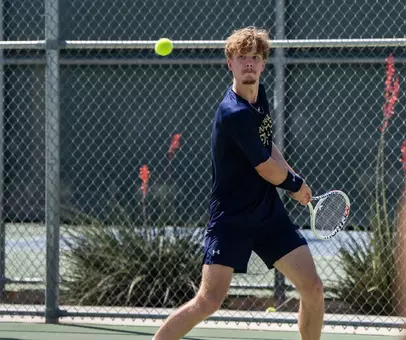
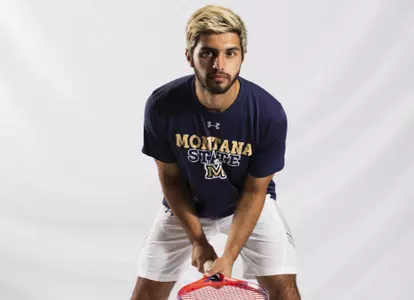
Joaquin Espinoza, a junior on the Bobcat men's tennis team, was 5-4 last spring when the COVID-19 global pandemic suddenly ended the spring sports season. Espinoza is from La Paz, Bolivia, and majors in mechanical engineering with a computer science minor. As part of the #PlantTheFlag Campaign, which raises funds to support scholarships, health, and nutrition for Bobcat student-athletes, this is Joaquin's story in his words.
When I was growing up in Bolivia I played tons of tennis and soccer, and I think somehow the combination of both made the athlete that I am right now. I started playing tennis when I was probably four years old. My dad played tennis when he was young, but, he stopped at a young age, but my uncle played college tennis here in the U.S. and he still lives in Texas, so that influenced me to play college tennis here.
My coach in Bolivia was helping me try to find a scholarship to play in the U.S., and I remember he found some options for me in Georgia, in New York, and in Arkansas. We finish school in November back there and school (in the U.S.) starts in August, so in that six month gap after my senior year I wanted to find what I'm going to do with my life. My goal was to get a scholarship in the U.S. for sure, and at the time there was a Bolivian playing here, Adrian Torrico. My coach talked to him and (Torrico) said that MSU is going to be looking for a new guy, and that's when my coach contacted Jared (Burnham, former MSU head coach).
When I was 12 years old I played against him in 14s in a tournament in Bolivia, and he beat me pretty bad. That's how I knew Adrian. When he saw me in Bozeman he said, 'Oh my God, you have a beard, and I remembered you when you were a little kid.' I was pretty sad when my parents left me here. I thought, 'I'm alone, it's me against the world.' But it helped me a lot having Adrian and having Matty (Ceolin), it was good having some South American company and having someone to speak Spanish with helped me not miss home as much.
I started playing tennis when I was four years old, probably. My dad played tennis until a young age, but my uncle played college tennis here in the U.S. and he still lives in Texas, in a place between San Antonio and Austin. I lived my first 19 years in La Paz. My mom is an economist, and my dad is a civil engineer. He loves working on highways in the countryside, and my mom used to travel and helps in different communities doing consultancies. She has started a new business, selling nuts, which is a new thing over there.
The average height for tennis players on the pro tour is about 6-2, around 1 meter and 85 centimeters, and I'm just 1.70 (meters). I know I don't have the perfect height, and I have always used that as motivation. I grew up playing tons of tennis and soccer, and somehow the combination of both made the athlete I am right now. I use my height (5-7) on the court as an advantage by being pretty quick, and I know if the other guy wants to beat me in a point by hitting a winner he's going to have to grind to do so. I'm going to try to hit every single ball back.
My dad is an engineer and my older brother is a mechanical engineer, so all my life I knew I would be an engineer. I just needed to figure out which field in engineering I would choose. My last two years in high school I was between civil engineering, mechanical and systems, the last one because I really like (computer) coding. I also really like motors, engines, the way things like that work, so mechanical is probably the best field for me right now, but I took a math lab class here and I enjoyed it too much, so I decided to go for a computer science minor.
The last three years in high school I went to some competitions in math, physics and coding, I was very into that. I took extra classes with one of my teachers in coding to get ready for these competitions, and with some friends I won one of those in coding, and I won another medal in math. I was very interested in those fields the last three years in high school, and I think that's why I'm studying something related to that in college. In my first semester here at MSU in physics I was like, 'I think I already know most of this stuff,' and in math, as well. I didn't know the math lab language, but I had an idea of programming, so I needed to implement that idea and learn the language. After that I didn't have any problems the first years.
English was a little bit of a problem for me at the beginning, and probably my English is the thing that has improved the most in my three years. In my school we had English every single year, but I wouldn't say they were intense classes. In high school the classes were harder in English, but when I finished my senior year I didn't feel my English was good enough so I took extra classes before coming here. It was fun, and after those classes I did very well on the SAT, TOIFL (standardized test for international students), and I thought, 'OK, my English is fine, I should not struggle over here.'
Then I came here and the first two weeks I couldn't understand English well, people speak so fast, and I thought, 'Oh my God, I can't understand anything.' But it made sense because the people who taught me English in Bolivia are Bolivians, so I could understand that accent, but here it was just different. It took me a while, for sure. It was a grind. After a month or two you get used to it and I didn't struggle as much anymore, but sometimes even now I hear an expression and I have to ask what that means. Probably my English is the thing that has improved the most in my three years. One of my hardest classes was the solid works one, that was terrible. Some words in that class were technicisms and it was too hard to me to understand. For example, in the first two weeks I missed a homework because I didn't know we had one. I was very lost in the beginning, but in time you get used to it. Your ear gets used to it and you understand how University is, and you figure it out.
My first semester here I wasn't playing tennis that well. It was my first time playing on hardcourt, and college tennis is different too, so it took me one semester here to find my game again. Bolivia is a clay court country, and I never played hardcourt there. The first thing I learned is that the feet movement is different. I couldn't slide into a shot in the beginning. I used to slide on every ball on clay, forehand I would slide, backhand I would slide and when I tried to slide on hardcourt it felt like I was going to break my ankles. I was sore my first month and my knees were hurting a little bit too. It was different and it felt different.
You have to be faster with your feet on hardcourt, you have to be more aggressive. On clay court I used to go back on the court and just make balls, that was my game, but trying to do that here didn't work as well because guys are more aggressive and the game is faster. On clay, if I had a nice ball I would not necessary attack, but when Jake (Rother, a former MSU assistant coach) was here he told me, 'If you want to play on the top spots on the team, I'm sorry to tell you but you have to be more aggressive.' You can't stay back on the court and just make balls. It's going to work well playing four or five (ladder spots). I did very well my freshman year playing five, but as Jake (Rother) told me, I needed to work on what he said. So I started working and I found a way to be more aggressive on some balls. But I'm still working on that.
The weekend that the season got cancelled last spring we were going to play the Griz in Missoula, it was a bummer. We were coming from one very good match and one not so good. We had a very good win against Portland State, a solid win because we knew they were a great team and we beat them with authority. The next day I think we relaxed against Northern Colorado and lost, but we were motivated. We know the Griz are very good at tennis, every single time we play them is a battle, they're very good but we knew we had a chance. We were going to play in Missoula, and I just love playing where the crowd is against me, where people are cheering for my opponent, and I'm like, 'These guys are going to be quiet in a bit.' I kind of like the feeling when you upset your rival at their own home.
Playing tennis on a team is so fun! My freshman year was the first time I experienced a big win in college when I clinched against Idaho State, we beat them 4-3 in Pocatello. That was an awesome feeling. Being there and knowing that all your teammates are cheering has no price. When and I watched that ball go out I screamed, 'Let's go boys!' And seeing all of my friends coming, that was the first time I realized: 'This is college tennis!' But that win against the Griz (in 2019) is the best one, it's so special. I couldn't enjoy it as much because when Marcos (Zelver) was clinching I was still on the court paying. I was in a very close match, I was down a set, but towards the end I was more focused on Marcos' match because I knew he was about to win. I was like, 'Please Marc, you've got to win this, don't leave this to me because I don't know if I'm going to make it.' When he clinched I was still on my court and I knew we won the series, and to be honest I was down 6-5 and I double-faulted twice and lost the match, I was just too happy about Marc and the team that we beat the Griz that I did not care about my match. After my match I just ran toward Marc and hugged him like, 'Dude, you're a legend!'
I think I understood rivalry with the Griz because I'm a big fan of soccer. We have the biggest game in Bolivian soccer in my city, it's my team against another team in the city, and that rivalry is crazy. My team is called The Strongest and the other team is Bolivar. Both of my parents, my mom and my dad, cheer for Bolivar, and me and my brother cheer for The Strongest, and every time they play it's crazy. I am very passionate about sports so I can understand the rivalry, and when I got here it was Montana our rival. Every time we play them I want to win, I can't lose against those guys. (laughs) No but, we know them and they are very good guys. When we play in the tournaments and Montana's playing different guys I hope (the UM player) wins because he's representing (the state of) Montana. But when we play against each other it's a battle. I know we have to win. I can't lose against Montana, it just can't happen. That is the mentality I have. The first time I played a guy from Montana in (the 2018 spring) season was here indoors. I was playing five, and I knew their guy was a very good player. I beat him in a third-set tiebreaker 12-10, and it was a battle against him, but I remember I was thinking during the match, 'I have to beat him, it's Montana, I can't lose.' Every time we play against them I really want to beat them.
When I got her I knew the team had trouble beating them in the past but as a team we knew we had to change that. Most of the international guys (on the tennis team) don't like football too much, but when it's about the Griz we want to beat them so we go out and support the University. Football is an interesting sport. It took me a while to understand the game and now I get it more. In the beginning I just didn't get it, but right now I know some of the rules and I have an idea what they are trying to do, so I can enjoy it more. It's a very interesting thing and it's a big part of the culture here, so I like that. One of the things I really love from here is how much (Americans) care about sports, how much you like sports and how passionate you are. I was very impressed about March Madness I didn't know it was a thing. People were going crazy and it's college basketball, not even the NBA, but people were betting and going to bars to watch games, It's awesome. The same with football. (Americans) are so passionate, and that's one of the things I appreciate the most about this culture, for sure.
Something I enjoy here is the fast food. I love the hamburgers! In Bolivia we have fast food, but here it's a big thing. I do miss food in Bolivia, there are so many meals there that are super good . There is a traditional dish called peanut soup, I could eat that every single day. Unfortunately, I don't know how to cook it here, but every time I go home the first thing I ask my mom is, 'Can you cook peanut soup please?' And she says, 'Of course, of course.' We have very, very good traditional dishes there. Another is from another city in Bolivia, Cochabamba, and the dish is called Pique macho. I know how to cook that one, the other day I cooked it. The taste from the dishes in Bolivia are different of course, but it's always good to have something from your own country. Another thing from here is that I did not know dining halls were so good here. I thought that the dining halls were like the cafeteria where you could have some food, but in the dining halls you can have pizza, tacos, there are so much stuff you can eat!. My first year I was so happy! I could eat as much as I wanted. But it played against me in the second semester, eating there everyday kind of gets you sick. At some point I decided I like to cook my own food, and that's why I decided to live off campus this year.
We have players from so many different countries on our team, and it's awesome experiencing different cultures. Sometimes between us we just make fun of (teammates') accents and talk about how different our languages are. I remember Christian (Damgaard Qvist), he's from Denmark, and when he talked in Danish it was impossible to know what he was talking about. When someone speaks Spanish some of the guys can understand some words, but with Danish, you can't even guess what he's saying. But it's very fun experiencing the different cultures. Nejc is from Slovenia, and I remembered when we traveled to Utah last season he contacted a Slovenian restaurant in Salt Lake City and brought us there to eat. He was talking Slovenian with the owner of the restaurant, getting the food for us, it was nice. I really like having guys from different places.
School is for sure a challenge, engineering is tough and mechanical engineering is not easy. But at the same time I really enjoy my classes a lot. Some classes like advanced mechanic of materials or thermodynamics II really liked me, the only one I didn't like was fluids. When I talked to my advisor about that class she told me, 'Don't worry, almost no one likes fluids.' You have to work hard outside the classroom to succeed and combining tennis and classes you have to be very organized. It becomes more of a challenge as classes become harder. My freshman year classes were not as hard so sometimes I would think, 'If I don't study too much for this exam I'll be fine. But right now when you have homework you have to do it, when you have an exam you have to study hard it's not easy any more. As I said it becomes more challenging as the classes become harder, but the key is organization. If you organize your time you can do just fine. There are a lot of athletes in engineering, and they do very good in these classes. It's not like they're hoping for a C, athletes are looking for A's, which is impressive considering that we all have like another job, being an athlete.
Bolivia is one of the smallest and one of the poorest countries in South America. One of the biggest problems is education. The system there is not great. I think that's the biggest change that needs to take place. If education changes, everything can change. Corruption in the government is very normal there. I was talking to my brother and my cousin the other day about how crazy it is when we talk about our government being corrupt, and we are like: 'That was expected, right? They're politicians.' Why is that normal for us? That's something that is very sad. So I think improving education is the biggest thing in the end.
There we have public and private schools. Our public schools are not so good. I was lucky I could attend to a private school. Surprisingly, private schools are not as expensive there as they are here so it is more common there to get private education. I was lucky to be in a very good school and learn so much from my teachers, who are awesome people. It was a hard school, we had lots of homework and exams weren't easy. We had the opportunity to go to different competitions in math, physics, chemistry, coding, etc. and they encouraged us to (participate). I played on the soccer team as well. I was lucky to find that school, it helped me to come here and be ready for university.
I feel like me, my brother, my family, has been super lucky. I was super lucky growing up in Bolivia with the friends I have, the awesome family I have, and the education I was able to get there. I was more than lucky to have the opportunity to come here and play tennis and study in a great university. Sometimes I just wonder how many kids, how many people, would like to have the opportunities I have. I'm very thankful to life for that.
If I really had the chance to play pro tennis, if I'm performing very well, I would take that chance for sure. But I wouldn't say that's my main goal. Right now I'm focused on tennis, I want to improve a lot, but I'm here also to study. One of my goals when I finish school is to get my master's degree in a field like engineering or computer science. Life is weird sometimes, you don't know what is going to happen, and I might just stay here a couple of years or I might just go somewhere else, who knows. I'm going to apply for jobs and for some master's programs, but one thing I want to do for sure in the future is return to Bolivia and apply all the things I learned here and experienced here and pass it to the next generation. I feel like if I don't go back to my country I am just not being grateful to the place I was raised. The idea of coming back to help my country some way sounds really good to me. It is a problematic country that needs help, and I really want to do my best to help it.