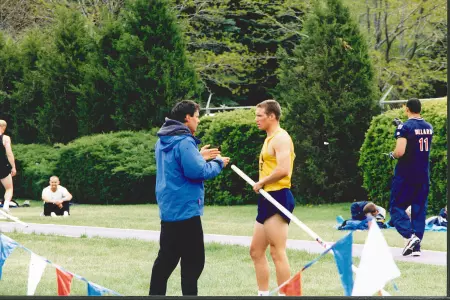
Stevie Keller (left) with Tom Eitel
BOBCAT ATHLETICS HALL OF FAME: Stevie Keller Rose to the Division I Challenge to Earn All-America Honors as a Bobcat
2/21/2020 1:58:00 PM | General, Men's Track and Field
North Dakota State transfer capped a brilliant collegiate career in Blue and Gold
BOZEMAN, Montana – By the time Stevie Keller arrived at Montana State he was already an accomplished college athlete.
Originally from Harvey, North Dakota, Keller began his career at North Dakota State. He was a Division II All-America decathlete for the Bison in 1995, won the 1996 North Central Conference javelin championship outdoors and the 1997 NCC Pentathlon crown indoors. Accompanying the success, though, was a yearning. "He did well at NDSU, which was Division II at the time, but because they weren't DI yet he wanted to see if he could compete (at the) higher (level)," said long-time Bobcat jumps and multi-event coach Tom Eitel. "He had a strong connection with Dale, and I think he really wanted to come here."
The journey to Montana State proved fruitful. He formed a one-two combination with fellow multi-event athlete Danny Groux, and Keller finished second in the decathlon at the Big Sky Championships in 1998, when he also finished eighth in the high jump. The next year, as a senior, Keller won the Big Sky Championship in the decathlon, and along the way qualified for the NCAA Championships. There, he finished eighth in the decathlon to couple Division I All-America honors with the same Division II achievement.
But Keller's success has much deeper roots, which is what eventually led him to Montana State. Legendary Bobcat head coach Dale Kennedy was a fixture as a coach for Champions in Action, "a track and field summer camp program that barnstormed throughout the Northwest," Kennedy said. The furthest stop east on the yearly circuit was Devil's Lake, North Dakota. That's where Kennedy came to know a brilliant and successful high school coach, Beckee Keller. Along with her team, her son Stevie accompanied her to the camp each year.
"The first year I was there Stevie was probably in fifth or sixth grade," Kennedy said. "He was one of the participants, and we could see then that had considerable athletic ability. Every year we got to see him for a week and watch his development. He was really a great all-around athlete at the high school level. His sister was a really good athlete, too, she went to Seattle Pacific as a heptathlete."
Keller began his career at North Dakota State, and according to Eitel enjoyed his time there. "(Keller) knew Dale from the get-go," Eitel said. "He went to NDSU, which was DII at the time, and he did well there. But because they weren't DI yet, he wanted to see if he could (compete) in DI. It's not like he didn't like the school, he loved everybody there, but he felt like he wanted to make the jump and try it out. I was actually gone during his recruiting visit, but Dale knew him so he came out and he was here before I even met him."
Keller's raw ability impressed Eitel immediately. "He's a big guy that can run, and if you can throw and you can high jump and you can run, you've got it made. He threw 48-8 in the shot, 147 maybe in the discus, and he was mid-90s in the javelin. He needed to work on his long jump, the 100, hurdles a little bit, and the vault."
But there was one trait that stood out to Eitel. "He had endurance, like the Energizer bunny. And he could really run."
Kennedy knew that Keller possessed inherent traits that would propel him in his new environment. "Almost every decathlete has a great work ethic," Kennedy said, "and Stevie really had that. He was a young guy that could endure a lot of training and was full of enthusiasm as he fulfilled his vision of reaching the NCAAs. Ultimately he strived to be an All-America, and when that was on the line he won the 1,500 (meters)."
Keller finished second in the Big Sky decathlon in 1998, and one year later won the event and qualified for the NCAA Championships. And that 1,500 meter run that closed the decathlon perfectly capped Keller's college career. He took an early lead and built on it. "He ran a 4:21, and nobody was close," Eitel said. Kennedy added, "When All-America (status) was on the line, he won the 1,500."
The Bobcats have enjoyed a long run of stellar decathletes, from Harry Clark and Brian Schweyen in the late 1980s to more contemporary stars such as All-America Jeff Mohl and Big Sky champs Mason Storm and Steven Hodge. Keller and Groux bridged the gap between the two eras, earning the rare distinction of All-America honors in both Division II and Division I, and on Friday, February 21, Keller – the current North Dakota State head women's track and field coach – takes his place among the all-time Bobcat greats when he is inducted into the Bobcat Athletics Hall of Fame.
Originally from Harvey, North Dakota, Keller began his career at North Dakota State. He was a Division II All-America decathlete for the Bison in 1995, won the 1996 North Central Conference javelin championship outdoors and the 1997 NCC Pentathlon crown indoors. Accompanying the success, though, was a yearning. "He did well at NDSU, which was Division II at the time, but because they weren't DI yet he wanted to see if he could compete (at the) higher (level)," said long-time Bobcat jumps and multi-event coach Tom Eitel. "He had a strong connection with Dale, and I think he really wanted to come here."
The journey to Montana State proved fruitful. He formed a one-two combination with fellow multi-event athlete Danny Groux, and Keller finished second in the decathlon at the Big Sky Championships in 1998, when he also finished eighth in the high jump. The next year, as a senior, Keller won the Big Sky Championship in the decathlon, and along the way qualified for the NCAA Championships. There, he finished eighth in the decathlon to couple Division I All-America honors with the same Division II achievement.
But Keller's success has much deeper roots, which is what eventually led him to Montana State. Legendary Bobcat head coach Dale Kennedy was a fixture as a coach for Champions in Action, "a track and field summer camp program that barnstormed throughout the Northwest," Kennedy said. The furthest stop east on the yearly circuit was Devil's Lake, North Dakota. That's where Kennedy came to know a brilliant and successful high school coach, Beckee Keller. Along with her team, her son Stevie accompanied her to the camp each year.
"The first year I was there Stevie was probably in fifth or sixth grade," Kennedy said. "He was one of the participants, and we could see then that had considerable athletic ability. Every year we got to see him for a week and watch his development. He was really a great all-around athlete at the high school level. His sister was a really good athlete, too, she went to Seattle Pacific as a heptathlete."
Keller began his career at North Dakota State, and according to Eitel enjoyed his time there. "(Keller) knew Dale from the get-go," Eitel said. "He went to NDSU, which was DII at the time, and he did well there. But because they weren't DI yet, he wanted to see if he could (compete) in DI. It's not like he didn't like the school, he loved everybody there, but he felt like he wanted to make the jump and try it out. I was actually gone during his recruiting visit, but Dale knew him so he came out and he was here before I even met him."
Keller's raw ability impressed Eitel immediately. "He's a big guy that can run, and if you can throw and you can high jump and you can run, you've got it made. He threw 48-8 in the shot, 147 maybe in the discus, and he was mid-90s in the javelin. He needed to work on his long jump, the 100, hurdles a little bit, and the vault."
But there was one trait that stood out to Eitel. "He had endurance, like the Energizer bunny. And he could really run."
Kennedy knew that Keller possessed inherent traits that would propel him in his new environment. "Almost every decathlete has a great work ethic," Kennedy said, "and Stevie really had that. He was a young guy that could endure a lot of training and was full of enthusiasm as he fulfilled his vision of reaching the NCAAs. Ultimately he strived to be an All-America, and when that was on the line he won the 1,500 (meters)."
Keller finished second in the Big Sky decathlon in 1998, and one year later won the event and qualified for the NCAA Championships. And that 1,500 meter run that closed the decathlon perfectly capped Keller's college career. He took an early lead and built on it. "He ran a 4:21, and nobody was close," Eitel said. Kennedy added, "When All-America (status) was on the line, he won the 1,500."
The Bobcats have enjoyed a long run of stellar decathletes, from Harry Clark and Brian Schweyen in the late 1980s to more contemporary stars such as All-America Jeff Mohl and Big Sky champs Mason Storm and Steven Hodge. Keller and Groux bridged the gap between the two eras, earning the rare distinction of All-America honors in both Division II and Division I, and on Friday, February 21, Keller – the current North Dakota State head women's track and field coach – takes his place among the all-time Bobcat greats when he is inducted into the Bobcat Athletics Hall of Fame.
Players Mentioned
Multis
/ Men's Track and FieldFriday, February 11
Monday, February 18
Tuesday, February 12
Tuesday, February 05