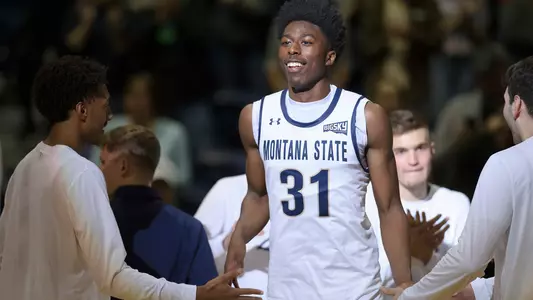
Photo by: Kelly Gorham
#PlantTheFlag FRIDAY: My Story, by Bobcat Men's Basketball Player Devin Kirby
9/25/2020 3:54:00 PM | Men's Basketball
Bobcat center Devin Kirby, known and loved as DK, looks at the heartbreak of last season's sudden cancellation and the hope of the upcoming season
Devin Kirby is a fifth-year senior on the Bobcat men's basketball team who has started the past two seasons. Kirby overcame a devastating knee injury during his junior year in high school, but the business major has thrived at Montana State in part because of Bobcat Athletics' nutrition and strength training efforts. From his arrival at MSU as a freshman in the summer of 2016 through the heartbreak of the Big Sky Tournament's cancellation last spring and his progress during the ensuing off-season, this feature in the #PlantTheFlag Friday series, is Devin Kirby's story in his own words.
The night before our first Big Sky Tournament game the Utah Jazz were supposed to play, but the news broke that Rudy Gobert got the virus and in our group chat we were all like, 'What does this mean for us?' Then the Power 5 conferences started to cancel their tournaments, and we saw the domino effect where we didn't want it to happen, but we ultimately knew it was looking like it. We were still preparing ourselves to play because there were no known cases in Idaho up to that time, but at breakfast we saw Coach Sprink (MSU head coach Danny Sprinkle) get on the phone and then rush out the door, and we knew at that point. It kind of shocked us. The shock factor was definitely there.
That team was a very special team for me personally, and for our two seniors, Ladan (Ricketts) and Harry (Frey), I felt sick for them.
When the NCAA figured out the start date (of November 25) for this season there's just relief. We've been preparing for it. We stayed in constant contact, the coaches and the players, since we left (Boise last spring). We didn't know exactly when it was going to start, but it's going to start, and when it does we need to make sure that we're ready and that we're prepped. Some schools are not blessed enough to be able due to the circumstances to get into their own facilities. We were lucky enough when we got back in June to quarantine for 14 days and when that was over we were able to get right back in here with the right steps and the right protocol. We feel very lucky that we're able to do that work in our own facilities when some other schools can't. We're very relieved, and we're very happy, that the start date is set.
This has been a crazy year. It's crazy times for everything, the COVID, the social justice stuff, everything. It's nuts. With all the outside stuff going on the basketball court is an escape for us, it's a time we can go in and just be us, put the work in that's necessary for when we do start. Our sights are set pretty high for this year, so our main job when we're on the floor is to maximize the time we have. With everything going on with school, some classes going on in person and some are on-line, it can be hard to manage from time to time. But we're all just trying to get used to it.
The school work is fine right now, these are my last two semesters so I'm close to getting my degree, but organizing everything has been a challenge. (Last week) a professor changed our whole schedule. Due dates changed, the class times changed, so it can be very unpredictable. It's a week-to-week thing and you just have to keep track of it, you have to hold yourself accountable, and you have to do your part to make it work.
There's a little bit of pressure to that, but mostly it's doing all the little things right. It's following the protocols, it's being smart when you're away from the coaches telling you to do X, Y and Z. When you're by yourself you still have to be accountable. You have to make sure you're washing your hands, sanitizing, all those little things, and as more information comes out, we adjust. For now, it's important to follow the doctor's opinions and the trainers' opinions and the coaches' opinions on how to handle the situation.
This year's team is a great group of guys, on and off the court, and we've really gelled naturally together. Our playing styles gel together, and it's been challenging with the social distancing and COVID (protocols) to do the team activities we've been able to do in the past, but we've been making do. It's a really great group.
The first summer I was in Bozeman, I remember this like it was yesterday. I got to campus and I was nervous because I hadn't heard from my roommate (Harald Frey). I'd watched his highlights, but I hadn't interacted with him, and I remember Haz (assistant coach Chris Haslam) went to pick him up from the airport. When he was unpacking his stuff, he started playing Notorious BIG, Tupac, and I'm like, "Whoa! Where did this come from? You're from Norway and I didn't think you'd be listening to stuff like this." We just bonded the first night, it came so natural, so easy, and that first summer when we were up in Roskie Hall, that was great. Getting to know him, building that bond to as strong as it is now, those four years with him were great. Those are times that I won't forget, ever.
And honestly, that's what I love the most about sports. If you would have told me four years ago that I was going to move to Bozeman, Montana, and my best friend would be from Oslo, Norway, I would have said that you're crazy. That's the beauty of sports, it brings together people of different cultures, different races, different ethnicities, it brings people together for a common bond. When you spend time with each other, day after day, and you get to know them, their habits and everything like that, their likes and dislikes, that's what I love about sports in general, how it brings people together.
My mom (Michelle Kirby, who played basketball at NAU) is the biggest influence I've ever had in my life. She's so strong, and what she's been through it's crazy to see where she is at now. I appreciate her so much. The thing about basketball is that she never really forced it on me, it was really the fifth or sixth sport I played. I did soccer first, then baseball, then football, a lot of different sports. She told me, "I played, but I never want to force that onto you. I want you to try all these sports and whatever sport you like that's the one we'll run with." She was my coach all the way up until high school. She coached my club teams, two of them, the inner-city leagues, she taught me to play the game the right way, very unselfish, team basketball. She pushed me a lot. Where we came from, basketball was the route I had to take if I wanted to get where I wanted to go, a college education. I had to work to get a scholarship, make sure my skill set was ready for the next level, and she always pushed me. She's my biggest influence.
My brother (Maurice Kirby, who played Division I basketball at Loyola Chicago and Indiana-Purdue Indianapolis before playing professionally in Spain and Mexico) and I were very competitive growing up, and he would push me daily, too. It was great seeing what he went through, going to college first, the decision-making, the recruiting process. I got to witness all of that first so that when it came to me, I wasn't shell-shocked. I knew how things work, how they operate. I remember when I was a freshman, I probably called him three times a week. 'Hey big bro, school, hoops, social life, how do you manage all of these things?' When I was a freshman in college he was a senior, so he had been through the wringer and he gave me great advice how to handle those situations. I can't thank him enough for that.
When things got shut down this spring it was great having him around. He got sent home from (playing basketball) overseas and had to work a job. In March and April travel was terrible, you couldn't go anywhere. He told me that this is my last year, you can't drop off, you have to maintain your strength and your weight. He was always reminding me, 'Hey DK, did you get your workout in today? Did you get your physical therapy in today? Did you talk to Brett (Ritter, MSU Athletic Trainer)? Did you talk to your coaches today?' He was making sure that I wouldn't drop off, and I took that time to get better, to gain some weight and some muscle, and a big part of that was him staying on my butt about that stuff.
I didn't have a lot of at-home weights, and the gyms were shut down. I remember driving (in Phoenix with my brother) and we passed an outdoor park, and they had screwed the rims off and (used) caution tape (to close the basketball courts). So that was challenging, but the coaches helped me find ways to stay on top of it. They recommended, 'Your mom's a teacher, try to get a crate of books or water bottles or something like that to use as weights.' I did body weight push-ups, body weight squats, and my mother's home cooking helped me a lot. It was very challenging, but we made due with what we had.
Nutrition is a very important part of the game that I took for granted as a freshman and redshirt sophomore. I played my senior year (in high school), but I was still getting into game shape. That transition from high school to my freshman year I think I came in 190 (lbs) and I never thought that was a vital part of my game, but I learned very quickly that you're not going to be very effective at 190 as a post player in Division I basketball. Talking to Brittney (Patera, Bobcat Athletics' Dietician and Nutritionist), we established a plan. I made a lot of excuses when I was a freshman, I would always say I don't have time to eat, it's my metabolism, but I was just lazy with it, that's the bottom line. But something in my brain just switched, I realized that this isn't a joke, this is going to help rather than harm me. Brittney helped me, and when I got home this last summer I would send her updates every week tracking my weight, I'd ask her for new recipes, start to meal prep. I couldn't use the excuse of school and basketball as for being too tired to cook. I ate like crap my freshman and sophomore years, pizza four times a week, I was just lazy. The pizza delivery was my best friend. Brittney showed me how to meal prep ahead of time so when the time comes, I can just heat up my meals. She's been a huge, huge, huge part of my development and I cannot thank her enough.
My academic path has been pretty good here. When I was a freshman I didn't take it seriously, I just skated by, but I've been blessed. Montana State has a great College of Business, one of the best in the nation, the professors are great resources. It's great to go them for knowledge and guidance. The counselors there don't even talk to me about school. It's, 'Hey, how's your mother doing, how's the team doing, how are you doing?' Then we get into the academic side of things. They're great professors, but as individuals who care about me, they're great. Learning from them and having those resources has been really, really good, and I love my major. Business finance is what I've wanted to do since I was a little kid, learning the financial side of things. It hasn't been easy, I've had my ups and down, but it's well worth it.
My senior year (in high school) was pretty productive, but coming back from that injury was the hardest time of my life. It couldn't have come at a worse time because your junior year is probably your most important year for recruiting. It happened around Christmas, and mentally it was so tough. When it happened I was literally in shock, it wasn't really pain, my lower body was numb. I couldn't move it. I had no idea what was going on, my mother ran onto the court, that's a scene I'll never get out of my head. The support of the whole community, my mother and my brother, but also my athletic trainer and my physical therapist, I wouldn't be here if it weren't for them. I remember my first session was literally an hour-and-a-half of learning how to sit and stand up from a chair. That took me an hour-and-a-half, taking guidance and learning tools, because I lost all the strength in my legs. I couldn't even bend them for a month-and-a-half and I couldn't walk for five. Both legs at the same time is not a common injury, it was mentally draining, but without my support system and the support of the community and the state I wouldn't have been able to make it out of there. They didn't think I would be able to play until December (of my senior year), and some didn't think I'd be able to play at all, so the game of basketball is something I never take for granted. I take it seriously because of what happened back then. I came back in seven months and we almost won state. We should have won state. But it's because of my support system that I was able to come back.
This is a crazy time, but I cannot be more grateful for our team, and our (coaching) staff is so behind us. I remember when the George Floyd incident happened, I got text from the coaches, 'How are you doing, how are you handling this time, if you need to talk to someone we're here.' It's very nice to have a staff that really loves and supports you away from the basketball court. They're such great people, the coaches that are here and the coaches that used to be here, and I've always known that, but it's always nice to see when something happens in our world who backs you up, and every single coach texted me. We held conference calls and Coach Sprink said, 'I don't know what it's like to be African American but I hurt for you and I feel for you, so whatever you guys want to say let's have an open discussion.' So he literally held a conference call about race in America and the social justice things that are going on right now. That means more to me than I can express. The team knows that we're backed up by the coaches here, and that's an amazing feeling.
When I first came out here to visit Bozeman, I had the stereotypical image of Montana because I'd never been here. I didn't know any of the cities within the state. But when I came out here one of the reasons I fell in love with it is that the people in Montana, but especially Bozeman, are so great. I haven't had one incident in five years in regard to my race or my stature. People always treat me with respect here, and from what I've experienced, the people are so genuine. When I first came in, I was nervous because I didn't know what to expect, but as I've gotten to know people here and to know the community, I fell in love with it, and the people here have a big role in that.
GCU recruited me, Loyola Chicago, Pacific, Brown – I know, an Ivy League! A couple others did too, and when the injury happened, I understand the business side of things, and some of the higher level schools dropped off, and that's understandable. If you're recruiting someone that breaks both their legs going into their senior year, your paycheck is determined by the recruits you bring in, your job is on the line, and I understand that. I never took it personally. Some schools said they're still interested but they want to see that my legs are stable, that I rehabbed well, and they were going to determine their decision based on my (senior) year. Some schools wanted me to sign in the spring (after his senior season), but I didn't want take that uncertainty. I wanted to sign in the early signing period. Montana State was one of those schools, pre-injury and post-injury, that was there. They never pulled the offer, they always believed I was going to rehab and come back better. (Coach Brian) Fish and Coach Haz came down for a home visit with my late grandmother and my mother and my brother, and they kept it real, they said, 'We're all in, we have faith in your rehab.' I'd send them videos of my rehab, and Fish and Haz were nothing but supportive the whole time.
My redshirt year (2017-18, his second at MSU) was tough. I had flashbacks to my junior year in high school when I couldn't play, and I really wanted to play. But it was the best thing that happened to me here. I needed that year because coming in as a freshman I didn't take my nutrition seriously, I had to fix a lot of things within myself in order to make a positive impact for my team. That conversation was hard to have, the coaches told me that they wanted this for me, and I had to switch my brain from taking it personal to (understand) it was going to help me in the long run. Looking back on it, ever since then I've taken the nutrition part very serious, I've taken the weight room part extremely serious, watching film, developing may game. There were different things through that whole time that really helped me. I attacked the weight room, I started to work on my nutrition to build my body up and have a great season and a positive impact. The guys were instrumental to that, too. They wanted me to know that I was still part of the team. They helped my mental (outlook) a lot, making sure I wasn't in my own head too much.
All of the uncertainty has made things difficult, going through the summer without having a start date for my last year. The pain that I felt for Harry and for Ladan, we didn't know that the Northern Colorado game at home was going to be the last game they ever played (for MSU). To come to a crashing halt made this year so uncertain, and I want to play my last season in full. Now I'm ready, I'm so ready to go out there and play the game I love.
I want to stay in the game of basketball as long as I can, playing or coaching, and after that I know I'll have options because of MSU and my education. It's been a great experience, but I'm so ready for this year.
#GoCatsGo
The night before our first Big Sky Tournament game the Utah Jazz were supposed to play, but the news broke that Rudy Gobert got the virus and in our group chat we were all like, 'What does this mean for us?' Then the Power 5 conferences started to cancel their tournaments, and we saw the domino effect where we didn't want it to happen, but we ultimately knew it was looking like it. We were still preparing ourselves to play because there were no known cases in Idaho up to that time, but at breakfast we saw Coach Sprink (MSU head coach Danny Sprinkle) get on the phone and then rush out the door, and we knew at that point. It kind of shocked us. The shock factor was definitely there.
That team was a very special team for me personally, and for our two seniors, Ladan (Ricketts) and Harry (Frey), I felt sick for them.
When the NCAA figured out the start date (of November 25) for this season there's just relief. We've been preparing for it. We stayed in constant contact, the coaches and the players, since we left (Boise last spring). We didn't know exactly when it was going to start, but it's going to start, and when it does we need to make sure that we're ready and that we're prepped. Some schools are not blessed enough to be able due to the circumstances to get into their own facilities. We were lucky enough when we got back in June to quarantine for 14 days and when that was over we were able to get right back in here with the right steps and the right protocol. We feel very lucky that we're able to do that work in our own facilities when some other schools can't. We're very relieved, and we're very happy, that the start date is set.
This has been a crazy year. It's crazy times for everything, the COVID, the social justice stuff, everything. It's nuts. With all the outside stuff going on the basketball court is an escape for us, it's a time we can go in and just be us, put the work in that's necessary for when we do start. Our sights are set pretty high for this year, so our main job when we're on the floor is to maximize the time we have. With everything going on with school, some classes going on in person and some are on-line, it can be hard to manage from time to time. But we're all just trying to get used to it.
The school work is fine right now, these are my last two semesters so I'm close to getting my degree, but organizing everything has been a challenge. (Last week) a professor changed our whole schedule. Due dates changed, the class times changed, so it can be very unpredictable. It's a week-to-week thing and you just have to keep track of it, you have to hold yourself accountable, and you have to do your part to make it work.
There's a little bit of pressure to that, but mostly it's doing all the little things right. It's following the protocols, it's being smart when you're away from the coaches telling you to do X, Y and Z. When you're by yourself you still have to be accountable. You have to make sure you're washing your hands, sanitizing, all those little things, and as more information comes out, we adjust. For now, it's important to follow the doctor's opinions and the trainers' opinions and the coaches' opinions on how to handle the situation.
This year's team is a great group of guys, on and off the court, and we've really gelled naturally together. Our playing styles gel together, and it's been challenging with the social distancing and COVID (protocols) to do the team activities we've been able to do in the past, but we've been making do. It's a really great group.
The first summer I was in Bozeman, I remember this like it was yesterday. I got to campus and I was nervous because I hadn't heard from my roommate (Harald Frey). I'd watched his highlights, but I hadn't interacted with him, and I remember Haz (assistant coach Chris Haslam) went to pick him up from the airport. When he was unpacking his stuff, he started playing Notorious BIG, Tupac, and I'm like, "Whoa! Where did this come from? You're from Norway and I didn't think you'd be listening to stuff like this." We just bonded the first night, it came so natural, so easy, and that first summer when we were up in Roskie Hall, that was great. Getting to know him, building that bond to as strong as it is now, those four years with him were great. Those are times that I won't forget, ever.
And honestly, that's what I love the most about sports. If you would have told me four years ago that I was going to move to Bozeman, Montana, and my best friend would be from Oslo, Norway, I would have said that you're crazy. That's the beauty of sports, it brings together people of different cultures, different races, different ethnicities, it brings people together for a common bond. When you spend time with each other, day after day, and you get to know them, their habits and everything like that, their likes and dislikes, that's what I love about sports in general, how it brings people together.
My mom (Michelle Kirby, who played basketball at NAU) is the biggest influence I've ever had in my life. She's so strong, and what she's been through it's crazy to see where she is at now. I appreciate her so much. The thing about basketball is that she never really forced it on me, it was really the fifth or sixth sport I played. I did soccer first, then baseball, then football, a lot of different sports. She told me, "I played, but I never want to force that onto you. I want you to try all these sports and whatever sport you like that's the one we'll run with." She was my coach all the way up until high school. She coached my club teams, two of them, the inner-city leagues, she taught me to play the game the right way, very unselfish, team basketball. She pushed me a lot. Where we came from, basketball was the route I had to take if I wanted to get where I wanted to go, a college education. I had to work to get a scholarship, make sure my skill set was ready for the next level, and she always pushed me. She's my biggest influence.
My brother (Maurice Kirby, who played Division I basketball at Loyola Chicago and Indiana-Purdue Indianapolis before playing professionally in Spain and Mexico) and I were very competitive growing up, and he would push me daily, too. It was great seeing what he went through, going to college first, the decision-making, the recruiting process. I got to witness all of that first so that when it came to me, I wasn't shell-shocked. I knew how things work, how they operate. I remember when I was a freshman, I probably called him three times a week. 'Hey big bro, school, hoops, social life, how do you manage all of these things?' When I was a freshman in college he was a senior, so he had been through the wringer and he gave me great advice how to handle those situations. I can't thank him enough for that.
When things got shut down this spring it was great having him around. He got sent home from (playing basketball) overseas and had to work a job. In March and April travel was terrible, you couldn't go anywhere. He told me that this is my last year, you can't drop off, you have to maintain your strength and your weight. He was always reminding me, 'Hey DK, did you get your workout in today? Did you get your physical therapy in today? Did you talk to Brett (Ritter, MSU Athletic Trainer)? Did you talk to your coaches today?' He was making sure that I wouldn't drop off, and I took that time to get better, to gain some weight and some muscle, and a big part of that was him staying on my butt about that stuff.
I didn't have a lot of at-home weights, and the gyms were shut down. I remember driving (in Phoenix with my brother) and we passed an outdoor park, and they had screwed the rims off and (used) caution tape (to close the basketball courts). So that was challenging, but the coaches helped me find ways to stay on top of it. They recommended, 'Your mom's a teacher, try to get a crate of books or water bottles or something like that to use as weights.' I did body weight push-ups, body weight squats, and my mother's home cooking helped me a lot. It was very challenging, but we made due with what we had.
Nutrition is a very important part of the game that I took for granted as a freshman and redshirt sophomore. I played my senior year (in high school), but I was still getting into game shape. That transition from high school to my freshman year I think I came in 190 (lbs) and I never thought that was a vital part of my game, but I learned very quickly that you're not going to be very effective at 190 as a post player in Division I basketball. Talking to Brittney (Patera, Bobcat Athletics' Dietician and Nutritionist), we established a plan. I made a lot of excuses when I was a freshman, I would always say I don't have time to eat, it's my metabolism, but I was just lazy with it, that's the bottom line. But something in my brain just switched, I realized that this isn't a joke, this is going to help rather than harm me. Brittney helped me, and when I got home this last summer I would send her updates every week tracking my weight, I'd ask her for new recipes, start to meal prep. I couldn't use the excuse of school and basketball as for being too tired to cook. I ate like crap my freshman and sophomore years, pizza four times a week, I was just lazy. The pizza delivery was my best friend. Brittney showed me how to meal prep ahead of time so when the time comes, I can just heat up my meals. She's been a huge, huge, huge part of my development and I cannot thank her enough.
My academic path has been pretty good here. When I was a freshman I didn't take it seriously, I just skated by, but I've been blessed. Montana State has a great College of Business, one of the best in the nation, the professors are great resources. It's great to go them for knowledge and guidance. The counselors there don't even talk to me about school. It's, 'Hey, how's your mother doing, how's the team doing, how are you doing?' Then we get into the academic side of things. They're great professors, but as individuals who care about me, they're great. Learning from them and having those resources has been really, really good, and I love my major. Business finance is what I've wanted to do since I was a little kid, learning the financial side of things. It hasn't been easy, I've had my ups and down, but it's well worth it.
My senior year (in high school) was pretty productive, but coming back from that injury was the hardest time of my life. It couldn't have come at a worse time because your junior year is probably your most important year for recruiting. It happened around Christmas, and mentally it was so tough. When it happened I was literally in shock, it wasn't really pain, my lower body was numb. I couldn't move it. I had no idea what was going on, my mother ran onto the court, that's a scene I'll never get out of my head. The support of the whole community, my mother and my brother, but also my athletic trainer and my physical therapist, I wouldn't be here if it weren't for them. I remember my first session was literally an hour-and-a-half of learning how to sit and stand up from a chair. That took me an hour-and-a-half, taking guidance and learning tools, because I lost all the strength in my legs. I couldn't even bend them for a month-and-a-half and I couldn't walk for five. Both legs at the same time is not a common injury, it was mentally draining, but without my support system and the support of the community and the state I wouldn't have been able to make it out of there. They didn't think I would be able to play until December (of my senior year), and some didn't think I'd be able to play at all, so the game of basketball is something I never take for granted. I take it seriously because of what happened back then. I came back in seven months and we almost won state. We should have won state. But it's because of my support system that I was able to come back.
This is a crazy time, but I cannot be more grateful for our team, and our (coaching) staff is so behind us. I remember when the George Floyd incident happened, I got text from the coaches, 'How are you doing, how are you handling this time, if you need to talk to someone we're here.' It's very nice to have a staff that really loves and supports you away from the basketball court. They're such great people, the coaches that are here and the coaches that used to be here, and I've always known that, but it's always nice to see when something happens in our world who backs you up, and every single coach texted me. We held conference calls and Coach Sprink said, 'I don't know what it's like to be African American but I hurt for you and I feel for you, so whatever you guys want to say let's have an open discussion.' So he literally held a conference call about race in America and the social justice things that are going on right now. That means more to me than I can express. The team knows that we're backed up by the coaches here, and that's an amazing feeling.
When I first came out here to visit Bozeman, I had the stereotypical image of Montana because I'd never been here. I didn't know any of the cities within the state. But when I came out here one of the reasons I fell in love with it is that the people in Montana, but especially Bozeman, are so great. I haven't had one incident in five years in regard to my race or my stature. People always treat me with respect here, and from what I've experienced, the people are so genuine. When I first came in, I was nervous because I didn't know what to expect, but as I've gotten to know people here and to know the community, I fell in love with it, and the people here have a big role in that.
GCU recruited me, Loyola Chicago, Pacific, Brown – I know, an Ivy League! A couple others did too, and when the injury happened, I understand the business side of things, and some of the higher level schools dropped off, and that's understandable. If you're recruiting someone that breaks both their legs going into their senior year, your paycheck is determined by the recruits you bring in, your job is on the line, and I understand that. I never took it personally. Some schools said they're still interested but they want to see that my legs are stable, that I rehabbed well, and they were going to determine their decision based on my (senior) year. Some schools wanted me to sign in the spring (after his senior season), but I didn't want take that uncertainty. I wanted to sign in the early signing period. Montana State was one of those schools, pre-injury and post-injury, that was there. They never pulled the offer, they always believed I was going to rehab and come back better. (Coach Brian) Fish and Coach Haz came down for a home visit with my late grandmother and my mother and my brother, and they kept it real, they said, 'We're all in, we have faith in your rehab.' I'd send them videos of my rehab, and Fish and Haz were nothing but supportive the whole time.
My redshirt year (2017-18, his second at MSU) was tough. I had flashbacks to my junior year in high school when I couldn't play, and I really wanted to play. But it was the best thing that happened to me here. I needed that year because coming in as a freshman I didn't take my nutrition seriously, I had to fix a lot of things within myself in order to make a positive impact for my team. That conversation was hard to have, the coaches told me that they wanted this for me, and I had to switch my brain from taking it personal to (understand) it was going to help me in the long run. Looking back on it, ever since then I've taken the nutrition part very serious, I've taken the weight room part extremely serious, watching film, developing may game. There were different things through that whole time that really helped me. I attacked the weight room, I started to work on my nutrition to build my body up and have a great season and a positive impact. The guys were instrumental to that, too. They wanted me to know that I was still part of the team. They helped my mental (outlook) a lot, making sure I wasn't in my own head too much.
All of the uncertainty has made things difficult, going through the summer without having a start date for my last year. The pain that I felt for Harry and for Ladan, we didn't know that the Northern Colorado game at home was going to be the last game they ever played (for MSU). To come to a crashing halt made this year so uncertain, and I want to play my last season in full. Now I'm ready, I'm so ready to go out there and play the game I love.
I want to stay in the game of basketball as long as I can, playing or coaching, and after that I know I'll have options because of MSU and my education. It's been a great experience, but I'm so ready for this year.
#GoCatsGo

Players Mentioned

G
/ Men's Basketball
C
/ Men's BasketballThursday, March 03
Friday, November 05
Monday, November 01
Sunday, October 31