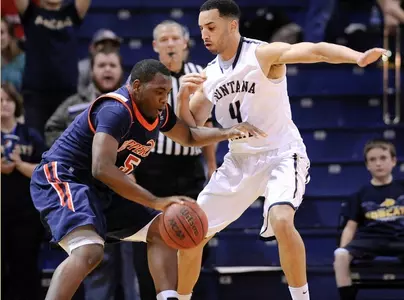
MSU's mid-season improvement has come through defensive work
Photo by: Kelly Gorham
Defensive Adjustment Boosts Bobcats
1/31/2013 8:18:00 AM | Men's Basketball
MSU rides zone defense to upper echelon of Big Sky at mid-way point
It wasn't an easy change for Montana State coach Brad Huse to make, but he's the first to point to his team's zone defense as a big reason for the Bobcats' current run of success.
“We've obviously changed some things schematically,” Huse said in preparation for his team's road trip to Eastern Washington (Thursday) and Portland State (Saturday) as the Big Sky Conference's second round begins. “I've traditionally been more of a hard-core man-to-man guy, but I finally gave in and realized that we need to play more zone. It's paid off.”
MSU has won seven of its last nine games, a streak that coincided directly with Huse's scheme change. “We trailed NAU by 18 points at halftime (in the teams' first Big Sky game of the season back in December), and we played zone in the second half and ended up losing by seven. We played zone two nights later at Sac State and lost by five, and were in that game the whole way. In a lot of ways, zone really helps you to stay in games.”
In the first nine games this season, a stretch the Bobcats completed with a 2-7 record, MSU opponents shot 49% from the floor. In the last nine contests, of which the Cats have won seven, MSU's field goal defense has allowed 44% shooting. The team has also trimmed 5.5 points a game off the scoring average allowed.
While the Bobcats haven't played exclusively zone since that NAU-Sacramento State trip, the team has spent considerable time in that defense. Huse says the combination of experience and a willingness of his players to pull in the same direction has bolstered his team's defensive success.
“Our ability to communicate and work together has definitely improved,” he said. “That has shown on both ends of the floor. Defense is not an individual task, it's a team thing, and the best defensive teams are those that can guard collectively. Our attention on that end has improved, but it still has a ways to go. The guys are working hard on that end of the floor. They realize the value in it. It's allowed us to pull out some games late, our defense, it's helped us get over the top in some of these conference games. But it's still a work in progress.”
Bobcat guard Christian Moon, a senior, says the communication systems differ greatly between man-to-man and zone. “It's really different,” he said. “When you're playing zone you have to be aware of all the different actions going on – baseline runners, cuts to the high post, you have to know everything the offense is doing. We use man principles, but you really have to be aware of your surroundings and be aware of everything happening on the court.”
Known for his commitment to hard-nosed defense regardless the form it takes, Huse agrees with Moon's assessment.
“If you don't have (toughness and effort) you can't (play good defense),” he says. “That's certainly a necessary constant if you're going to be successful on that end. But there's so much more to it – your alertness and awareness, your ability to communicate with your teammates, the ability to see a play ahead, the ability to understand a scouting report, the ability to understand the other players' tendencies, what a team's trying to accomplish, where they're trying to go with the basketball, the coverages we're in. There's a lot to it.”
Huse likes the direction his team's defense – and the team in general – is heading. “We've seen a lot of growth, and we continue to grow,” he said. “We've put ourselves in position to finish well. We're moving in the right direction. I feel like we're much more of a team than when the conference season started, so that's been a real positive. Obviously we have a little momentum and we want to play off that.”
MSU's head coach knows, though, that the Bobcats will be severely tested on defense this weekend. “Eastern Washington is one of the top three-point shooting teams in the nation,” he says. “They are very dangerous, and Venky Jois is really a good all-around player. Portland State is very dynamic offensively, too.”
“We've obviously changed some things schematically,” Huse said in preparation for his team's road trip to Eastern Washington (Thursday) and Portland State (Saturday) as the Big Sky Conference's second round begins. “I've traditionally been more of a hard-core man-to-man guy, but I finally gave in and realized that we need to play more zone. It's paid off.”
MSU has won seven of its last nine games, a streak that coincided directly with Huse's scheme change. “We trailed NAU by 18 points at halftime (in the teams' first Big Sky game of the season back in December), and we played zone in the second half and ended up losing by seven. We played zone two nights later at Sac State and lost by five, and were in that game the whole way. In a lot of ways, zone really helps you to stay in games.”
In the first nine games this season, a stretch the Bobcats completed with a 2-7 record, MSU opponents shot 49% from the floor. In the last nine contests, of which the Cats have won seven, MSU's field goal defense has allowed 44% shooting. The team has also trimmed 5.5 points a game off the scoring average allowed.
While the Bobcats haven't played exclusively zone since that NAU-Sacramento State trip, the team has spent considerable time in that defense. Huse says the combination of experience and a willingness of his players to pull in the same direction has bolstered his team's defensive success.
“Our ability to communicate and work together has definitely improved,” he said. “That has shown on both ends of the floor. Defense is not an individual task, it's a team thing, and the best defensive teams are those that can guard collectively. Our attention on that end has improved, but it still has a ways to go. The guys are working hard on that end of the floor. They realize the value in it. It's allowed us to pull out some games late, our defense, it's helped us get over the top in some of these conference games. But it's still a work in progress.”
Bobcat guard Christian Moon, a senior, says the communication systems differ greatly between man-to-man and zone. “It's really different,” he said. “When you're playing zone you have to be aware of all the different actions going on – baseline runners, cuts to the high post, you have to know everything the offense is doing. We use man principles, but you really have to be aware of your surroundings and be aware of everything happening on the court.”
Known for his commitment to hard-nosed defense regardless the form it takes, Huse agrees with Moon's assessment.
“If you don't have (toughness and effort) you can't (play good defense),” he says. “That's certainly a necessary constant if you're going to be successful on that end. But there's so much more to it – your alertness and awareness, your ability to communicate with your teammates, the ability to see a play ahead, the ability to understand a scouting report, the ability to understand the other players' tendencies, what a team's trying to accomplish, where they're trying to go with the basketball, the coverages we're in. There's a lot to it.”
Huse likes the direction his team's defense – and the team in general – is heading. “We've seen a lot of growth, and we continue to grow,” he said. “We've put ourselves in position to finish well. We're moving in the right direction. I feel like we're much more of a team than when the conference season started, so that's been a real positive. Obviously we have a little momentum and we want to play off that.”
MSU's head coach knows, though, that the Bobcats will be severely tested on defense this weekend. “Eastern Washington is one of the top three-point shooting teams in the nation,” he says. “They are very dangerous, and Venky Jois is really a good all-around player. Portland State is very dynamic offensively, too.”

Thursday, March 03
Friday, November 05
Monday, November 01
Sunday, October 31