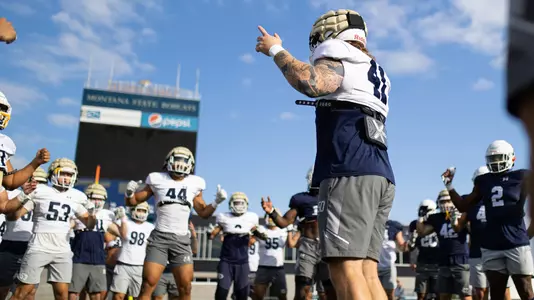
Photo by: Garrett Becker
Evaluating Freshmen for Playing Time Takes on Different Look in 2021
8/14/2021 3:20:00 PM | Football
Nuances emerge in process of deciding on playing time for first-year frosh
BOZEMAN, Montana (August 14, 2021) – In years past, first-year Montana State football coach Brent Vigen would have faced a difficult but clear-cut decision regarding his talented class of first-year freshmen.
To redshirt, or not to redshirt.
Then, a rule change in the last couple of seasons allowed a student-athlete appearing in four games or less to maintain his eligibility status into the next season. Coaches at different levels interpreted and applied that rule in different ways, but it was nearly universally hailed.
In 2021, though, even more considerations emerged. It's possible to be a third-year freshman, using a true redshirt year and a four-game redshirt year in the 2018-2019 cycle of seasons, while essentially using no eligibility at all during the 2020 football season.
Given somewhat unusual depth entering 2021 because of the lost campaign of 2020, Vigen has much more to consider. "I think we're probably positioned this year where playing a true freshman should not be the way it has to be," he said when discussing first-year frosh under strong consideration for game action. "We're going to have 50 freshmen, whether it be first- or second- or third-year guys, so (we want to be able) to split that grouping. So (playing) true freshmen, that's probably not the best for your numbers."
While praising his group of first-year freshman individually and as a group, he said Simeon Woodard has emerged as the most likely to jump into the rotation. That has come to pass because Woodard's performance has impressed coaches, because cornerback is a position most college coaches agree contains less obstacles when it comes to contributing very early in a career, and because the addition of a nickel back to MSU's base defense has accentuated the need to add cornerbacks to the rotation.
"I think Simeon's continued to progress," Vigen said, "and I think that's a position where guys can play early. I think he's definitely in the mix."
Vigen has also lauded a couple other true freshmen, as well, although circumstances at their positions may not demand an instant influx of first-year talent. "I think Andrew Patterson, I mentioned him earlier (in the week), is a little further (from playing in 2021) simply because of our depth at that (receiver), but I like what I see there. The same can probably be said of Elijah (Reynolds, a tight end)."
Beyond strong individual performances and positional need, another factor determines when and how much first-year freshmen play. "I come from the FBS where you weren't thinking long-term about (redshirt) situations," Vigen said. "You were trying to play out the four-game thought process (to determine a true freshman's playing status) a little bit."
In the FCS, he said, saving a player's four games for later in the season, given reduced scholarship numbers and the presence of a possible playoff run, makes more sense. "At the FCS level you're trying to play that long game, you're probably trying to hold off to see if you'll need that extra depth in weeks nine, 10 and 11, and maybe even into the playoffs God willing that we get there. If you're going to play a guy early you're probably going to play him (the entire season)."
In total, Vigen likes the four-game rule. "It's a really good rule for the kids, and I think it's a good rule (to) temper coaches in how they deal with true freshmen. We'll look long and hard at that with both the first-year true freshmen and the second-year guys that still have that year left."
To redshirt, or not to redshirt.
Then, a rule change in the last couple of seasons allowed a student-athlete appearing in four games or less to maintain his eligibility status into the next season. Coaches at different levels interpreted and applied that rule in different ways, but it was nearly universally hailed.
In 2021, though, even more considerations emerged. It's possible to be a third-year freshman, using a true redshirt year and a four-game redshirt year in the 2018-2019 cycle of seasons, while essentially using no eligibility at all during the 2020 football season.
Given somewhat unusual depth entering 2021 because of the lost campaign of 2020, Vigen has much more to consider. "I think we're probably positioned this year where playing a true freshman should not be the way it has to be," he said when discussing first-year frosh under strong consideration for game action. "We're going to have 50 freshmen, whether it be first- or second- or third-year guys, so (we want to be able) to split that grouping. So (playing) true freshmen, that's probably not the best for your numbers."
While praising his group of first-year freshman individually and as a group, he said Simeon Woodard has emerged as the most likely to jump into the rotation. That has come to pass because Woodard's performance has impressed coaches, because cornerback is a position most college coaches agree contains less obstacles when it comes to contributing very early in a career, and because the addition of a nickel back to MSU's base defense has accentuated the need to add cornerbacks to the rotation.
"I think Simeon's continued to progress," Vigen said, "and I think that's a position where guys can play early. I think he's definitely in the mix."
Vigen has also lauded a couple other true freshmen, as well, although circumstances at their positions may not demand an instant influx of first-year talent. "I think Andrew Patterson, I mentioned him earlier (in the week), is a little further (from playing in 2021) simply because of our depth at that (receiver), but I like what I see there. The same can probably be said of Elijah (Reynolds, a tight end)."
Beyond strong individual performances and positional need, another factor determines when and how much first-year freshmen play. "I come from the FBS where you weren't thinking long-term about (redshirt) situations," Vigen said. "You were trying to play out the four-game thought process (to determine a true freshman's playing status) a little bit."
In the FCS, he said, saving a player's four games for later in the season, given reduced scholarship numbers and the presence of a possible playoff run, makes more sense. "At the FCS level you're trying to play that long game, you're probably trying to hold off to see if you'll need that extra depth in weeks nine, 10 and 11, and maybe even into the playoffs God willing that we get there. If you're going to play a guy early you're probably going to play him (the entire season)."
In total, Vigen likes the four-game rule. "It's a really good rule for the kids, and I think it's a good rule (to) temper coaches in how they deal with true freshmen. We'll look long and hard at that with both the first-year true freshmen and the second-year guys that still have that year left."



Players Mentioned

WR
/ FootballLeon Costello Press Conference: Kennedy-Stark Athletic Center
Thursday, July 31
A Conversation with President Dr. Waded Cruzado | Montana State Athletics
Monday, May 19
Big Cats, Little Trucks - Willie Patterson
Wednesday, May 03
Matt Houk Introductory Press Conference
Wednesday, May 03