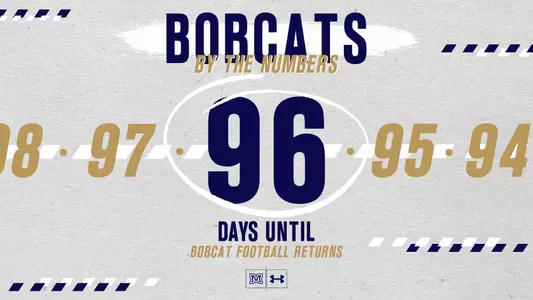
BOBCATS BY THE NUMBERS: 96 Days Until Kickoff, and a Look at a Bobcat Legacy
5/31/2021 2:00:00 PM | Football
Paul Brott follows his tough and talented brothers to Montana State
Bobcats by the Numbers takes a look at current and past Bobcats whose jersey numbers correspond to the number of days remaining before Montana State opens the 2021 football season at Wyoming on September 4.
#96
Paul Brott, DL: It admittedly didn't take much salesmanship, but when former Bobcats Mitch and Wilson Brott spoke to MSU coaches on behalf of their younger brother Paul the main pitch was always upside. And it had to be, because unlike his brothers Paul Brott focused on basketball during much of his youth. But when he turned his attention to football – perhaps at some amount of familial urging – things took off quickly. In his second season of high school football last fall he earned Class AA First Team All-State honors as a defensive lineman. The inferences we can draw from the span of time his brothers spent as Bobcat football players include that Paul Brott will be a tough, smart player who is also versatile and durable.
Bobcat Spotlight: #96 – If you're looking for a literal starting point for the success of the Mike Kramer era of MSU football you could do worse than to start with a very early, possibly the first, verbal commitment that the Big Human obtained – Dusty Daws. A Bobcat legacy (Dusty's father Brad was a star defensive lineman for the Cats in the early '70s), Dusty came to the Bobcats as a "by-you tight end," in Kramer's words, but found his niche as an elite long snapper. He was named the best in the FCS at that position during his senior season while also playing both tight end and offensive tackle. His versatility served the program well, and his long snapping benefited some really good punters (Nate Cook, Travis Lulay) and kickers (Nate Cook, EJ Cochrane).
More #96 – While 1897 marks the official beginning of the Bobcat football program, the foundation was laid one season earlier. The game of foot ball had a strong foothold in the east, where the Big Three of Harvard, Yale and Princeton mostly dominated the gridiron and the sporting press, but "owing partly to the fact that the colleges are situated many miles apart and the railroad fares are so exorbitant" intercollegiate sporting contests were more difficult to pull together in the 19th century West, the November, 1896 Exponent reported. "It is earnestly hoped that our college officials and the students will soon co-operate in a movement to encourage contests with other colleges and even with other teams of the adjacent cities and towns." Denizens of Bozeman could hardly have imagined the spectacle college football would become, and later in that same issue an early example of trash talk emerged: "There was considerable talk about arranging a game of foot ball between the college team and a picked team of ex-players from the city of Bozeman. The game was to be played on Thanksgiving, but the day went by without anyone witnessing that important event, which would have been the first foot ball game that ever took place in the city. As there were many anxious people waiting to see that great game which did not take place, we feel that it would be some satisfaction to them if we make a prophecy as to how it would have been carried on. The majority of the ex-players of the city are 200-pound professional business men and a few of the city employees. It would have been a sight worth seeing to witness the heavyweights of our professional ranks and police force taking their respective positions as quarter-back, right and left-tackle, center-rush, etc., and then watching patiently for the ball to be put in play, in order for them to make an exhibit of their present activity and past experience. We can imagine how hard these heavy-weights would have hit the ground whenever there chanced to be a fall thereon, and what a waste of energy whenever they attempted to kick the ball through a goal, missing it completely. If the city team expects to play the college eleven they had better practice how to fall easy, also how to kick a foot ball, unless they intend to use one as large as a whisky barrel. We firther suggest that they had better be careful and not select the most able men from the professional ranks and police force of the city, because there will be need of medical aid during the game, a coroner to hold inquests, able police to make arrests, and also some experienced lawyers the winning players for their heartless action against the city foot ball team. We trust that the foot ball enthusiasm existing among the players of the proposed city team will not cease to such a degree that it cannot be rekindled some time in the near future." Early accounts credit Professor William Fisk Brewer as the person most responsible for organizing and coaching the first Montana State football team, although he is never credited as the school's head coach. His name appears in the Exponent and Montanan throughout the 1920s as both a beloved faculty member and an avid supporter of Bobcat Athletics. He served for many years on the Athletics Commission, which oversaw the school's sports teams and served as a liaison to the administration and faculty. Brewer graduated from Iowa College (now Grinnell), where he a charter member of that school's Phi Beta Kappa honorary, earning his bachelor's degree there in 1891 and a master's degree in 1897. He also earned a master's degree from Harvard in 1891. He became a Professor of English and Latin at Montana State College of Agriculture and Mechanic Arts in 1896, and taught at the school until 1942. He and his wife Mabel moved to Lodi, California, in 1948, and he passed away there in 1963 at the age of 92. He is interred in Bozeman's Sunset Hills Cemetery.
Chronology: Boyd Burtsch (1983), Ron Hanson (1984-87), Larry Keltner (1988), Walter Sampson (1989-90), Pat Call (1991), Rob Brandland (1992-94), Jeremy Curry (1995-96), Kevin Kimball (1997-98), Dusty Daws (2000-04), Jason Macciola (2005), Paul Bartsch (2006-08), Zach Minter (2009-12), Monte Folsom (2013-14), Zach Wright (2014-18), Amandre Williams (2019-20), Paul Brott (2021-).
#96
Paul Brott, DL: It admittedly didn't take much salesmanship, but when former Bobcats Mitch and Wilson Brott spoke to MSU coaches on behalf of their younger brother Paul the main pitch was always upside. And it had to be, because unlike his brothers Paul Brott focused on basketball during much of his youth. But when he turned his attention to football – perhaps at some amount of familial urging – things took off quickly. In his second season of high school football last fall he earned Class AA First Team All-State honors as a defensive lineman. The inferences we can draw from the span of time his brothers spent as Bobcat football players include that Paul Brott will be a tough, smart player who is also versatile and durable.
Bobcat Spotlight: #96 – If you're looking for a literal starting point for the success of the Mike Kramer era of MSU football you could do worse than to start with a very early, possibly the first, verbal commitment that the Big Human obtained – Dusty Daws. A Bobcat legacy (Dusty's father Brad was a star defensive lineman for the Cats in the early '70s), Dusty came to the Bobcats as a "by-you tight end," in Kramer's words, but found his niche as an elite long snapper. He was named the best in the FCS at that position during his senior season while also playing both tight end and offensive tackle. His versatility served the program well, and his long snapping benefited some really good punters (Nate Cook, Travis Lulay) and kickers (Nate Cook, EJ Cochrane).
More #96 – While 1897 marks the official beginning of the Bobcat football program, the foundation was laid one season earlier. The game of foot ball had a strong foothold in the east, where the Big Three of Harvard, Yale and Princeton mostly dominated the gridiron and the sporting press, but "owing partly to the fact that the colleges are situated many miles apart and the railroad fares are so exorbitant" intercollegiate sporting contests were more difficult to pull together in the 19th century West, the November, 1896 Exponent reported. "It is earnestly hoped that our college officials and the students will soon co-operate in a movement to encourage contests with other colleges and even with other teams of the adjacent cities and towns." Denizens of Bozeman could hardly have imagined the spectacle college football would become, and later in that same issue an early example of trash talk emerged: "There was considerable talk about arranging a game of foot ball between the college team and a picked team of ex-players from the city of Bozeman. The game was to be played on Thanksgiving, but the day went by without anyone witnessing that important event, which would have been the first foot ball game that ever took place in the city. As there were many anxious people waiting to see that great game which did not take place, we feel that it would be some satisfaction to them if we make a prophecy as to how it would have been carried on. The majority of the ex-players of the city are 200-pound professional business men and a few of the city employees. It would have been a sight worth seeing to witness the heavyweights of our professional ranks and police force taking their respective positions as quarter-back, right and left-tackle, center-rush, etc., and then watching patiently for the ball to be put in play, in order for them to make an exhibit of their present activity and past experience. We can imagine how hard these heavy-weights would have hit the ground whenever there chanced to be a fall thereon, and what a waste of energy whenever they attempted to kick the ball through a goal, missing it completely. If the city team expects to play the college eleven they had better practice how to fall easy, also how to kick a foot ball, unless they intend to use one as large as a whisky barrel. We firther suggest that they had better be careful and not select the most able men from the professional ranks and police force of the city, because there will be need of medical aid during the game, a coroner to hold inquests, able police to make arrests, and also some experienced lawyers the winning players for their heartless action against the city foot ball team. We trust that the foot ball enthusiasm existing among the players of the proposed city team will not cease to such a degree that it cannot be rekindled some time in the near future." Early accounts credit Professor William Fisk Brewer as the person most responsible for organizing and coaching the first Montana State football team, although he is never credited as the school's head coach. His name appears in the Exponent and Montanan throughout the 1920s as both a beloved faculty member and an avid supporter of Bobcat Athletics. He served for many years on the Athletics Commission, which oversaw the school's sports teams and served as a liaison to the administration and faculty. Brewer graduated from Iowa College (now Grinnell), where he a charter member of that school's Phi Beta Kappa honorary, earning his bachelor's degree there in 1891 and a master's degree in 1897. He also earned a master's degree from Harvard in 1891. He became a Professor of English and Latin at Montana State College of Agriculture and Mechanic Arts in 1896, and taught at the school until 1942. He and his wife Mabel moved to Lodi, California, in 1948, and he passed away there in 1963 at the age of 92. He is interred in Bozeman's Sunset Hills Cemetery.
Chronology: Boyd Burtsch (1983), Ron Hanson (1984-87), Larry Keltner (1988), Walter Sampson (1989-90), Pat Call (1991), Rob Brandland (1992-94), Jeremy Curry (1995-96), Kevin Kimball (1997-98), Dusty Daws (2000-04), Jason Macciola (2005), Paul Bartsch (2006-08), Zach Minter (2009-12), Monte Folsom (2013-14), Zach Wright (2014-18), Amandre Williams (2019-20), Paul Brott (2021-).

Players Mentioned

DL
/ Football
DE
/ FootballThursday, July 31
Monday, May 19
Wednesday, May 03
Wednesday, May 03