BOBCAT GAME DAY NOTEBOOK: Montana State Welcomes a New Athletics Era, Tyrel Thomas' 2021 Debut, and Cal Poly for Homecoming
10/9/2021 1:00:00 PM | Football
Tyrel Thomas is finally expected to makes his 2021 debut today...
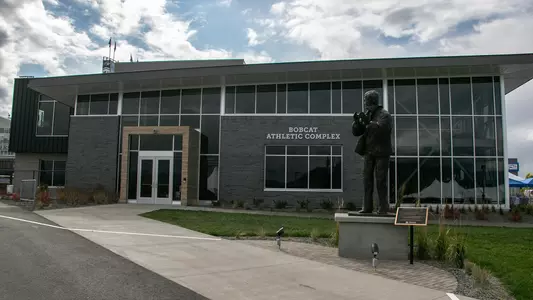
BOZEMAN, Montana – Montana State University opened the Bobcat Athletic Complex in the north end zone of its football stadium Friday, a celebratory event that certainly stands as an emblem of a strong and proud football program while offering great things for all Bobcat student-athletes.
The BAC's opening creates a new icon for the Bobcat football program while positively impacting every MSU student-athlete by creating space in Brick Breeden Fieldhouse for use by athletic academic services and also meeting space for all the programs teams. It's also the latest phase in the evolution of the Bobcat football team's facilities. Here is an overview of the long history of MSU's football fields.
Butler of College Field, 1897-1905: Somewhere near the present corner of 11th and College Streets, Butler Field ran north and south, and the further south the field went the more uphill it was. An early edition of UM's Kaimin quipped that the Varsity practiced at the foot of Mt. Sentinel to replicate playing conditions at the College. Fairgrounds, 1903-14: MAC played most of its games in this era on a dirt field that ran through the parking lot that currently serves Heroes Field, home of the American Legion Bozeman Bucks baseball program. Players dressed on campus or behind the field's bleachers. Brewer and Original Gatton Field, 1915-22: Named first for William F. Brewer, a long-time campus icon who helped organize football as a campus activity as early as 1896, and then for fallen World War I flying ace and one-time Bobcat star Cy Gatton, sat just south of old Butler Field. It ran east and west and was the first playing field to fall inside the campus' boundaries. Its completion necessitated covering 9th Street, and the northwest corner of the field butted up against the school's old Barracks, where its military program was housed. Roundup Stadium, 1919-20: After World War I, Bozeman constructed a large arena near the Fairgrounds to host rodeos it hoped would rival Frontier Days and the Calgary Stampede. The Bobcats, as the football team was now called, roared to a 3-0-2 record there, which included a 6-6 tie with UM in 1919. Temporary Gatton Field, 1923-29: With talk beginning of building a permanent facility to house its outdoor sports teams, Montana State College moved its football field about a block south to take advantage of better grass. The playing surface was an upgrade, and the field ran from 8th Street on the east between Cleveland and Harrison Streets on the north and south. Gatton Field, 1930-71: The first truly permanent home of Bobcat Football was widely celebrated, but didn't necessarily usher in an era of success. It paralleled Grant Street just south of the school's newly-constructed gymnasium, now known and loved as Romney Gym. The school's most glorious era of football began when Tony Storti revived the program in the early 1950s. From the beginning of 1956 until the stadium closed, the Cats were 48-16-2 at Gatton Field. The stadium's brick gate remains as a campus icon on Grant Street in front of the school's rec complex. Van Winkle Stadium, 1972: Montana State won its fifth Big Sky crown at Bozeman High's stadium in 1972, while its second permanent stadium was under construction. Reno H. Sales/Bobcat Stadium: Named for benefactor and early Montana State grad Reno Sales, who was a member of the school's first football team, this scaled down version of an earlier proposal was a beautiful venue for its time and level. Until its major renovation in 1998, the Cats won two national championships and claimed or shared four league titles at Reno H. Sales Stadium. The renovation of 1998 spurred the success MSU has enjoyed in the 21st century, including league crowns in 2002-03, 2005, and 2010-12. FieldTurf and lights modernized the stadium in 2008, and the Sonny Holland End Zone expanded seating to 17,777 in2011.
* * * * *
Today may finally be the day that Tyrel Thomas makes his 2021 debut. "He could have played last week," defensive coordinator Freddie Banks said and head coach Brent Vigen confirmed. Thomas has battled an injury since the summer, and the extra week of rest has the senior cornerback primed to burst into the new era of Bobcat football after the 2020 season was canceled. The only other change in status today is freshman receiver Andrew Patterson, who enters today as questionable.
* * * * *
Cal Poly may have lost four of its five games in 2021, and seven of eight since head coach Tim Walsh walked away after the 2019 season, but there's one name that has the attention of everyone devoted to the Blue and Gold. Cal Poly coach Beau Baldwin was 7-2 against the Bobcats as Eastern Washington's head coach from 2008-16, but his success against the Bobcats reaches back even further. He was part of the Central Washington coaching staff that fell to the Bobcats in 1995 but was also a CWU assistant when the Wildcats upset MSU in 2002. One year later he was Eastern's offensive coordinator, and he won all four matchups with MSU in that capacity. After spending 2007 as Central Washington's head coach he returned to EWU as head coach in 2008. After the 2016 season, Baldwin became an assistant coach at Cal. In 2020, he accepted the role as head coach at Cal Poly.
* * * * *
Looking for other names that conjure bad memories for Bobcat fans? Offensive coordinator Nick Edwards, quarterbacks coach Erik Meyer, defensive coordinator JC Sherritt all played at Eastern. Pula Wulff was the head coach at Eastern Washington and Washington State. Running backs coach James Montgomery played for Washington State in 2010 when the Cougs nipped MSU.
* * * * *
The only previous meeting contest with Cal Poly serving as Montana State's Homecoming foe was 2015, when the Bobcats ended an eight-game Mustangs win streak in the series with an easy 45-28 win over Tim Walsh's outfit. That began MSU's current three-game streak in the series.
#GoCatsGo
The BAC's opening creates a new icon for the Bobcat football program while positively impacting every MSU student-athlete by creating space in Brick Breeden Fieldhouse for use by athletic academic services and also meeting space for all the programs teams. It's also the latest phase in the evolution of the Bobcat football team's facilities. Here is an overview of the long history of MSU's football fields.
Butler of College Field, 1897-1905: Somewhere near the present corner of 11th and College Streets, Butler Field ran north and south, and the further south the field went the more uphill it was. An early edition of UM's Kaimin quipped that the Varsity practiced at the foot of Mt. Sentinel to replicate playing conditions at the College. Fairgrounds, 1903-14: MAC played most of its games in this era on a dirt field that ran through the parking lot that currently serves Heroes Field, home of the American Legion Bozeman Bucks baseball program. Players dressed on campus or behind the field's bleachers. Brewer and Original Gatton Field, 1915-22: Named first for William F. Brewer, a long-time campus icon who helped organize football as a campus activity as early as 1896, and then for fallen World War I flying ace and one-time Bobcat star Cy Gatton, sat just south of old Butler Field. It ran east and west and was the first playing field to fall inside the campus' boundaries. Its completion necessitated covering 9th Street, and the northwest corner of the field butted up against the school's old Barracks, where its military program was housed. Roundup Stadium, 1919-20: After World War I, Bozeman constructed a large arena near the Fairgrounds to host rodeos it hoped would rival Frontier Days and the Calgary Stampede. The Bobcats, as the football team was now called, roared to a 3-0-2 record there, which included a 6-6 tie with UM in 1919. Temporary Gatton Field, 1923-29: With talk beginning of building a permanent facility to house its outdoor sports teams, Montana State College moved its football field about a block south to take advantage of better grass. The playing surface was an upgrade, and the field ran from 8th Street on the east between Cleveland and Harrison Streets on the north and south. Gatton Field, 1930-71: The first truly permanent home of Bobcat Football was widely celebrated, but didn't necessarily usher in an era of success. It paralleled Grant Street just south of the school's newly-constructed gymnasium, now known and loved as Romney Gym. The school's most glorious era of football began when Tony Storti revived the program in the early 1950s. From the beginning of 1956 until the stadium closed, the Cats were 48-16-2 at Gatton Field. The stadium's brick gate remains as a campus icon on Grant Street in front of the school's rec complex. Van Winkle Stadium, 1972: Montana State won its fifth Big Sky crown at Bozeman High's stadium in 1972, while its second permanent stadium was under construction. Reno H. Sales/Bobcat Stadium: Named for benefactor and early Montana State grad Reno Sales, who was a member of the school's first football team, this scaled down version of an earlier proposal was a beautiful venue for its time and level. Until its major renovation in 1998, the Cats won two national championships and claimed or shared four league titles at Reno H. Sales Stadium. The renovation of 1998 spurred the success MSU has enjoyed in the 21st century, including league crowns in 2002-03, 2005, and 2010-12. FieldTurf and lights modernized the stadium in 2008, and the Sonny Holland End Zone expanded seating to 17,777 in2011.
* * * * *
Today may finally be the day that Tyrel Thomas makes his 2021 debut. "He could have played last week," defensive coordinator Freddie Banks said and head coach Brent Vigen confirmed. Thomas has battled an injury since the summer, and the extra week of rest has the senior cornerback primed to burst into the new era of Bobcat football after the 2020 season was canceled. The only other change in status today is freshman receiver Andrew Patterson, who enters today as questionable.
* * * * *
Cal Poly may have lost four of its five games in 2021, and seven of eight since head coach Tim Walsh walked away after the 2019 season, but there's one name that has the attention of everyone devoted to the Blue and Gold. Cal Poly coach Beau Baldwin was 7-2 against the Bobcats as Eastern Washington's head coach from 2008-16, but his success against the Bobcats reaches back even further. He was part of the Central Washington coaching staff that fell to the Bobcats in 1995 but was also a CWU assistant when the Wildcats upset MSU in 2002. One year later he was Eastern's offensive coordinator, and he won all four matchups with MSU in that capacity. After spending 2007 as Central Washington's head coach he returned to EWU as head coach in 2008. After the 2016 season, Baldwin became an assistant coach at Cal. In 2020, he accepted the role as head coach at Cal Poly.
* * * * *
Looking for other names that conjure bad memories for Bobcat fans? Offensive coordinator Nick Edwards, quarterbacks coach Erik Meyer, defensive coordinator JC Sherritt all played at Eastern. Pula Wulff was the head coach at Eastern Washington and Washington State. Running backs coach James Montgomery played for Washington State in 2010 when the Cougs nipped MSU.
* * * * *
The only previous meeting contest with Cal Poly serving as Montana State's Homecoming foe was 2015, when the Bobcats ended an eight-game Mustangs win streak in the series with an easy 45-28 win over Tim Walsh's outfit. That began MSU's current three-game streak in the series.
#GoCatsGo

Players Mentioned
WR
/ Football
CB
/ FootballLeon Costello Press Conference: Kennedy-Stark Athletic Center
Thursday, July 31
A Conversation with President Dr. Waded Cruzado | Montana State Athletics
Monday, May 19
Big Cats, Little Trucks - Willie Patterson
Wednesday, May 03
Matt Houk Introductory Press Conference
Wednesday, May 03