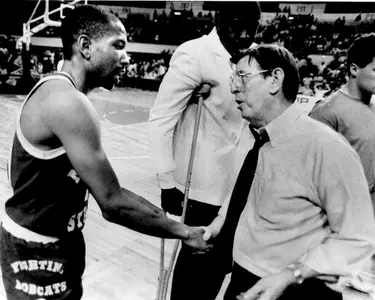
Tony Hampton and St. John's coach Lou Carnesecca
BOBCAT ATHLETICS HALL OF FAME: The Success of MSU's 1985-86/1986-87 Basketball Teams Resounds in Bobcat Program Still
2/21/2020 1:09:00 PM | General, Men's Basketball
Montana State won the 1985-86 Big Sky Tournament title and the 1986-87 regular season crown
BOZEMAN, Montana – Stu Starner saw it coming, but in a rare admission for a coach he is adamant that the fans were first.
"We sure could" feel great things coming for his Montana State men's basketball program in the winter of 1985-86, "and people in the community realized it before we did that something special was happening with this team." The 1985-86 Big Sky Tournament Championship team and the 1986-87 Big Sky regular season champions will be inducted into the Bobcat Athletics Hall of Fame on Friday.
In many ways, Starner took over a Bobcat basketball program built for the 1970s when he became head coach in the fall of 1983. "We were big and slow," Starner said of his first couple of MSU teams, reliant on post play and a deliberate style. "The first two years that's what I had," Starner said, "so we played (through the) low post because that's who we were. We did not have speed and we couldn't run the court."
Starner's first team finished 7-7 in the Big Sky and the next year MSU was 6-8. But the process of reforming the program had begun. "We made the decision as we began recruiting that we were going to change how we played the game," Starner said of the plan he laid out with his coaching staff, which included Mick Durham and Ron Anderson from the beginning and later Jerry Olson and John Jurgenson. "Tony Hampton was the first player that I recruited, and he was the only real fast guy on the team. Jeff Epperly from Kalispell was a wing and a pretty good player, but we weren't getting up and down the court. Then we picked up Kral (Ferch) a year later, and Ray (Willis Jr.) and Tom Domako came in and played early, and all of a sudden we were no longer big and we were no longer slow."
By 1985-86 the transformation was complete. Hampton ran the operation as the point guard, Willis was a stylistic guard, Ferch was a high-flying forward about whom songs were sung in Bozeman, and Domako was a brilliant blend of perimeter sharp-shooting and rebounding production. Greg Walters, a player legendary coach and broadcaster Al McGuire would have called "an aircraft carrier," planted his 7-0, 240 lb frame in the paint and provided rim protection, rebounding, and inside scoring. Add in redshirts Mike Fellows and Michael Ligons, blend in six new freshmen, and Starner was now pleased with the possibilities.
"Collectively as a staff we went to four-man motion (on offense), which was four out," he said. "Greg Walters was a big guy who redshirted, but we went through a change of matching up how we were going to play with the kind of player we were recruiting. As a result of that we were in a total rebuild. We had two seniors (in 1985-86), Tony Hampton and Greg Walters, we had one junior, Kral Ferch, we had two sophomores, Domako and Willis, and we had six freshmen. So we were picked bottom-ish (in the Big Sky), as we should have been, because we were in a total transition of how we were playing the game and how we were recruiting."
That transition was a carefully-orchestrated match of his newly-configured roster and external factors. The 1985-86 season saw two rule changes that impacted the game greatly, and the Bobcats were on the vanguard the game's new style. Nationally, the NCAA introduced a 45-second shot clock. In a day and age when North Carolina was famous for the four-corners offense, just a decade after teams took the air out of the ball regularly against Idaho State's suffocating zone defense, this change was impactful. The second was even more so. A handful of leagues used an experimental three-point line.
"Along with us switching to a totally perimeter game and running and pressing, the NCAA allowed conferences to experiment with (the three-point line)," Starner said. "The Big Sky experimented with the three-point line, and that was very much to our benefit. Most coaches were cursing it, saying 'I'll never do that,' but we embraced it. That was a big deal, and it fit who we were."
Nowhere did the contrast of the new style and the old emerge than the Cat-Griz rivalry. Playing the Jud Heathcoate-inspired mix of tough defense, often a zone, and deliberate, physical, inside-oriented offense that emphasized high-percentage shots, Montana utilized discipline, structure, and size. The Bobcats did not. Montana State used smaller players, moved the basketball around the perimeter in order to create open shots, often from deep, and thrived on an up-tempo game. That was appropriate at the school that pioneered 'racehorse basketball' even before the Golden Bobcats era of the 1920s.
The Bobcats struggled through a difficult December, winning only four of their 11 games before the Big Sky campaign began. "We played a tough schedule, as you do here in the non-conference, but we were playing good basketball and losing close games," Starner said. "We started early on drawing amazingly for that time. People were coming to games. Part of it was how we were playing, and people really identified with our players, especially the Ferches, who were very, very good." The Cats also drew some intriguing, talented opponents to Bozeman. More than 4,300 fans came out to watch Kevin Johnson's Cal Bears beat the Bobcats 69-62, and Nebraska won 76-59 in the Fieldhouse in front of nearly 5,000 fans. In MSU's marquee non-league win, the Cats topped Paul Westhead's Loyola Marymount squad.
The early league season mirrored the non-conference portion of the schedule, with the Bobcats struggling on the road but finding traction in the Fieldhouse. MSU beat Idaho State, Weber State and NAU at home, but after losing to Weber State on Valentine's Day and Idaho State the next night, MSU stood 4-8 in Big Sky action. But the 88-74 loss at Montana was MSU's only defeat by more than 10 points. With four games remaining in the regular season, Montana State beat lost a close game at home to Idaho but blew out Boise State 95-65. That set up an important regular season finale against the Grizzlies.
Emotions ran high, and in front of a packed house in the Fieldhouse Domako scored 29 points and Walters grabbed 10 boards to lead Montana State to a solid 88-76 win. "We beat the Grizzlies two out of three times (in 1985-86), we beat them twice in a week, and they had overpowering inside guys led by (All-America Larry) Krystkowiak. We beat them convincingly here the last game of the season."
Montana State's run through the Big Sky Tournament was pure magic, but it almost didn't get past the first night. Nevada's Rob Harden hit two three-pointers in the first-round game's final 30 seconds to give the Wolf Pack an 80-79 lead, but the game's official play-by-play recounted the closing moments: "Hampton lets fly off balance J from 12… great individual play goes through off glass to send Montana State to semi-finals! HAMPTON'S SHOT STUNS THIS CROWD, WHICH WAS CONVINCED THAT ROB'S BOMB WAS GOINGTO SEND THE PACK TO THE SEMIS…PAST TWO-TIME CHAMP UNR FALLS TO BOBCATS 81-80 AT BUZZER!"
There was less drama the next night against top-seeded NAU, when Walters, Willis and Kral Ferch made consecutive baskets midway through the second half to give MSU a lead it would hold for all but 20 seconds the rest of the way. Kral Ferch finished with 29 points and Hampton scored seven of MSU's last 15 points to boost the Bobcats into the league finals against their arch-enemy, Montana.
Since Heathcote's arrival in 1971 Montana had resided at or near the top of the Big Sky. But coach Mike Montgomery had never led UM to the NCAA Tournament, and Krystkowiak had never played in the Big Dance. This Cat-Griz showdown in Reno for the Big Sky Championship would prove to be the last chance for both, as Krystkowiak was a senior and Montgomery, as it turned out, was soon to take over the Stanford program.
Krystkowiak scored 30 points in that championship game to lead all players, but Kral Ferch scored 28 and Tony Hampton added 27 and Montana State stunned the Grizzlies 82-77. "We beat the Grizzlies here pretty convincingly (to close the regular season), and there was a feeling that they didn't want to face us again," Starner said. Montana State hit nine of their 15 three-point tries, while Montana made only three of 11. "The three-point shot was definitely to our advantage" in that Championship win, according to Starner. It was definitely an equalizer, helping the Cats overcome UM's inside effort, which provided UM 40 of its 77 points. The Cats scored 27 of their 82 points behind the arc.
Even though the Bobcats lost to St. John's 83-74 in the NCAA Tournament at Long Beach, California, it was a positive step in the program's development. St. John's star Walter Berry scored 31 points, but Kral Ferch scored 20 points in a starring role and made highlight reels with a thunderous dunk over Berry that Bobcat fans still discuss. The game was close throughout, proving correct a hunch the coaching staff. "(The coaches) had watched video tape (of St. John's) separately, and when we got together we all had the same feeling, that we had a chance in this game." The game remained competitive throughout, with SJU holding a double-digit lead for less than four minutes of game time.
The Cats returned with what Starner called "a primo team" in 1986-87, and the Bobcats didn't disappoint. MSU finished the non-conference portion of the schedule 9-4, and the Cats won their first nine Big Sky outings. The Bobcats lost game 10 at NAU, then won three more in a row before a loss at Boise State. The Bobcats then won 96-86 in Missoula to close the regular season and enter the Big Sky Tournament as the top seed.
But at this point, the Bobcats encountered an unfortunate twist of their own making. Northern Arizona had earned the top seed in the 1985-86 tournament because the Bobcats beat the Grizzlies in the regular season finale. That pushed UM and NAU into a tie, and the Lumberjacks held the tie-breaker. The consequence that was little-considered in real time was that Northern Arizona would host the 1987 Big Sky Tournament. That, Starner said, worked against the Cats. "We always struggled to play at Flagstaff, it's just a really difficult place to play," Starner said. His teams lost six of the eight games they played in Flagstaff. "Had the (1986-87) tournament been in Missoula, which would have been more favorable for us."
After beating Weber State 88-83 in Ogden and 108-78 in Bozeman, the Bobcats faltered in the unfriendly environs of the Walkup Skydome. Willis' 24 points wasn't enough in what Starner called "a crazy game." Montana State earned a berth to the NIT, but Christian Welp's late basket sank the Bobcats, and the team's amazing run was over. The Bobcats continued to play good and exciting basketball, and the team finished third in the league in 1987-88 with a 19-11 overall record, 10-6 in the Big Sky. Tom Domako earned league MVP honors in 1987, and as seniors in 1988 he, Willis, Chris Conway and Steve Snodgrass were the links to the championship era whose careers came to an end.
But the legacy of the two championship teams stayed with the Bobcat program for many years. Under Mick Durham, a former Bobcat guard who took over for Starner as head coach in 1990, the Cats continued to emphasize up-tempo basketball and three-point shooting. That continues to this day under Danny Sprinkle, one of Durham's key recruits. And Starner remains a familiar presence around the Bobcat basketball program, a constant reminder of the program's legacy and the 1985-86 and 1986-87 teams' role.
"We sure could" feel great things coming for his Montana State men's basketball program in the winter of 1985-86, "and people in the community realized it before we did that something special was happening with this team." The 1985-86 Big Sky Tournament Championship team and the 1986-87 Big Sky regular season champions will be inducted into the Bobcat Athletics Hall of Fame on Friday.
In many ways, Starner took over a Bobcat basketball program built for the 1970s when he became head coach in the fall of 1983. "We were big and slow," Starner said of his first couple of MSU teams, reliant on post play and a deliberate style. "The first two years that's what I had," Starner said, "so we played (through the) low post because that's who we were. We did not have speed and we couldn't run the court."
Starner's first team finished 7-7 in the Big Sky and the next year MSU was 6-8. But the process of reforming the program had begun. "We made the decision as we began recruiting that we were going to change how we played the game," Starner said of the plan he laid out with his coaching staff, which included Mick Durham and Ron Anderson from the beginning and later Jerry Olson and John Jurgenson. "Tony Hampton was the first player that I recruited, and he was the only real fast guy on the team. Jeff Epperly from Kalispell was a wing and a pretty good player, but we weren't getting up and down the court. Then we picked up Kral (Ferch) a year later, and Ray (Willis Jr.) and Tom Domako came in and played early, and all of a sudden we were no longer big and we were no longer slow."
By 1985-86 the transformation was complete. Hampton ran the operation as the point guard, Willis was a stylistic guard, Ferch was a high-flying forward about whom songs were sung in Bozeman, and Domako was a brilliant blend of perimeter sharp-shooting and rebounding production. Greg Walters, a player legendary coach and broadcaster Al McGuire would have called "an aircraft carrier," planted his 7-0, 240 lb frame in the paint and provided rim protection, rebounding, and inside scoring. Add in redshirts Mike Fellows and Michael Ligons, blend in six new freshmen, and Starner was now pleased with the possibilities.
"Collectively as a staff we went to four-man motion (on offense), which was four out," he said. "Greg Walters was a big guy who redshirted, but we went through a change of matching up how we were going to play with the kind of player we were recruiting. As a result of that we were in a total rebuild. We had two seniors (in 1985-86), Tony Hampton and Greg Walters, we had one junior, Kral Ferch, we had two sophomores, Domako and Willis, and we had six freshmen. So we were picked bottom-ish (in the Big Sky), as we should have been, because we were in a total transition of how we were playing the game and how we were recruiting."
That transition was a carefully-orchestrated match of his newly-configured roster and external factors. The 1985-86 season saw two rule changes that impacted the game greatly, and the Bobcats were on the vanguard the game's new style. Nationally, the NCAA introduced a 45-second shot clock. In a day and age when North Carolina was famous for the four-corners offense, just a decade after teams took the air out of the ball regularly against Idaho State's suffocating zone defense, this change was impactful. The second was even more so. A handful of leagues used an experimental three-point line.
"Along with us switching to a totally perimeter game and running and pressing, the NCAA allowed conferences to experiment with (the three-point line)," Starner said. "The Big Sky experimented with the three-point line, and that was very much to our benefit. Most coaches were cursing it, saying 'I'll never do that,' but we embraced it. That was a big deal, and it fit who we were."
Nowhere did the contrast of the new style and the old emerge than the Cat-Griz rivalry. Playing the Jud Heathcoate-inspired mix of tough defense, often a zone, and deliberate, physical, inside-oriented offense that emphasized high-percentage shots, Montana utilized discipline, structure, and size. The Bobcats did not. Montana State used smaller players, moved the basketball around the perimeter in order to create open shots, often from deep, and thrived on an up-tempo game. That was appropriate at the school that pioneered 'racehorse basketball' even before the Golden Bobcats era of the 1920s.
The Bobcats struggled through a difficult December, winning only four of their 11 games before the Big Sky campaign began. "We played a tough schedule, as you do here in the non-conference, but we were playing good basketball and losing close games," Starner said. "We started early on drawing amazingly for that time. People were coming to games. Part of it was how we were playing, and people really identified with our players, especially the Ferches, who were very, very good." The Cats also drew some intriguing, talented opponents to Bozeman. More than 4,300 fans came out to watch Kevin Johnson's Cal Bears beat the Bobcats 69-62, and Nebraska won 76-59 in the Fieldhouse in front of nearly 5,000 fans. In MSU's marquee non-league win, the Cats topped Paul Westhead's Loyola Marymount squad.
The early league season mirrored the non-conference portion of the schedule, with the Bobcats struggling on the road but finding traction in the Fieldhouse. MSU beat Idaho State, Weber State and NAU at home, but after losing to Weber State on Valentine's Day and Idaho State the next night, MSU stood 4-8 in Big Sky action. But the 88-74 loss at Montana was MSU's only defeat by more than 10 points. With four games remaining in the regular season, Montana State beat lost a close game at home to Idaho but blew out Boise State 95-65. That set up an important regular season finale against the Grizzlies.
Emotions ran high, and in front of a packed house in the Fieldhouse Domako scored 29 points and Walters grabbed 10 boards to lead Montana State to a solid 88-76 win. "We beat the Grizzlies two out of three times (in 1985-86), we beat them twice in a week, and they had overpowering inside guys led by (All-America Larry) Krystkowiak. We beat them convincingly here the last game of the season."
Montana State's run through the Big Sky Tournament was pure magic, but it almost didn't get past the first night. Nevada's Rob Harden hit two three-pointers in the first-round game's final 30 seconds to give the Wolf Pack an 80-79 lead, but the game's official play-by-play recounted the closing moments: "Hampton lets fly off balance J from 12… great individual play goes through off glass to send Montana State to semi-finals! HAMPTON'S SHOT STUNS THIS CROWD, WHICH WAS CONVINCED THAT ROB'S BOMB WAS GOINGTO SEND THE PACK TO THE SEMIS…PAST TWO-TIME CHAMP UNR FALLS TO BOBCATS 81-80 AT BUZZER!"
There was less drama the next night against top-seeded NAU, when Walters, Willis and Kral Ferch made consecutive baskets midway through the second half to give MSU a lead it would hold for all but 20 seconds the rest of the way. Kral Ferch finished with 29 points and Hampton scored seven of MSU's last 15 points to boost the Bobcats into the league finals against their arch-enemy, Montana.
Since Heathcote's arrival in 1971 Montana had resided at or near the top of the Big Sky. But coach Mike Montgomery had never led UM to the NCAA Tournament, and Krystkowiak had never played in the Big Dance. This Cat-Griz showdown in Reno for the Big Sky Championship would prove to be the last chance for both, as Krystkowiak was a senior and Montgomery, as it turned out, was soon to take over the Stanford program.
Krystkowiak scored 30 points in that championship game to lead all players, but Kral Ferch scored 28 and Tony Hampton added 27 and Montana State stunned the Grizzlies 82-77. "We beat the Grizzlies here pretty convincingly (to close the regular season), and there was a feeling that they didn't want to face us again," Starner said. Montana State hit nine of their 15 three-point tries, while Montana made only three of 11. "The three-point shot was definitely to our advantage" in that Championship win, according to Starner. It was definitely an equalizer, helping the Cats overcome UM's inside effort, which provided UM 40 of its 77 points. The Cats scored 27 of their 82 points behind the arc.
Even though the Bobcats lost to St. John's 83-74 in the NCAA Tournament at Long Beach, California, it was a positive step in the program's development. St. John's star Walter Berry scored 31 points, but Kral Ferch scored 20 points in a starring role and made highlight reels with a thunderous dunk over Berry that Bobcat fans still discuss. The game was close throughout, proving correct a hunch the coaching staff. "(The coaches) had watched video tape (of St. John's) separately, and when we got together we all had the same feeling, that we had a chance in this game." The game remained competitive throughout, with SJU holding a double-digit lead for less than four minutes of game time.
The Cats returned with what Starner called "a primo team" in 1986-87, and the Bobcats didn't disappoint. MSU finished the non-conference portion of the schedule 9-4, and the Cats won their first nine Big Sky outings. The Bobcats lost game 10 at NAU, then won three more in a row before a loss at Boise State. The Bobcats then won 96-86 in Missoula to close the regular season and enter the Big Sky Tournament as the top seed.
But at this point, the Bobcats encountered an unfortunate twist of their own making. Northern Arizona had earned the top seed in the 1985-86 tournament because the Bobcats beat the Grizzlies in the regular season finale. That pushed UM and NAU into a tie, and the Lumberjacks held the tie-breaker. The consequence that was little-considered in real time was that Northern Arizona would host the 1987 Big Sky Tournament. That, Starner said, worked against the Cats. "We always struggled to play at Flagstaff, it's just a really difficult place to play," Starner said. His teams lost six of the eight games they played in Flagstaff. "Had the (1986-87) tournament been in Missoula, which would have been more favorable for us."
After beating Weber State 88-83 in Ogden and 108-78 in Bozeman, the Bobcats faltered in the unfriendly environs of the Walkup Skydome. Willis' 24 points wasn't enough in what Starner called "a crazy game." Montana State earned a berth to the NIT, but Christian Welp's late basket sank the Bobcats, and the team's amazing run was over. The Bobcats continued to play good and exciting basketball, and the team finished third in the league in 1987-88 with a 19-11 overall record, 10-6 in the Big Sky. Tom Domako earned league MVP honors in 1987, and as seniors in 1988 he, Willis, Chris Conway and Steve Snodgrass were the links to the championship era whose careers came to an end.
But the legacy of the two championship teams stayed with the Bobcat program for many years. Under Mick Durham, a former Bobcat guard who took over for Starner as head coach in 1990, the Cats continued to emphasize up-tempo basketball and three-point shooting. That continues to this day under Danny Sprinkle, one of Durham's key recruits. And Starner remains a familiar presence around the Bobcat basketball program, a constant reminder of the program's legacy and the 1985-86 and 1986-87 teams' role.

Thursday, March 03
Friday, November 05
Monday, November 01
Sunday, October 31