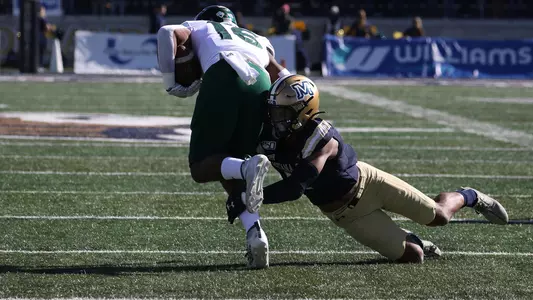
JoJo Henderson
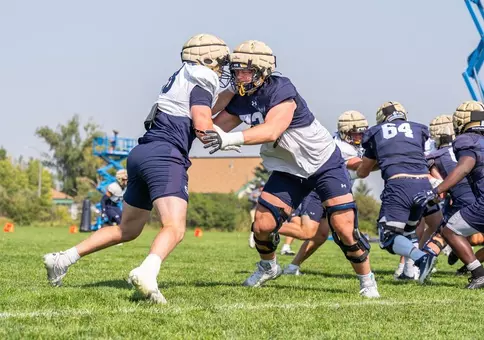
Photo by: Garrett Becker
GAME #8: Bobcats Visit North Dakota for Last League Tilt Against Fighting Hawks
10/24/2019 9:55:00 AM | Football
Montana State returns to field after bye week, faces unbeaten-at-home UND squad
BOZEMAN, Montana – In one important regard, Montana State football coach Jeff Choate says Saturday's game at North Dakota (4-3 overall) is typical of any Big Sky Conference contest.
"You turn (their video) on and this is like any Big Sky (game)," he said. "They're a lot better than you want them to be. We're going to have our hands full."
In a couple of other ways, though, this is anything but a typical conference game. For one, in spite of the fact that North Dakota is playing a Big Sky schedule, and that their games count in the league's standings for the Big Sky team, the Fighting Hawks are no longer BSC members. UND becomes a full-fledged Missouri Valley Football Conference institution next fall, playing as an FCS independent this year. Another factor that differentiates this game, Choate says, is North Dakota's persona playing inside the Alerus Center, it's home venue.
"They're playing very, very well at home," he says, and results strongly back that point. North Dakota is 3-0 at home, with wins against nationally-ranked Sam Houston State (27-23) and UC Davis (38-36). The Fighting Hawks gain nearly 100 yards per game more than they allow at home (395.3 yards per game to 295.7) with eight takeaways and only three turnovers.
Choate says the difference between watching UND video at home versus on the road is "almost like watching two different teams at times," he said. "They look different at home. They play fast, confident, you can tell they feed off that crowd, it's an impressive looking group."
Sixth-year UND coach Bubba Schweigert has built his program from the line of scrimmage out, a philosophy that mirrors Choate's, and that draws the Bobcat head coach's admiration. "Coach Schweigert has an identity there," Choate said, "defensively in particular. They've really been the same group. This will be the third time that we've played them in my four years here, the second time we've gone over there, and it's a tough environment."
Linebacker Donnell Rodgers (74 total tackles, 5.5 behind the line of scrimmage) leads a defense that allows opponents around 10 offensive plays per game less than the Fighting Hawks run. North Dakota's eight takeaways in 2019 have all come at home.
"I just like watching this team play defense because they play hard," Choate said. "They run to the ball. The inside linebacker (Donnell Rodgers) is their leading tackler and that guy is a sideline-to-sideline player. He's 6-foot-1, 238 lbs, and he's physical. You can tell these guys are coached the right way, great passion for the game, I really enjoy watching this group play."
North Dakota's defensive philosophy is built on creating negative plays, borne out by the team's 37 tackles-for-loss. "They create a lot of problems for you because of their pre- and post-snap movement," Choate said. "They'll stem a bunch pre-snap, and post-snap they'll do a lot of stunting and moving. (They have) about a 34-35 percent blitz percentage. You get into a pass game against them, you don't want to do that. I think UC Davis is a prime example of that. (Against) the drop-back pass game they're going to get their hits on the quarterback, they're going to create problems. They're a very good tackling team, and not just the front seven. Their DBs tackle well. You don't get a ton of big plays, you have to earn it against this group."
Behind the emergence of quarterback Nate Ketteringham, who transferred from Sacramento State to North Dakota before the 2017 season, the Fighting Hawks have added a dynamic passing element to the program's bedrock ground-and-pound philosophy. Ketteringham throws for 247.2 yards a game, completing 62.2 percent of his passes. "Offensively they're very multiple," Choate says, "much more so than they have been in the past. In the past you'd get a lot of the unbalanced sets, extra offensive linemen, very heavy in the run game. They're still committed to running the football, but they're more balanced. They do a nice job of managing the perimeter. Ketteringham does a really good job of box counting and if he likes the numbers advantage on the perimeter of the offense he's going to get the ball out there."
Ketteringham's favorite targets are receivers Noah Wanzek (39 catches, 495 yards, two touchdowns) and Garrett Maag (34 catches, 368 yards, three touchdowns). Choate said UND's receivers contribute in all phases of the team's offense. "They've got a big, physical receiver corps that creates matchup problems for a lot of teams, especially in the red zone. They'll hit a lot of back-shoulder fades. I think all three of their starting receivers are listed at 6-4, so it creates matchup problems, not just in the pass game but because those guys are so big they're so good at blocking on the perimeter of their offense."
The running back tandem of James Johannesson (79 rushes, 368 yards, six touchdowns) and Dalton Gee (40 carries, 197 yards, one touchdown) account for 119 of the team's 216 rushes and 565 of UND's 870 yards on the ground. They operate behind what Choate calls a "big, physical" offensive line "as they always have at the University of North Dakota under Coach Schweigert… They've got a one-two punch at running back. (James Johannesson) is a load, man, there's some guys making business decisions when he comes through the hole. (Dalton Gee) is a little more of a complete back, I wouldn't say he's a scat-back because he's a 6-foot, 195 lb guy, but they do use him a little more in the pass game. I like their balance on offense."
While North Dakota enters Saturday's game after a 30-26 win at Cal Poly, Montana State (5-2 overall, 2-1 Big Sky) had its open week to recover from a 34-21 home loss to Sacramento State. Choate said MSU's staff used the extra time on self-scouting. "The coordinators stuck around and we dug in on Sunday and Monday really hard and looked at us," he said. "Every team develops tendencies, play-callers develop tendencies, and I think you have to look at that and see it for what it is. You've got to recognize that those are the calls that are dictated by the game situation. Everybody kind of is who they are by midway through the season, and you can't really re-invent yourself, but you've got to be self-aware. You've got to be willing to adjust, and that was a big part of the emphasis the first part of the week."
Choate also indicated that improved health may also be a benefit of the time not in game preparation, but less than many may think. "At this stage, there are certain guys that are going to play with what they have. It's probably not going to get a lot better until they get a couple of weeks off at the end of the season. We're not unlike anybody else. Everybody's got nicks and bruises and dings."
The Bobcat offense has made strides with sophomore Tucker Rovig behind center. MSU averages 67 offensive yards per FCS game with Rovig operating the offense, and he throws for 151.2 yards a game and completes 59.0 percent of his passes. The Bobcats remain a run-oriented team, with 62.6 percent of its plays from scrimmage on the ground. MSU averages 5.5 yards per rush and 247.0 rushing yards a game.
That production has come from many sources, with senior Logan Jones the lone constant. He leads the team with 70 carries and 476 rushing yards, and he and Troy Andersen have each crossed the goal line five times. Sophomore Isaiah Ifanse has been slowed by injury, but when healthy he averages 7.0 yards a carry and 65.0 yards per game. Andersen, a junior who has played primarily linebacker, also chips in 27.3 yards a game, and the duo that Choate affectionately calls the "bowling balls" – sophomores Lane Sumner and Shane Perry – combine to chip in about 50 yards a game.
Facing opponents that rely on the run-ass option (Sacramento State), the triple option (Cal Poly) and the quick pass game (NAU), Montana State's pass rush has been somewhat mitigated. The Cats have three sacks in the last four games (all against Cal Poly) after logging 12 in the team's first four games. North Dakota's run-pass option presents a similar challenge, and Choate said that's been a focus for the Bobcat staff. "Getting creative with what we're doing in terms of our pre-snap looks has got to be something (improve) at. That was a focus for us in our bye week, because we're going to see other teams that do this. That's the evolution you can see of the UND offense."
Offensively, Choate said the team concentrated on cleaning up blocking assignments, not just related to offensive linemen but running backs and tight ends. Mistakes in those areas, Choate said, have inhibited the run game while limiting effectiveness in the pass game. "You can't have those self-inflicted wounds against a good team. Some of it is matchup-related, but we have things to clean up."
Saturday's showdown with North Dakota may be the last one scheduled between the occasional rivals, but Choate said it is not one his team will take lightly. "It's a conference game for us. I pointed that out to our players on Sunday to make sure they understand the significance of this game for us. I also pointed out that there's been a couple teams that rolled out there to North Dakota and maybe not understood the importance of that and paid the price. This is a huge, huge game for us. A huge game for us, in terms of coming off the bye week, getting that taste out of our mouth from the Sacramento State game."
Kickoff is 11 am MT. The game is televised on ABC stations across Montana, and on SWX in Billings.
"You turn (their video) on and this is like any Big Sky (game)," he said. "They're a lot better than you want them to be. We're going to have our hands full."
In a couple of other ways, though, this is anything but a typical conference game. For one, in spite of the fact that North Dakota is playing a Big Sky schedule, and that their games count in the league's standings for the Big Sky team, the Fighting Hawks are no longer BSC members. UND becomes a full-fledged Missouri Valley Football Conference institution next fall, playing as an FCS independent this year. Another factor that differentiates this game, Choate says, is North Dakota's persona playing inside the Alerus Center, it's home venue.
"They're playing very, very well at home," he says, and results strongly back that point. North Dakota is 3-0 at home, with wins against nationally-ranked Sam Houston State (27-23) and UC Davis (38-36). The Fighting Hawks gain nearly 100 yards per game more than they allow at home (395.3 yards per game to 295.7) with eight takeaways and only three turnovers.
Choate says the difference between watching UND video at home versus on the road is "almost like watching two different teams at times," he said. "They look different at home. They play fast, confident, you can tell they feed off that crowd, it's an impressive looking group."
Sixth-year UND coach Bubba Schweigert has built his program from the line of scrimmage out, a philosophy that mirrors Choate's, and that draws the Bobcat head coach's admiration. "Coach Schweigert has an identity there," Choate said, "defensively in particular. They've really been the same group. This will be the third time that we've played them in my four years here, the second time we've gone over there, and it's a tough environment."
Linebacker Donnell Rodgers (74 total tackles, 5.5 behind the line of scrimmage) leads a defense that allows opponents around 10 offensive plays per game less than the Fighting Hawks run. North Dakota's eight takeaways in 2019 have all come at home.
"I just like watching this team play defense because they play hard," Choate said. "They run to the ball. The inside linebacker (Donnell Rodgers) is their leading tackler and that guy is a sideline-to-sideline player. He's 6-foot-1, 238 lbs, and he's physical. You can tell these guys are coached the right way, great passion for the game, I really enjoy watching this group play."
North Dakota's defensive philosophy is built on creating negative plays, borne out by the team's 37 tackles-for-loss. "They create a lot of problems for you because of their pre- and post-snap movement," Choate said. "They'll stem a bunch pre-snap, and post-snap they'll do a lot of stunting and moving. (They have) about a 34-35 percent blitz percentage. You get into a pass game against them, you don't want to do that. I think UC Davis is a prime example of that. (Against) the drop-back pass game they're going to get their hits on the quarterback, they're going to create problems. They're a very good tackling team, and not just the front seven. Their DBs tackle well. You don't get a ton of big plays, you have to earn it against this group."
Behind the emergence of quarterback Nate Ketteringham, who transferred from Sacramento State to North Dakota before the 2017 season, the Fighting Hawks have added a dynamic passing element to the program's bedrock ground-and-pound philosophy. Ketteringham throws for 247.2 yards a game, completing 62.2 percent of his passes. "Offensively they're very multiple," Choate says, "much more so than they have been in the past. In the past you'd get a lot of the unbalanced sets, extra offensive linemen, very heavy in the run game. They're still committed to running the football, but they're more balanced. They do a nice job of managing the perimeter. Ketteringham does a really good job of box counting and if he likes the numbers advantage on the perimeter of the offense he's going to get the ball out there."
Ketteringham's favorite targets are receivers Noah Wanzek (39 catches, 495 yards, two touchdowns) and Garrett Maag (34 catches, 368 yards, three touchdowns). Choate said UND's receivers contribute in all phases of the team's offense. "They've got a big, physical receiver corps that creates matchup problems for a lot of teams, especially in the red zone. They'll hit a lot of back-shoulder fades. I think all three of their starting receivers are listed at 6-4, so it creates matchup problems, not just in the pass game but because those guys are so big they're so good at blocking on the perimeter of their offense."
The running back tandem of James Johannesson (79 rushes, 368 yards, six touchdowns) and Dalton Gee (40 carries, 197 yards, one touchdown) account for 119 of the team's 216 rushes and 565 of UND's 870 yards on the ground. They operate behind what Choate calls a "big, physical" offensive line "as they always have at the University of North Dakota under Coach Schweigert… They've got a one-two punch at running back. (James Johannesson) is a load, man, there's some guys making business decisions when he comes through the hole. (Dalton Gee) is a little more of a complete back, I wouldn't say he's a scat-back because he's a 6-foot, 195 lb guy, but they do use him a little more in the pass game. I like their balance on offense."
While North Dakota enters Saturday's game after a 30-26 win at Cal Poly, Montana State (5-2 overall, 2-1 Big Sky) had its open week to recover from a 34-21 home loss to Sacramento State. Choate said MSU's staff used the extra time on self-scouting. "The coordinators stuck around and we dug in on Sunday and Monday really hard and looked at us," he said. "Every team develops tendencies, play-callers develop tendencies, and I think you have to look at that and see it for what it is. You've got to recognize that those are the calls that are dictated by the game situation. Everybody kind of is who they are by midway through the season, and you can't really re-invent yourself, but you've got to be self-aware. You've got to be willing to adjust, and that was a big part of the emphasis the first part of the week."
Choate also indicated that improved health may also be a benefit of the time not in game preparation, but less than many may think. "At this stage, there are certain guys that are going to play with what they have. It's probably not going to get a lot better until they get a couple of weeks off at the end of the season. We're not unlike anybody else. Everybody's got nicks and bruises and dings."
The Bobcat offense has made strides with sophomore Tucker Rovig behind center. MSU averages 67 offensive yards per FCS game with Rovig operating the offense, and he throws for 151.2 yards a game and completes 59.0 percent of his passes. The Bobcats remain a run-oriented team, with 62.6 percent of its plays from scrimmage on the ground. MSU averages 5.5 yards per rush and 247.0 rushing yards a game.
That production has come from many sources, with senior Logan Jones the lone constant. He leads the team with 70 carries and 476 rushing yards, and he and Troy Andersen have each crossed the goal line five times. Sophomore Isaiah Ifanse has been slowed by injury, but when healthy he averages 7.0 yards a carry and 65.0 yards per game. Andersen, a junior who has played primarily linebacker, also chips in 27.3 yards a game, and the duo that Choate affectionately calls the "bowling balls" – sophomores Lane Sumner and Shane Perry – combine to chip in about 50 yards a game.
Facing opponents that rely on the run-ass option (Sacramento State), the triple option (Cal Poly) and the quick pass game (NAU), Montana State's pass rush has been somewhat mitigated. The Cats have three sacks in the last four games (all against Cal Poly) after logging 12 in the team's first four games. North Dakota's run-pass option presents a similar challenge, and Choate said that's been a focus for the Bobcat staff. "Getting creative with what we're doing in terms of our pre-snap looks has got to be something (improve) at. That was a focus for us in our bye week, because we're going to see other teams that do this. That's the evolution you can see of the UND offense."
Offensively, Choate said the team concentrated on cleaning up blocking assignments, not just related to offensive linemen but running backs and tight ends. Mistakes in those areas, Choate said, have inhibited the run game while limiting effectiveness in the pass game. "You can't have those self-inflicted wounds against a good team. Some of it is matchup-related, but we have things to clean up."
Saturday's showdown with North Dakota may be the last one scheduled between the occasional rivals, but Choate said it is not one his team will take lightly. "It's a conference game for us. I pointed that out to our players on Sunday to make sure they understand the significance of this game for us. I also pointed out that there's been a couple teams that rolled out there to North Dakota and maybe not understood the importance of that and paid the price. This is a huge, huge game for us. A huge game for us, in terms of coming off the bye week, getting that taste out of our mouth from the Sacramento State game."
Kickoff is 11 am MT. The game is televised on ABC stations across Montana, and on SWX in Billings.
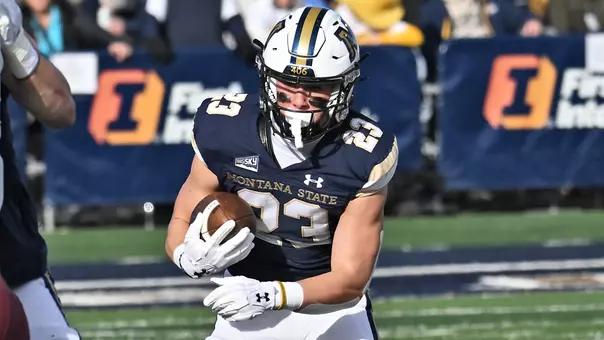
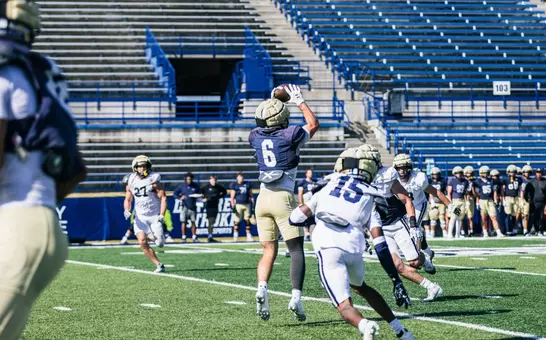
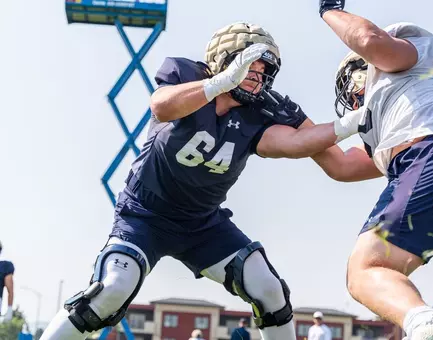
Players Mentioned

RB/LB
/ Football
RB
/ Football
RB
/ Football
RB
/ Football
QB
/ Football
RB
/ FootballThursday, July 31
Monday, May 19
Wednesday, May 03
Wednesday, May 03