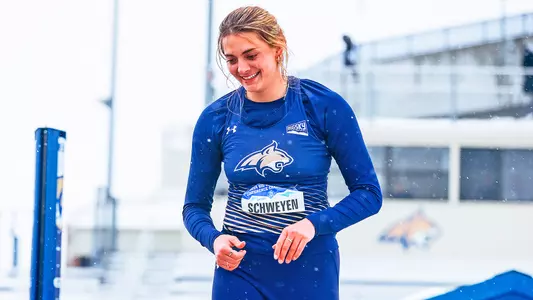
Shelby Schweyen
Photo by: Bobcat Creative Services
Shelby Schweyen Clears Hurdles On and Off Track, Competes for Heptathlon Championship TODAY!
5/9/2024 11:52:00 AM | Women's Track and Field
Former Missoula Sentinel star follows takes long way around to follow in father's footsteps at MSU
BOZEMAN, Montana – Shelby Schweyen concludes her first collegiate heptathlon on Thursday in the Big Sky Conference Outdoor Track and Field Championships in Bozeman, an event that for many years has seemed to Schweyen both inevitable and impossible.
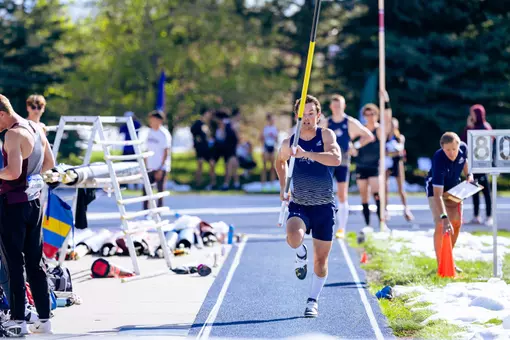
The Bobcat senior from Missoula Sentinel ran 14.56 in Wednesday's snowy 100 meter hurdles, the heptathlon's opening event, and cleared 5-foot-7 in the high jump, one-quarter inch from a personal best in that event. Beginning shortly after noon on Thursday, Schweyen finishes the multi-event competition with the long jump, javelin throw, and 800 m. From one perspective, that fulfills destiny for one of the Treasure State's most accomplished prep athletes and the daughter of two Montana sports legends (Brian Schweyen and Shannon Cate Schweyen).
From a different perspective, though, simply making it to the starting line this week is a triumph of spirit. Shelby Schweyen's body has rarely cooperated in helping her achieve the lofty potential apparent for so long, with reaching and maintaining health proving a much more severe and challenging hurdle than any she'll clear at the Bobcat Track and Field Complex this week. "My injuries," she said, "have been what's held me back and kept me from competing and training."
Five knee surgeries stand out on a list that also includes current battles with knee splints and muscle tightness, so to say the injuries are behind her would be fiction. To say she's put that aside this week, even during the frigid cold front that descended on Bozeman Wednesday, shines a light on Schweyen's inner strength, which is the point that's impossible to miss.
"It's unbelievable," MSU track and field multi-events coach Craig Hunter said of Schweyen's toughness. "The girl has had five knee surgeries, her shins hurt after every practice, she's got pulled muscles every time we do something, and she just shows up every single day and works hard."
Schweyen enjoyed one of the legendary high school athletic careers in state history, and prepared to play women's basketball for her mother, then Lady Griz basketball coach Shannon Schweyen, while competing in track and field for her father, UM's track and field coach at the time Brian Schweyen. She also was exploring the opportunity to play volleyball at UM in the fall of 2019.
"That was the plan," she says, "play all three sports." But just before her meeting with the UM volleyball staff to discuss joining the team she suffered her first knee injury. Her first surgery followed. Then, intermittently, more. She spent two seasons on the Lady Griz basketball roster, 2019-20 and 2020-21, but never played in an official game. Injuries prevented her from even participating in a single practice with the UM track squad.
Injuries that kept her from playing in games was shattering, stifling her competitive fire, but shelving Shelby Schweyen's elite athleticism by eliminating the opportunity to practice, to train, may have been worse. "It was hard mentally," she said, but after three grueling years, getting through the final surgery and to the point where rehab was possible, she made the decision to return to track and field and committing to multi-event competitions, one of her early athletic loves.
"I switched from basketball to track already with a broken body," she said, a process that played right into a growing strength. "Track, I'd say, is 80 percent mental and 20 percent physical. In my opinion it is one of the biggest mental challenges in any sport that you'll ever face. It is you against yourself every day. In the heptathlon it is a big mental challenge because if you have one event that doesn't go how you want it can affect the rest of your performance and it can be tough to stay solid through seven different events. But I would say the mental aspect of it and how hard it is on your body."
This was the moment she'd needed, and in fact had been preparing for years. She fully committed to track and field, and the environment she chose to travel that path was Montana State. This involved complete commitment mentally even more than physically, and she had the best teacher available.
"He was probably the best athlete I've ever worked with, male or female, the way he prepared," Tom Eitel, the now-retired Bobcat track and field assistant coach, says of Brian Schweyen, Shelby's father and an MSU Athletics Hall of Famer as a high jump All-America and pole vault record-holder. "He was really coordinated and picked things up really fast, and could visualize really, really well. That's why he was such a good coach. He did that better than anyone I've ever seen."
The elder Schweyen developed the technique of visualizing training and competition scenarios while battling his own injuries during his time as a Bobcat, "He was always in a lot of pain," Eitel said. "He had really bad knees. He had Osgood-Schlatter (syndrome) when he was growing up, he couldn't even touch his kneecap without going through the roof, he had a ton of pain."
"I was really limited in practice in what we could do high jumping," Brian Schweyen recalled. "It was rare that I could get much quality high jump practice, I'd just kind of save it for the meets. There were meets where I wouldn't (compete) at times and meets I could get through and not have to worry. But there was a lot of managing what you can and can't do and accomplish. For better or worse it forced me to really concentrate on the mental side of visualization and understanding how my mind and body worked together to do what it needed to without the physical reps."
Brian Schweyen advanced to the point where "you can do hundreds of reps in your head without fatiguing your body or putting yourself in a position to be injured. When done properly those can be as great a quality or better than a physical rep."
Over the course of time he introduced the concept to his daughters Shelby, her older sister Jordyn, and the youngest, Sheridan, who both enjoyed fine athleteic careers, as well. "With Shelby, we've talked about that and it's something she really had to dive into, understanding how to visualize and make it real. You have to understand every position your body has to go into and put it in a place in your head like a movie, at full speed, at slow speed, looking at different angles to see what your positions are. I think Shelby is closing in on that capability."
Shelby lauds her father for developing the mental component of her success, from the toughness and competitiveness that showed up early to the visualization techniques she has honed in recent times. "Oh, 100 percent," she said. "He built up my mental game like none other. That's definitely the thing that he's focused a lot on, because at the end of the day when you're limited in reps in practice you can always be good at (visualization) and something that can override practice reps."
Watching film is another technique that Shelby Schweyen has fully embraced. "I watch a ton of video," she said. "It's really interesting moving from playing basketball to track and field, the amount of time you spend in basketball going over film, whether it's practice film, or going over your opponent and strategizing, or going over your game film. It's a piece that's built into practice and built into the competition itself."
Without formal video sessions in the equation, she noticed the void. "When you get to track and field it was really interesting because I have so much free time because you don't have film, you don't have all the meetings. But my Dad said if you can't visualize you watch things (so) you can see it in your head. You've got to learn how things work and really understand it before you can do it. He's someone that's really helped me with that, and mom too in basketball, but definitely my dad hounding me and telling me to watch video and see this and that. I'd sit at home for hours sometimes and just scroll through my phone and watch old (track and field) videos."
Shelby Schweyen even confesses to spending time watching dramatic Olympic javelin and historic World Championship heptathlon 800 meter races. "Knowing that the hep often comes down to the 800, and that could be me, running the 800 with the chance to win, just having to lead the charge and put my head down and go as hard as I can."
In fact, she faced that scenario about 10 weeks ago at the Big Sky Indoor Championships pentathlon. "I came out of the long jump and knew I had about a 50-points lead (over Idaho's Hanna Tait), so she could beat me by about two seconds and I'd still win (the pentathlon championship). I knew I was capable of running a fast time, a time I haven't run yet," but instead of pushing the issue Schweyen opted to "not come out too hot." Rather than running to post the best time possible she ran to win. Even though she says now that she would like to have pushed the limit, she came away with a coveted Big Sky title.
"It was incredible," Hunter said of Schweyen's performance in Spokane and also of her commitment to transitioning from injury rehab and training to full-on competition last winter. "Knowing her story, coming from where she did (physically), the preseason she was having, to make that really bold decision to turn back around and say, 'This is my goal, I want to win the indoor conference, let's do it.' It was great."
Montana State's Dale Kennedy Director of Track and Field Lyle Weese, himself a former Bobcat track star, was struck by one particular element of Schweyen's championship-winning performance. "I was impressed with how confident Shelby was, especially having such limited competition opportunities for a full multi over the last few years. She went in there with a lot of confidence and ready to do great things, and that's what she did."
The 2024 Big Sky Indoor Pentathlon title also thrilled her father, but not for the reason many people thought. "People after her performance said, 'Oh, you have to be so proud of her,' and my answer was, 'I'm always proud of her,'" he said. "But I'm more proud of her perseverance and her stick-to-it-iveness to continue to do this when many other people wouldn't. So in that moment I wasn't more proud of her, because I always am, I was just absolutely elated and excited for her to finally feel some type of success after all these years of not being able to compete."
Lost in the excitement of the indoor conference championship and the leadup to competing for an outdoor title on her home track, at the complex where her father built his legacy and a legendary Bobcat career, is the new this all is to Shelby Schweyen. She's never completed a heptathlon, hasn't long jumped since high school, and she's run only a handful of competitive 100 m hurdles and 800 m in the last two years.
"Getting into the multis, there's a lot of events I'd never done," she said. "I'd never done hurdles, I just ran my second hurdle race a couple weeks ago so it's something I'm still very inexperienced in. I hadn't done long jump since high school."
Hunter said one of Schweyen's strongest traits is her ability to fully commit. "She believed in me from day one, which is awesome," he said. "We work well together. She tells me what she needs, I tell her what I need from her, and it's been great. It seems like no matter what path we're on, whether it's training hard or having to take time off, indoor season basically just trying to get her fit or outdoor season being able to do a little more technical work, no matter what she shows up at the meet and puts it together."
Arriving at a high point of her track and field comeback, with so much on the horizon, is framed by the depths from which she's returned, she said. "I'm happy with track, it's a great sport, it's challenging. It's nice to be challenged every and not have everything be easy. I look at where I started when I was in college, I was an incredible athlete in high school and had all these accolades and accomplishments and then I got to college and after years of being out of training I was at the bottom, and it sucked. But having to work back to the top has been humbling, nonetheless, and I've learned a lot along the way and I'm happy with where I'm at."
Just as Shelby Schweyen transitioned from basketball to track and from struggling with injuries to fighting through rehab to the exhilaration of competing again, so too did she transition from the University of Montana to Montana State. "To be honest I didn't know what to expect," she said of facing her new opportunity. "I was excited to move here, excited for a change. I was a little nervous, for sure, but when I got here I was welcomed with open arms. It was about as easy a transition as I could have asked for.
"I had great staff within the athletic department," she said, "amazing staff, I couldn't be more thankful for the people that work here. We have a great group of people, for sure. I have great coaches who welcomed me in, our strength and conditioning coach is great, all over, just great people who love to be here and love their job and want to make us better. I've been very thankful for that, top to bottom throughout the athletic department."
An exercise science major with designs on medical school (and possibly a second bachelor's degree in psychology), Schweyen said the change in academic environment provided more difficulty. "Academically it was much more challenging," she said, noting difficulty in credits transferring. "It's a higher academic standard over here. I had to re-take some classes, but I know that material very well now," she laughed. "I had the hardest semester I've ever had in my life this semester, but I'm through it now. I'm planning on going to med school when it's all said and done, but I want to ride the track train as long as I can."
That train continues Thursday – as well as Friday and Saturday, when Schweyen competes in the open javelin and high jump during the Championships – and Hunter said he's looking forward to watching her rise to the occasion because of her competitive spirit. "She just knows how to compete. It comes from having competitive parents, growing up in athletics her entire life, team sports, track. She knows how to compete, she knows how to turn on that part of her brain. It's an intangible in this sport, dialing in and focusing on the exact thing you need to, and she'll do it seven times (in a heptathlon). She'll go out and give it her best no matter what."
Schweyen leads the heptathlon and Bobcat Nicola Paletti leads the decathlon heading into Thursday's muti-event finale. The decathlon and heptathlon begin at 12 noon Thursday at the Bobcat Track and Field Complex.
#GoCatsGo
The Bobcat senior from Missoula Sentinel ran 14.56 in Wednesday's snowy 100 meter hurdles, the heptathlon's opening event, and cleared 5-foot-7 in the high jump, one-quarter inch from a personal best in that event. Beginning shortly after noon on Thursday, Schweyen finishes the multi-event competition with the long jump, javelin throw, and 800 m. From one perspective, that fulfills destiny for one of the Treasure State's most accomplished prep athletes and the daughter of two Montana sports legends (Brian Schweyen and Shannon Cate Schweyen).
From a different perspective, though, simply making it to the starting line this week is a triumph of spirit. Shelby Schweyen's body has rarely cooperated in helping her achieve the lofty potential apparent for so long, with reaching and maintaining health proving a much more severe and challenging hurdle than any she'll clear at the Bobcat Track and Field Complex this week. "My injuries," she said, "have been what's held me back and kept me from competing and training."
Five knee surgeries stand out on a list that also includes current battles with knee splints and muscle tightness, so to say the injuries are behind her would be fiction. To say she's put that aside this week, even during the frigid cold front that descended on Bozeman Wednesday, shines a light on Schweyen's inner strength, which is the point that's impossible to miss.
"It's unbelievable," MSU track and field multi-events coach Craig Hunter said of Schweyen's toughness. "The girl has had five knee surgeries, her shins hurt after every practice, she's got pulled muscles every time we do something, and she just shows up every single day and works hard."
Schweyen enjoyed one of the legendary high school athletic careers in state history, and prepared to play women's basketball for her mother, then Lady Griz basketball coach Shannon Schweyen, while competing in track and field for her father, UM's track and field coach at the time Brian Schweyen. She also was exploring the opportunity to play volleyball at UM in the fall of 2019.
"That was the plan," she says, "play all three sports." But just before her meeting with the UM volleyball staff to discuss joining the team she suffered her first knee injury. Her first surgery followed. Then, intermittently, more. She spent two seasons on the Lady Griz basketball roster, 2019-20 and 2020-21, but never played in an official game. Injuries prevented her from even participating in a single practice with the UM track squad.
Injuries that kept her from playing in games was shattering, stifling her competitive fire, but shelving Shelby Schweyen's elite athleticism by eliminating the opportunity to practice, to train, may have been worse. "It was hard mentally," she said, but after three grueling years, getting through the final surgery and to the point where rehab was possible, she made the decision to return to track and field and committing to multi-event competitions, one of her early athletic loves.
"I switched from basketball to track already with a broken body," she said, a process that played right into a growing strength. "Track, I'd say, is 80 percent mental and 20 percent physical. In my opinion it is one of the biggest mental challenges in any sport that you'll ever face. It is you against yourself every day. In the heptathlon it is a big mental challenge because if you have one event that doesn't go how you want it can affect the rest of your performance and it can be tough to stay solid through seven different events. But I would say the mental aspect of it and how hard it is on your body."
This was the moment she'd needed, and in fact had been preparing for years. She fully committed to track and field, and the environment she chose to travel that path was Montana State. This involved complete commitment mentally even more than physically, and she had the best teacher available.
"He was probably the best athlete I've ever worked with, male or female, the way he prepared," Tom Eitel, the now-retired Bobcat track and field assistant coach, says of Brian Schweyen, Shelby's father and an MSU Athletics Hall of Famer as a high jump All-America and pole vault record-holder. "He was really coordinated and picked things up really fast, and could visualize really, really well. That's why he was such a good coach. He did that better than anyone I've ever seen."
The elder Schweyen developed the technique of visualizing training and competition scenarios while battling his own injuries during his time as a Bobcat, "He was always in a lot of pain," Eitel said. "He had really bad knees. He had Osgood-Schlatter (syndrome) when he was growing up, he couldn't even touch his kneecap without going through the roof, he had a ton of pain."
"I was really limited in practice in what we could do high jumping," Brian Schweyen recalled. "It was rare that I could get much quality high jump practice, I'd just kind of save it for the meets. There were meets where I wouldn't (compete) at times and meets I could get through and not have to worry. But there was a lot of managing what you can and can't do and accomplish. For better or worse it forced me to really concentrate on the mental side of visualization and understanding how my mind and body worked together to do what it needed to without the physical reps."
Brian Schweyen advanced to the point where "you can do hundreds of reps in your head without fatiguing your body or putting yourself in a position to be injured. When done properly those can be as great a quality or better than a physical rep."
Over the course of time he introduced the concept to his daughters Shelby, her older sister Jordyn, and the youngest, Sheridan, who both enjoyed fine athleteic careers, as well. "With Shelby, we've talked about that and it's something she really had to dive into, understanding how to visualize and make it real. You have to understand every position your body has to go into and put it in a place in your head like a movie, at full speed, at slow speed, looking at different angles to see what your positions are. I think Shelby is closing in on that capability."
Shelby lauds her father for developing the mental component of her success, from the toughness and competitiveness that showed up early to the visualization techniques she has honed in recent times. "Oh, 100 percent," she said. "He built up my mental game like none other. That's definitely the thing that he's focused a lot on, because at the end of the day when you're limited in reps in practice you can always be good at (visualization) and something that can override practice reps."
Watching film is another technique that Shelby Schweyen has fully embraced. "I watch a ton of video," she said. "It's really interesting moving from playing basketball to track and field, the amount of time you spend in basketball going over film, whether it's practice film, or going over your opponent and strategizing, or going over your game film. It's a piece that's built into practice and built into the competition itself."
Without formal video sessions in the equation, she noticed the void. "When you get to track and field it was really interesting because I have so much free time because you don't have film, you don't have all the meetings. But my Dad said if you can't visualize you watch things (so) you can see it in your head. You've got to learn how things work and really understand it before you can do it. He's someone that's really helped me with that, and mom too in basketball, but definitely my dad hounding me and telling me to watch video and see this and that. I'd sit at home for hours sometimes and just scroll through my phone and watch old (track and field) videos."
Shelby Schweyen even confesses to spending time watching dramatic Olympic javelin and historic World Championship heptathlon 800 meter races. "Knowing that the hep often comes down to the 800, and that could be me, running the 800 with the chance to win, just having to lead the charge and put my head down and go as hard as I can."
In fact, she faced that scenario about 10 weeks ago at the Big Sky Indoor Championships pentathlon. "I came out of the long jump and knew I had about a 50-points lead (over Idaho's Hanna Tait), so she could beat me by about two seconds and I'd still win (the pentathlon championship). I knew I was capable of running a fast time, a time I haven't run yet," but instead of pushing the issue Schweyen opted to "not come out too hot." Rather than running to post the best time possible she ran to win. Even though she says now that she would like to have pushed the limit, she came away with a coveted Big Sky title.
"It was incredible," Hunter said of Schweyen's performance in Spokane and also of her commitment to transitioning from injury rehab and training to full-on competition last winter. "Knowing her story, coming from where she did (physically), the preseason she was having, to make that really bold decision to turn back around and say, 'This is my goal, I want to win the indoor conference, let's do it.' It was great."
Montana State's Dale Kennedy Director of Track and Field Lyle Weese, himself a former Bobcat track star, was struck by one particular element of Schweyen's championship-winning performance. "I was impressed with how confident Shelby was, especially having such limited competition opportunities for a full multi over the last few years. She went in there with a lot of confidence and ready to do great things, and that's what she did."
The 2024 Big Sky Indoor Pentathlon title also thrilled her father, but not for the reason many people thought. "People after her performance said, 'Oh, you have to be so proud of her,' and my answer was, 'I'm always proud of her,'" he said. "But I'm more proud of her perseverance and her stick-to-it-iveness to continue to do this when many other people wouldn't. So in that moment I wasn't more proud of her, because I always am, I was just absolutely elated and excited for her to finally feel some type of success after all these years of not being able to compete."
Lost in the excitement of the indoor conference championship and the leadup to competing for an outdoor title on her home track, at the complex where her father built his legacy and a legendary Bobcat career, is the new this all is to Shelby Schweyen. She's never completed a heptathlon, hasn't long jumped since high school, and she's run only a handful of competitive 100 m hurdles and 800 m in the last two years.
"Getting into the multis, there's a lot of events I'd never done," she said. "I'd never done hurdles, I just ran my second hurdle race a couple weeks ago so it's something I'm still very inexperienced in. I hadn't done long jump since high school."
Hunter said one of Schweyen's strongest traits is her ability to fully commit. "She believed in me from day one, which is awesome," he said. "We work well together. She tells me what she needs, I tell her what I need from her, and it's been great. It seems like no matter what path we're on, whether it's training hard or having to take time off, indoor season basically just trying to get her fit or outdoor season being able to do a little more technical work, no matter what she shows up at the meet and puts it together."
Arriving at a high point of her track and field comeback, with so much on the horizon, is framed by the depths from which she's returned, she said. "I'm happy with track, it's a great sport, it's challenging. It's nice to be challenged every and not have everything be easy. I look at where I started when I was in college, I was an incredible athlete in high school and had all these accolades and accomplishments and then I got to college and after years of being out of training I was at the bottom, and it sucked. But having to work back to the top has been humbling, nonetheless, and I've learned a lot along the way and I'm happy with where I'm at."
Just as Shelby Schweyen transitioned from basketball to track and from struggling with injuries to fighting through rehab to the exhilaration of competing again, so too did she transition from the University of Montana to Montana State. "To be honest I didn't know what to expect," she said of facing her new opportunity. "I was excited to move here, excited for a change. I was a little nervous, for sure, but when I got here I was welcomed with open arms. It was about as easy a transition as I could have asked for.
"I had great staff within the athletic department," she said, "amazing staff, I couldn't be more thankful for the people that work here. We have a great group of people, for sure. I have great coaches who welcomed me in, our strength and conditioning coach is great, all over, just great people who love to be here and love their job and want to make us better. I've been very thankful for that, top to bottom throughout the athletic department."
An exercise science major with designs on medical school (and possibly a second bachelor's degree in psychology), Schweyen said the change in academic environment provided more difficulty. "Academically it was much more challenging," she said, noting difficulty in credits transferring. "It's a higher academic standard over here. I had to re-take some classes, but I know that material very well now," she laughed. "I had the hardest semester I've ever had in my life this semester, but I'm through it now. I'm planning on going to med school when it's all said and done, but I want to ride the track train as long as I can."
That train continues Thursday – as well as Friday and Saturday, when Schweyen competes in the open javelin and high jump during the Championships – and Hunter said he's looking forward to watching her rise to the occasion because of her competitive spirit. "She just knows how to compete. It comes from having competitive parents, growing up in athletics her entire life, team sports, track. She knows how to compete, she knows how to turn on that part of her brain. It's an intangible in this sport, dialing in and focusing on the exact thing you need to, and she'll do it seven times (in a heptathlon). She'll go out and give it her best no matter what."
Schweyen leads the heptathlon and Bobcat Nicola Paletti leads the decathlon heading into Thursday's muti-event finale. The decathlon and heptathlon begin at 12 noon Thursday at the Bobcat Track and Field Complex.
#GoCatsGo
Players Mentioned

Jumps
/ Women's Track and FieldMonday, May 16
Monday, February 18
Tuesday, February 12
Tuesday, February 05