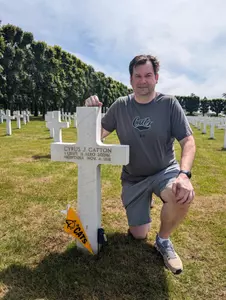
Dustin Johnson at Cy Gatton's grave site in France
Photo by: Dustin Johnson
VETERANS DAY: A Summertime Trip to Europe Featured Visits to Graves of Two Treasure State Legends
11/11/2024 9:53:00 AM | Football
MSU grad Dustin Johnson and former Bobcat football coach paid homage to Cy Gatton, Paul Dornblaser
In the summer of 2024, Montana State grad Dustin Johnson and his father-in-law, former Bobcat football coach Mike Kramer, visited several battlefields and cemeteries in Europe. That trip brought them to the graves of Bobcat legend Cy Gatton and UM's Paul Dornblaser, whose losses inspired each school to name their athletic fields after the fallen heroes. Originally from Castle Rock, Washington, Dustin graduated from MSU in 2001 with a degree in civil engineering. He is the public works director for the city of Lewiston, Idaho, and is married to Courtney Kramer Johnson, an MSU history graduate. They have two daughters, Avery (4) and Cora (12) who can't wait to attend Montana State. This is Dustin's story.
Last Christmas, my father-in-law gifted me a plane ticket to France, launching a two-week pilgrimage through some of the 20th century's most historic battlegrounds. As we traversed these hallowed grounds, from the trenches of World War I to the strategic sites of World War II, I gained a profound appreciation for the immense sacrifices made by countless young men and women who shaped the course of world history.
If you've ever been around Mike Kramer, my father-in-law who served as MSU's 30th Head Coach of Bobcat Football from 2000-06, you know two things about him: He's an energetic dynamo who sets a blistering pace, and his deep appreciation for American history, and World War II in particular, is encyclopedic. There would be no relaxation, or typical tourist stops included in the itinerary.
Over the last decade and a half, I have read Mike's expansive collection of World War I and World War II history books. Mike and I share a fascination with the individual stories of people who served in the armed forces during the time period, especially those veterans who have ties to Montana, Idaho, or Washington.
One of the motivations for this trip was to not only explore the locations of where these historic events took place, but to better understand the people who were there. To prepare, we dug through local newspaper articles, internet archives, and family stories to find out more about the people from our home states and universities who sacrificed their lives in these two world conflicts.
Incredibly, in developing the itinerary, I realized that two former student-athletes revered by their respective university athletic departments are buried in the same cemetery. Cyrus 'Cy' Gatton, for whom Montana State College first named its football field in 1921, and Paul Dornblaser, whose name the University of Montana's home fields bore from 1920-86, are buried in the Meuse-Argonne American Cemetery.
Located three hours east of Paris, the Meuse-Argonne American Cemetery is the largest American cemetery in France. The agrarian landscape of gently rolling hills covered in wheat is reminiscent of the fields around Lewistown, Montana. A quiet and solemn place not on the typical itinerary for most modern American tourists, the Meuse-Argonne Cemetery is the final resting place for 14,246 Americans who gave their life during the closing days of the First World War.
America officially entered World War 1 at the very end of the conflict. Europe had been at war since 1914, and by the summer of 1918 the European Allies desperately needed replacement troops. The largest action faced by the American Expeditionary Forces was in a sector along France's eastern border with Germany and Luxembourg, hemmed in between the Meuse River and the Argonne Forest.
Born July 25, 1894, in Melbourne, Iowa, Cyrus Gatton relocated with his family to the Gallatin Valley in 1908. A standout athlete at Gallatin County High School, Gatton joined the Bobcat football team in the fall of 1913. Injuries hampered his performance the first two years, but by 1915 he was 1st team all-state and selected by his teammates to be captain for the 1916 season.
Less than a month after the United States entered World War I, Gatton had already left Bozeman and enlisted into the armed forces on May 18, 1917. Sent by the Army to study aeronautics in Illinois before being sent to France in August 1917. Gatton was one of the first 200 pilots trained in the United States to enter service for the Allies that summer.
Gatton initially flew combat missions with the French, as up to that point the United States had not yet assembled a functioning aerial combat wing. The tenacity he exhibited on the football field carried into aerial combat, and he was one of 11,598 Americans awarded the French Croix de Guerre in recognition for his bravery during his service with the French.
By 1918, the American Air Corps assigned First Lieutenant Gatton to the 111th Aero Squadron to assist with training new inexperienced American pilots as the United States' role in the war was expanding. On November 4, 1918, Gatton postponed his planned leave and volunteered to climb into the Airco DH-4 Liberty to engage the enemy. It would be Gatton's last flight
According to witness accounts, German anti-aircraft fire hit Gatton's plane, causing it to explode in the air. Gatton and his spotter were ejected from the damaged plane, and their bodies were not found in the plane's wreckage.
Over the course of the next year Gatton's sister Laura corresponded with U.S. military officials in France in hopes of finding Gatton's body and bringing closure for the family. Eventually a team of US Army specialists discovered a makeshift grave dug by a French farmer containing Gatton's remains in a wooded area a few miles from his plane's crash site. When given the option to bring Gatton's remains home to Bozeman, his family decided that his final resting place would be amongst his fellow soldiers who sacrificed their lives in France.
Less than one month earlier another recognizable name from Montana sacrificed his life in the Great War. Paul Dornblaser was a standout football player from the University of Montana. Raised in Chicago, Illinois, Dornblaser made his way to Missoula where his success on the football field made him a local celebrity. Dornblaser, a team captain for the Montana Grizzlies, was a few years older than Gatton, and their playing days only overlapped during Gatton's injury-prone freshman year of 1913. It's unclear if the two ever actually faced each other on the gridiron.
Dornblaser graduated from U of M law school in 1915 and practiced law in Missoula up until the outbreak of the war. On June 20, 1917, Dornblaser entered the service as a Marine. He became a Corporal within the 2nd Division and received two silver stars for valor from the US Army in action leading up to his death. Dornblaser was killed on October 10, 1918, volunteering to assist in guiding replacement troops into position in the battle for Blanc Mont Ridge as part of the larger Meuse-Argonne Offensive.
Gatton and Dornblaser were two of the roughly 26,000 Americans killed in the Meuse-Argonne Offensive. 1.2 million American troops participated in this offensive and it was a major factor in the armistice of November 11th, 1918. American casualties were often buried in temporary battlefield cemeteries until the next of kin could be contacted to determine what they wanted for the remains. After the war large regional cemeteries were established for the various combatant countries. To this day you can still find large German, French, British, and American cemeteries scattered across the landscape. Each country has very unique and recognizable differences in their architectural styles for their cemeteries.
Even by today's standards the locations where Gatton and Dornblaser fell are remote. The battlefields have been reclaimed by farmland, interspersed with cemeteries and monuments scattered across the landscape.
Established by the US Congress in 1923 the American Battle Monuments Commission maintains the American cemeteries. The organization is responsible for 26 cemeteries and 31 memorials, most of which are located outside the United States. Each cemetery is maintained to a stunning level of care. We visited nine American cemeteries, and every single one was immaculate and impressive with its own unique landscaping, sculptures, and architecture.
The landscape of the Meuse-Argonne Cemetery makes visitors feel small. A large gate and massive columns mark the entrance, and mature landscaping obscures many of the headstones, so visitors never actually get a full perspective of the cemetery's expanse.
We checked in at the main office and learned that the staff will help visitors find a grave and will rub sand imported from Omaha Beach into the headstone so the name is more easily legible for photographs. We provided the names of Gatton and Dornblaser to the groundskeeper, who quickly jumped into her golf cart with a special tool and bucket of sand. By the time we arrived at the headstones, the sand had been applied and the groundskeeper moved on, giving us the space needed to reflect on Gatton and Dornblaser's sacrifice.
There is some strange irony that two men that mean so much to two rivalry schools from Montana are buried in rural France less than a football field apart. In honor of that history, we brought Montana state flags and pennants from both MSU and UM. While I'm a proud Montana State alum, it was a special moment to be there at both Gatton's and Dornblaser's graves. I could easily reflect on the immense sacrifices made by these young men, imagining the vibrant lives cut short so violently, and imagine the unrealized dreams both young men must have carried. The cemetery, with its rows of identical markers, served as a stark reminder of the human cost of war.
A trip of this nature was not without near-misses. Neither Mike or I speak French, and our overconfidence in Google navigation often put us in situations that the rental car agency would definitely not approve of. We visited strikingly remote battlefield locations, accessible only by rural narrow French roads and during early harvest seasons are plugged full of farm equipment.
Unlike in Paris, the English language is not spoken very frequently in this part of France. In one situation a waitress misinterpreted our request for the 'check' as a request for 'Jack'. It came as a complete surprise to receive two shots of 'Jack Daniels' instead of our bill.
Intimidation factor aside, combining forays to remote battlefields and cemeteries like the Meuse-Argonne with more well-known destinations like Bastogne, the Somme, Verdun, Belleau Wood and Omaha Beach deepened my understanding of the vast spaces the people involved in these military campaigns experienced. Each battlefield, cemetery, museum, and landmark is a poignant reminder of the price that young men, like Cyrus Gatton and Paul Dornblaser, paid a century ago. It was an unforgettable trip.
#GoCatsGo
Last Christmas, my father-in-law gifted me a plane ticket to France, launching a two-week pilgrimage through some of the 20th century's most historic battlegrounds. As we traversed these hallowed grounds, from the trenches of World War I to the strategic sites of World War II, I gained a profound appreciation for the immense sacrifices made by countless young men and women who shaped the course of world history.
If you've ever been around Mike Kramer, my father-in-law who served as MSU's 30th Head Coach of Bobcat Football from 2000-06, you know two things about him: He's an energetic dynamo who sets a blistering pace, and his deep appreciation for American history, and World War II in particular, is encyclopedic. There would be no relaxation, or typical tourist stops included in the itinerary.
Over the last decade and a half, I have read Mike's expansive collection of World War I and World War II history books. Mike and I share a fascination with the individual stories of people who served in the armed forces during the time period, especially those veterans who have ties to Montana, Idaho, or Washington.
One of the motivations for this trip was to not only explore the locations of where these historic events took place, but to better understand the people who were there. To prepare, we dug through local newspaper articles, internet archives, and family stories to find out more about the people from our home states and universities who sacrificed their lives in these two world conflicts.
Incredibly, in developing the itinerary, I realized that two former student-athletes revered by their respective university athletic departments are buried in the same cemetery. Cyrus 'Cy' Gatton, for whom Montana State College first named its football field in 1921, and Paul Dornblaser, whose name the University of Montana's home fields bore from 1920-86, are buried in the Meuse-Argonne American Cemetery.
Located three hours east of Paris, the Meuse-Argonne American Cemetery is the largest American cemetery in France. The agrarian landscape of gently rolling hills covered in wheat is reminiscent of the fields around Lewistown, Montana. A quiet and solemn place not on the typical itinerary for most modern American tourists, the Meuse-Argonne Cemetery is the final resting place for 14,246 Americans who gave their life during the closing days of the First World War.
America officially entered World War 1 at the very end of the conflict. Europe had been at war since 1914, and by the summer of 1918 the European Allies desperately needed replacement troops. The largest action faced by the American Expeditionary Forces was in a sector along France's eastern border with Germany and Luxembourg, hemmed in between the Meuse River and the Argonne Forest.
Born July 25, 1894, in Melbourne, Iowa, Cyrus Gatton relocated with his family to the Gallatin Valley in 1908. A standout athlete at Gallatin County High School, Gatton joined the Bobcat football team in the fall of 1913. Injuries hampered his performance the first two years, but by 1915 he was 1st team all-state and selected by his teammates to be captain for the 1916 season.
Less than a month after the United States entered World War I, Gatton had already left Bozeman and enlisted into the armed forces on May 18, 1917. Sent by the Army to study aeronautics in Illinois before being sent to France in August 1917. Gatton was one of the first 200 pilots trained in the United States to enter service for the Allies that summer.
Gatton initially flew combat missions with the French, as up to that point the United States had not yet assembled a functioning aerial combat wing. The tenacity he exhibited on the football field carried into aerial combat, and he was one of 11,598 Americans awarded the French Croix de Guerre in recognition for his bravery during his service with the French.
By 1918, the American Air Corps assigned First Lieutenant Gatton to the 111th Aero Squadron to assist with training new inexperienced American pilots as the United States' role in the war was expanding. On November 4, 1918, Gatton postponed his planned leave and volunteered to climb into the Airco DH-4 Liberty to engage the enemy. It would be Gatton's last flight
According to witness accounts, German anti-aircraft fire hit Gatton's plane, causing it to explode in the air. Gatton and his spotter were ejected from the damaged plane, and their bodies were not found in the plane's wreckage.
Over the course of the next year Gatton's sister Laura corresponded with U.S. military officials in France in hopes of finding Gatton's body and bringing closure for the family. Eventually a team of US Army specialists discovered a makeshift grave dug by a French farmer containing Gatton's remains in a wooded area a few miles from his plane's crash site. When given the option to bring Gatton's remains home to Bozeman, his family decided that his final resting place would be amongst his fellow soldiers who sacrificed their lives in France.
Less than one month earlier another recognizable name from Montana sacrificed his life in the Great War. Paul Dornblaser was a standout football player from the University of Montana. Raised in Chicago, Illinois, Dornblaser made his way to Missoula where his success on the football field made him a local celebrity. Dornblaser, a team captain for the Montana Grizzlies, was a few years older than Gatton, and their playing days only overlapped during Gatton's injury-prone freshman year of 1913. It's unclear if the two ever actually faced each other on the gridiron.
Dornblaser graduated from U of M law school in 1915 and practiced law in Missoula up until the outbreak of the war. On June 20, 1917, Dornblaser entered the service as a Marine. He became a Corporal within the 2nd Division and received two silver stars for valor from the US Army in action leading up to his death. Dornblaser was killed on October 10, 1918, volunteering to assist in guiding replacement troops into position in the battle for Blanc Mont Ridge as part of the larger Meuse-Argonne Offensive.
Gatton and Dornblaser were two of the roughly 26,000 Americans killed in the Meuse-Argonne Offensive. 1.2 million American troops participated in this offensive and it was a major factor in the armistice of November 11th, 1918. American casualties were often buried in temporary battlefield cemeteries until the next of kin could be contacted to determine what they wanted for the remains. After the war large regional cemeteries were established for the various combatant countries. To this day you can still find large German, French, British, and American cemeteries scattered across the landscape. Each country has very unique and recognizable differences in their architectural styles for their cemeteries.
Even by today's standards the locations where Gatton and Dornblaser fell are remote. The battlefields have been reclaimed by farmland, interspersed with cemeteries and monuments scattered across the landscape.
Established by the US Congress in 1923 the American Battle Monuments Commission maintains the American cemeteries. The organization is responsible for 26 cemeteries and 31 memorials, most of which are located outside the United States. Each cemetery is maintained to a stunning level of care. We visited nine American cemeteries, and every single one was immaculate and impressive with its own unique landscaping, sculptures, and architecture.
The landscape of the Meuse-Argonne Cemetery makes visitors feel small. A large gate and massive columns mark the entrance, and mature landscaping obscures many of the headstones, so visitors never actually get a full perspective of the cemetery's expanse.
We checked in at the main office and learned that the staff will help visitors find a grave and will rub sand imported from Omaha Beach into the headstone so the name is more easily legible for photographs. We provided the names of Gatton and Dornblaser to the groundskeeper, who quickly jumped into her golf cart with a special tool and bucket of sand. By the time we arrived at the headstones, the sand had been applied and the groundskeeper moved on, giving us the space needed to reflect on Gatton and Dornblaser's sacrifice.
There is some strange irony that two men that mean so much to two rivalry schools from Montana are buried in rural France less than a football field apart. In honor of that history, we brought Montana state flags and pennants from both MSU and UM. While I'm a proud Montana State alum, it was a special moment to be there at both Gatton's and Dornblaser's graves. I could easily reflect on the immense sacrifices made by these young men, imagining the vibrant lives cut short so violently, and imagine the unrealized dreams both young men must have carried. The cemetery, with its rows of identical markers, served as a stark reminder of the human cost of war.
A trip of this nature was not without near-misses. Neither Mike or I speak French, and our overconfidence in Google navigation often put us in situations that the rental car agency would definitely not approve of. We visited strikingly remote battlefield locations, accessible only by rural narrow French roads and during early harvest seasons are plugged full of farm equipment.
Unlike in Paris, the English language is not spoken very frequently in this part of France. In one situation a waitress misinterpreted our request for the 'check' as a request for 'Jack'. It came as a complete surprise to receive two shots of 'Jack Daniels' instead of our bill.
Intimidation factor aside, combining forays to remote battlefields and cemeteries like the Meuse-Argonne with more well-known destinations like Bastogne, the Somme, Verdun, Belleau Wood and Omaha Beach deepened my understanding of the vast spaces the people involved in these military campaigns experienced. Each battlefield, cemetery, museum, and landmark is a poignant reminder of the price that young men, like Cyrus Gatton and Paul Dornblaser, paid a century ago. It was an unforgettable trip.
#GoCatsGo

Thursday, July 31
Monday, May 19
Wednesday, May 03
Wednesday, May 03