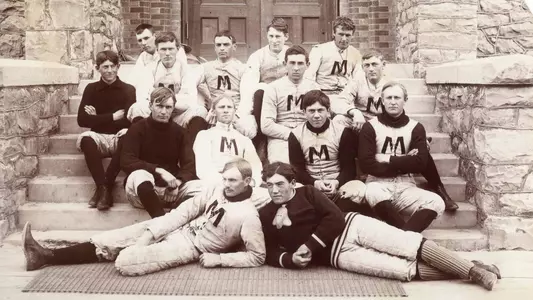
Reno Sales (top row, fourth from left) in Montana State's 1897 football team photo
BOBCATS 125: Reno Sales
7/6/2022 4:05:00 PM | Football
We go to the very beginning, before the Bobcats were the Bobcats
Leading to the 2022 season, the 125th anniversary of Montana State's first football team, we will look at 125 of the greatest Bobcats. You can find details here and a directory here.
Reno Sales, E, 1897
ALL-TIME TEAM: None previously
HONORS: None existed
A CLOSER LOOK: Reno Sales doesn't make this list for his supreme athletic ability, although at least in the context of the Montana State campus in the 19th century he possessed that. He doesn't make the list for athletic honors and awards, although, again, he was a highly-considered athlete among his peers. Heck, the town where his family settled even carried his surname.
Reno H. Sales is on this list because most Bobcat fans know his name, and all should., and for some period of time he was known by everyone affiliated with the college as Mr. Bobcat. He was among the young men on campus that organized to play football in the fall of 1896, and played on the school's first varsity team one season later. In fact, he may have scored (there are conflicting reports) Montana State's only touchdown in the first-ever Cat-Griz game.
Sales grew up in Salesville (named for his father), now Gallatin Gateway, and attended Gallatin County High School and Montana State. He was among the most active and by all accounts popular men on campus, serving as an editor for the Exponent as a junior and senior and joining several honorary societies.
An indication of his athletic ability comes in Montana State's "Field Day" in the spring of 1897 - essentially the school's intramural track meet - when Sales won the quarter-mile bicycle race (32 seconds) and the pole vault (8 feet, 3 inches), and his status as the College baseball team's top pitcher in 1898. After graduating that spring he traveled to the East Coast for field work and then graduate studies at Columbia University, culminating with his commencement in 1900.
After completing that phase of his education, Sales joined the Boston and Montana Consolidated Copper and Silver Co. in Butte, and one year later became assistant to H.V. Winchell in the Anaconda Copper Company charged with organizing the company's legal efforts after its bombardment of legal claims by F. Augustus Heinze. He was appointed Chief Geologist in 1906 and prolifically produced professional papers and presentations throughout his life. He won national awards too numerous to list, including an honorary doctorate from Montana State in 1935. In 1937 became President of the Society of Economic Geologists, retiring from his position with the Anaconda Copper Mining Company in 1948 after developing a field mapping system that protected his company's rich ore deposits from legal maneuvering.
A philanthropist throughout his life, reflecting his strong presence on the Montana State campus, he was a founding member of the Butte Country Club, contributed to the Butte YMCA and Butte Community Chest, and one of his last gifts was to help his alma mater sort out its floundering "Stadium for State" campaign to build a new football stadium with a $50,000 gift of stock options. Posthumously, that grant helped create Reno H. Sales Stadium. Sales passed away in 1969.
Reno Sales, E, 1897
ALL-TIME TEAM: None previously
HONORS: None existed
A CLOSER LOOK: Reno Sales doesn't make this list for his supreme athletic ability, although at least in the context of the Montana State campus in the 19th century he possessed that. He doesn't make the list for athletic honors and awards, although, again, he was a highly-considered athlete among his peers. Heck, the town where his family settled even carried his surname.
Reno H. Sales is on this list because most Bobcat fans know his name, and all should., and for some period of time he was known by everyone affiliated with the college as Mr. Bobcat. He was among the young men on campus that organized to play football in the fall of 1896, and played on the school's first varsity team one season later. In fact, he may have scored (there are conflicting reports) Montana State's only touchdown in the first-ever Cat-Griz game.
Sales grew up in Salesville (named for his father), now Gallatin Gateway, and attended Gallatin County High School and Montana State. He was among the most active and by all accounts popular men on campus, serving as an editor for the Exponent as a junior and senior and joining several honorary societies.
An indication of his athletic ability comes in Montana State's "Field Day" in the spring of 1897 - essentially the school's intramural track meet - when Sales won the quarter-mile bicycle race (32 seconds) and the pole vault (8 feet, 3 inches), and his status as the College baseball team's top pitcher in 1898. After graduating that spring he traveled to the East Coast for field work and then graduate studies at Columbia University, culminating with his commencement in 1900.
After completing that phase of his education, Sales joined the Boston and Montana Consolidated Copper and Silver Co. in Butte, and one year later became assistant to H.V. Winchell in the Anaconda Copper Company charged with organizing the company's legal efforts after its bombardment of legal claims by F. Augustus Heinze. He was appointed Chief Geologist in 1906 and prolifically produced professional papers and presentations throughout his life. He won national awards too numerous to list, including an honorary doctorate from Montana State in 1935. In 1937 became President of the Society of Economic Geologists, retiring from his position with the Anaconda Copper Mining Company in 1948 after developing a field mapping system that protected his company's rich ore deposits from legal maneuvering.
A philanthropist throughout his life, reflecting his strong presence on the Montana State campus, he was a founding member of the Butte Country Club, contributed to the Butte YMCA and Butte Community Chest, and one of his last gifts was to help his alma mater sort out its floundering "Stadium for State" campaign to build a new football stadium with a $50,000 gift of stock options. Posthumously, that grant helped create Reno H. Sales Stadium. Sales passed away in 1969.
Thursday, July 31
Monday, May 19
Wednesday, May 03
Wednesday, May 03