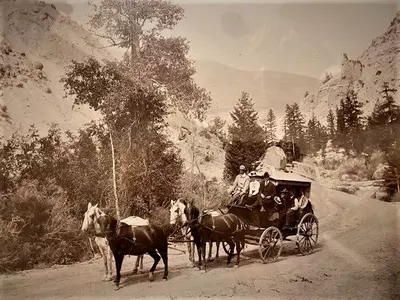
Fred Ervin drove tourists from Bozeman to Yellowstone National Park on a stage coach in the summer of 1900 (this may be that coach, but that is not confirmed)
Photo by: Ervin family photograph
BOBCATS 125: Fred Ervin
5/13/2022 2:00:00 PM | Football
A three-time team captain, Fred Ervin coached the Bobcats as an undergrad once his eligibility expired
Much of the information in this piece was graciously provided by MSU alum Craig Kirwin, whose ability to research is surpassed only by his willingness to help.
Leading to the 2022 season, the 125th anniversary of Montana State's first football season, we will look at 125 of the greatest Bobcats. You can find details here and a directory here.
Fred Ervin, G/T/HB, 1899-1903
ALL-TIME TEAM: 1933 Exponent 2nd Team
HONORS: None available at the time
A CLOSER LOOK: Fred Ervin presents an unusual but illuminating case as a member of Montana State's all-time team. He joined the Montana State football team in the fall of 1899 when he enrolled in the school's preparatory academy, what seems to have amounted to a boarding school available to students from outside of Bozeman designed to prepare them for the rigors of a college education. In other words, it was a high school necessitated by educational limitations inherit in a large, mostly unsettled state. For instance, Richard Flaherty "entered the preparatory course and makes a valuable man for the football team," according to the Exponent, joining his brothers Will and Charles. William J. Adams also entered the prep course after transferring from Notre Dame, and would become the school's coach when the season commenced. To offer some context, the school's enrollment stood at 170 that fall (which didn't include music students), all but 50 enrolled in the prep academy.
Listed as starting right guard "F. Ervine" in the October 1899 Exponent, Ervin's name was misspelled about as many ways as one can imagine during his time on the MSAC football team. His career came primarily during his time in the prep academy because college football adopted a rule limiting eligibility to four seasons in the midst of his career.
Arthur Frederick Ervin was born on November 10, 1876, in Trenton, Missouri, one of 10 children of Silas and Mary (Tabor) Ervin. In 1885 the family moved to central Nebraska, where his father would reside for the remainder of his life. A maternal uncle, Stephen Tabor, served as a Methodist minister in Bozeman, and Fred lived with he and his wife Laura at least early in his time at Montana State. In the summer of 1900, which followed his second year in Bozeman, Ervin drove stage coaches of tourists to Yellowstone National Park. On the back of a family photo that once belonged to Hullie Ervin Newman, Fred's sister, an inscription indicates that "his stage coach was robbed by an armed gunman and some time later when the gunman was found dead, he was still wearing Fred's jewelry."
In addition to starring on the football team, Ervin played catcher and first base for the school's baseball team. He also competed in the school's annual Field Day in the spring, a intracampus track meet that included other competitions, such as bicycle races. He remains the only man to captain the Bobcat football team three times and captained the baseball team, as well.
Ervin played all over the field during at MAC (as it was then known), beginning his career as a guard and later in his playing both halfback and tackle. Playing left halfback and against the Montana School of Mines (now Montana Tech) in 1902, according to the October 19, 1902, Butte Miner, Ervin "jumped over the line for five more (yards). He liked the experience and tried it twice more in quick succession for good gains, going over the line for another touchdown after (Willis) Ray, (William) Schbarker and (Henry) Gardiner had made good gains. This time Ervin kicked the goal (what we now know as the PAT)."
Ervin's eligibility expired following the 1903 season - his freshman year in college after passing through the preparatory course - due to the new 'four-year' rule that established limits on seasons played. Coupled with the departure of John Flynn, this allowed for the transition of Ervin into the role as Bobcat coach, the school's first alum to occupy that position. The following notice appeared in the September 17, 1904 Butte Miner: "The first step in starting the football interests in the college this fall was taken today when a meeting of those interested was held, and Dexter Moser was appointed temporary chairman. Practice will begin at once. The team will be coached this year by Fred Ervin, who has played on the team for several years. He is expected to arrive next week."
The Agricultural College rode a nine-game unbeaten streak (dating to a 1901 season-opening loss at the Butte Business College) into Fred Ervin's head coaching debut, and beat Billings High in its lone home game before winning at Montana College in Deer Lodge and losing at the University in Missoula. Ervin didn't coach in 1905 and the Exponent lists him as having graduated from the school in 1906. After moving on from Bozeman he had relocated to central Arizona by 1915, residing there when he married Florence Slaven of Van Buren, Arkansas (originally from Ervin's hometown in Missouri). An "Arthur Ervin" is registered as a Grand Canyon guide in 1910, and given the frequency of his name being misspelled it's possible that was our Fred, but there is no confirmation. By 1918 the couple had relocated to Custer County, Nebraska (just north of North Platte), where his father had remained since the 18880s and where six of his siblings lived. Fred worked as an auto mechanic and later as an electrician. By 1930 the couple had relocated to Van Buren, Arkansas, where they resided for the remainder of their lives. Florence died in 1956, and Fred passed on December 14, 1960, at the age of 84.
There is no record of him returning to Bozeman once he left, although he was well-remembered at the College well into the 20th century.
FROM THE DECEMBER, 1899 EXPONENT: "F. Ervin proved to be a stone wall at right guard. He weighs 175 pounds and stands 5 ft. 11 in. in height. He is a new man atthe game and has many more years yet to play; he is a youth of 22 summers. He has a bright future in the football world."
FROM THE OCTOBER 15, 1902 BUTTE INTER MOUNTAIN: "Captian Irvin (sic) has had a wide experience on the gridiron and is thoroughly familiar with the finer points of play that help win games. The boys who play on the Agricultural College forces ar a husky set and already show the effect of the careful training they have received at the hands of Captain Irvin. Now that the team has rounded into good shape it is evident that the college is to have one of the strongest gridiron aggregation of the season in Montana."
FROM A. FRED ERVIN'S OBITUARY IN THE PRESS ARGUS OF VAN BUREN, ARKANSAS, DECEMBER 22, 1960: "The aged gentleman (Ervin) was widely known and beloved by many people. He was retired as a Rural Electric worker out of Ozark, and lived with his late wife, Mrs. Florence Slaven Ervin, a sister of the Slavens, in the Rena community for many years."
Leading to the 2022 season, the 125th anniversary of Montana State's first football season, we will look at 125 of the greatest Bobcats. You can find details here and a directory here.
Fred Ervin, G/T/HB, 1899-1903
ALL-TIME TEAM: 1933 Exponent 2nd Team
HONORS: None available at the time
A CLOSER LOOK: Fred Ervin presents an unusual but illuminating case as a member of Montana State's all-time team. He joined the Montana State football team in the fall of 1899 when he enrolled in the school's preparatory academy, what seems to have amounted to a boarding school available to students from outside of Bozeman designed to prepare them for the rigors of a college education. In other words, it was a high school necessitated by educational limitations inherit in a large, mostly unsettled state. For instance, Richard Flaherty "entered the preparatory course and makes a valuable man for the football team," according to the Exponent, joining his brothers Will and Charles. William J. Adams also entered the prep course after transferring from Notre Dame, and would become the school's coach when the season commenced. To offer some context, the school's enrollment stood at 170 that fall (which didn't include music students), all but 50 enrolled in the prep academy.
Listed as starting right guard "F. Ervine" in the October 1899 Exponent, Ervin's name was misspelled about as many ways as one can imagine during his time on the MSAC football team. His career came primarily during his time in the prep academy because college football adopted a rule limiting eligibility to four seasons in the midst of his career.
Arthur Frederick Ervin was born on November 10, 1876, in Trenton, Missouri, one of 10 children of Silas and Mary (Tabor) Ervin. In 1885 the family moved to central Nebraska, where his father would reside for the remainder of his life. A maternal uncle, Stephen Tabor, served as a Methodist minister in Bozeman, and Fred lived with he and his wife Laura at least early in his time at Montana State. In the summer of 1900, which followed his second year in Bozeman, Ervin drove stage coaches of tourists to Yellowstone National Park. On the back of a family photo that once belonged to Hullie Ervin Newman, Fred's sister, an inscription indicates that "his stage coach was robbed by an armed gunman and some time later when the gunman was found dead, he was still wearing Fred's jewelry."
In addition to starring on the football team, Ervin played catcher and first base for the school's baseball team. He also competed in the school's annual Field Day in the spring, a intracampus track meet that included other competitions, such as bicycle races. He remains the only man to captain the Bobcat football team three times and captained the baseball team, as well.
Ervin played all over the field during at MAC (as it was then known), beginning his career as a guard and later in his playing both halfback and tackle. Playing left halfback and against the Montana School of Mines (now Montana Tech) in 1902, according to the October 19, 1902, Butte Miner, Ervin "jumped over the line for five more (yards). He liked the experience and tried it twice more in quick succession for good gains, going over the line for another touchdown after (Willis) Ray, (William) Schbarker and (Henry) Gardiner had made good gains. This time Ervin kicked the goal (what we now know as the PAT)."
Ervin's eligibility expired following the 1903 season - his freshman year in college after passing through the preparatory course - due to the new 'four-year' rule that established limits on seasons played. Coupled with the departure of John Flynn, this allowed for the transition of Ervin into the role as Bobcat coach, the school's first alum to occupy that position. The following notice appeared in the September 17, 1904 Butte Miner: "The first step in starting the football interests in the college this fall was taken today when a meeting of those interested was held, and Dexter Moser was appointed temporary chairman. Practice will begin at once. The team will be coached this year by Fred Ervin, who has played on the team for several years. He is expected to arrive next week."
The Agricultural College rode a nine-game unbeaten streak (dating to a 1901 season-opening loss at the Butte Business College) into Fred Ervin's head coaching debut, and beat Billings High in its lone home game before winning at Montana College in Deer Lodge and losing at the University in Missoula. Ervin didn't coach in 1905 and the Exponent lists him as having graduated from the school in 1906. After moving on from Bozeman he had relocated to central Arizona by 1915, residing there when he married Florence Slaven of Van Buren, Arkansas (originally from Ervin's hometown in Missouri). An "Arthur Ervin" is registered as a Grand Canyon guide in 1910, and given the frequency of his name being misspelled it's possible that was our Fred, but there is no confirmation. By 1918 the couple had relocated to Custer County, Nebraska (just north of North Platte), where his father had remained since the 18880s and where six of his siblings lived. Fred worked as an auto mechanic and later as an electrician. By 1930 the couple had relocated to Van Buren, Arkansas, where they resided for the remainder of their lives. Florence died in 1956, and Fred passed on December 14, 1960, at the age of 84.
There is no record of him returning to Bozeman once he left, although he was well-remembered at the College well into the 20th century.
FROM THE DECEMBER, 1899 EXPONENT: "F. Ervin proved to be a stone wall at right guard. He weighs 175 pounds and stands 5 ft. 11 in. in height. He is a new man atthe game and has many more years yet to play; he is a youth of 22 summers. He has a bright future in the football world."
FROM THE OCTOBER 15, 1902 BUTTE INTER MOUNTAIN: "Captian Irvin (sic) has had a wide experience on the gridiron and is thoroughly familiar with the finer points of play that help win games. The boys who play on the Agricultural College forces ar a husky set and already show the effect of the careful training they have received at the hands of Captain Irvin. Now that the team has rounded into good shape it is evident that the college is to have one of the strongest gridiron aggregation of the season in Montana."
FROM A. FRED ERVIN'S OBITUARY IN THE PRESS ARGUS OF VAN BUREN, ARKANSAS, DECEMBER 22, 1960: "The aged gentleman (Ervin) was widely known and beloved by many people. He was retired as a Rural Electric worker out of Ozark, and lived with his late wife, Mrs. Florence Slaven Ervin, a sister of the Slavens, in the Rena community for many years."

Leon Costello Press Conference: Kennedy-Stark Athletic Center
Thursday, July 31
A Conversation with President Dr. Waded Cruzado | Montana State Athletics
Monday, May 19
Big Cats, Little Trucks - Willie Patterson
Wednesday, May 03
Matt Houk Introductory Press Conference
Wednesday, May 03