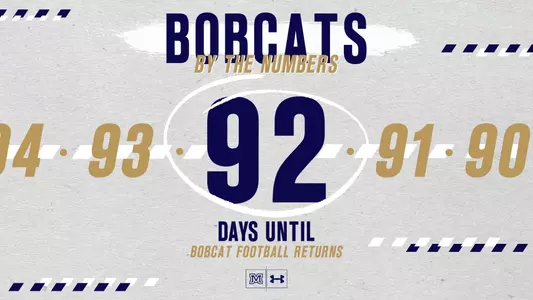
BOBCATS BY THE NUMBERS: 92 Days Until the Cats Play Football!
6/4/2021 2:00:00 PM | Football
A quick look at the No. 92 in Montana State Football history
Bobcats by the Numbers takes a look at current and past Bobcats whose jersey numbers correspond to the number of days remaining before Montana State opens the 2021 football season at Wyoming on September 4.
#92
Blake Schmidt, DT: If you listen closely and have access to the right people during any football season you'll usually hear names of young players expected to become really good. Blake Schmidt is one of those players at MSU, a young defensive lineman who combines power and explosiveness. Montana State has had pretty good luck with interior defensive linemen who bring strong wrestling backgrounds to the Bobcat football program – Dan Ogden and Tucker Yates jump to mind – and Blake Schmidt fits that mold. A wrestling standout as well as earning Conference Defensive Player of the Year for his play as a defensive lineman in high school, Schmidt's versatility is likely to make him a valuable piece of the equation this season.
92 – That is the number of points scored in Montana State's first four games of the team's 1923 season. Ott Romney's first season as the school's director of athletics and head of physical education, a role at most mid-sized or small schools of that era that included head football and basketball coach, in 1922 produced a 4-4 season, but the Cats didn't win an out-of-state game that season. In fact, the team only played one game against a fellow Rocky Mountain Conference opponent. The 1923 campaign opened with MSC (as it was then known) spending a full week at the Hotel Utah in Salt Lake City. The team sandwiched a narrow 16-15 loss at BYU on September 29 and an October 6 loss at Idaho State with training at several athletic fields and gymnasiums in Utah's capital that were made available to Romney, a favored son. (Remember, Montana State was on the quarter system at that time so classes were not quite underway.) The Bobcats smashed Idaho Southern Branch (now Idaho State) 41-0, and returned home to beat Montana Wesleyan 30-3. That season-opening stretch of four games in 20 days closed with another narrow conference loss, this a 7-6 home decision against Denver. After finishing 1922 4-4, the Bobcats compiled a superficially similar 5-4 mark in 1923. In hindsight, the difference between the two campaigns was significant. Romney's second season saw the Bobcats beat Carroll, Northern Colorado and New Mexico, while losing its fourth straight to UM, along with a 7-2 loss to Montana Tech. Braced by the modest gains of 1923 the Cats rolled up a 19-12-2 mark in the next four seasons, Romney's final seasons in Bozeman. And while MSC's next win against the Grizzlies didn't come until 1929, the Bobcats became competitive in the nationally-prominent Rocky Mountain Conference for the first time. From those one-point losses to open 1923 until his departure, Romney's teams were 3-0 against Northern Colorado, 2-1 against BYU, 2-2 vs. Wyoming, 0-0-1 against powerful Denver, 2-1 against Colorado (that's not a typo), and 1-1 against Utah State. The 1926 Bobcats won all four of its games against RMC foes, but Utah's five league victories gave the Utes the league title. Among the factors in the revival of Bobcat football was the completion of the MSC Gymnasium, now Romney Gym. As Romney put it in an open letter to the student body in 1923, "A magnificent new gymnasium – a home for physical education and play activity which leaves little to be desired – enables the department of physical welfare to assure you the golden opportunity for happy, wholesome, healthful and carefully directed recreation." Later, Romney referred to the gym that decades later would bear his name as a "health factory" that he hoped would make physical activity "habit-forming." Regardless of whether the building served that purpose, it certainly benefited Bobcat Athletics for generations to come, including attracting quality student-athletes that would lead Montana State to athletics glory throughout the 1920s.
Chronology: Mark Stromberg (1982), Tate Kopp (1983), Shane Quilling (1984), Shane Powell (1985-86), Ken Buss (1987), Scott Eaton (1988), Tim Hanson (1989-90), Terry Phelan (1991), Devlan Geddes (1992-96), Aaron Nava (1997), Nathan Schmidt (1999), Adam Cordeiro (2000-03), Daryl Rogers (2004-05), Kody Swartz (2006), Brad Smith (2007-10), Nate Bignell (2012-13), Tucker Yates (2014-18), Blake Schmidt (2019-)
Other 92 Notes: The big guy wearing #92 snagged the ball on a hop and headed toward paydirt. A dozen or so strides into his gallop toward Eastern Washington's end zone he noted that no one was really chasing him. The thought popped into Adam Cordeiro's mind that maybe the pass was incomplete and not a lateral, but he knew what he knew so he kept rolling. Several Eagles caught on and began the chase, but Cordeiro's head start was too big and when he crossed the goal line with what was ruled a 76-yard fumble return for touchdown he had clinched a stunning Bobcat win that, honestly, was just one of about five in a row that conspired to give the Cats the 2002 Big Sky title. Cordeiro was a freakish athlete from Boulder, with a whimsical outlook on life. Asked during the 2002 and '03 seasons to move inside to tackle from his more natural defensive end position, he unselfishly made the transition while understanding exactly what it meant to his own station in life. And he remained a stud. Playing primarily end in 2002 he logged 10.5 tackles-for-loss, including 5.5 sacks. He recovered four fumbles and forced two. A year later playing defensive tackle his stats were essentially halved, but his impact resonated more strongly. MSU's defensive front of Cordeiro and Ray Sebestyen inside, flanked by Jon Montoya and Clive Lowe, was remarkable, with Cordeiro's presence inside creating pass rush opportunities that led to MSU's 43 sacks.
Devlan Geddes and teammates Chad Mayer and Scott Matthews were three of a kind. They were hard-working kids that came to Bobcat football in Cliff Hysell's first recruiting class as raw athletes. They survived the ups-and-downs of Cliff Hysell's early years as MSU's head coach, and left as part of a group that helped restore pride in the Bobcat football program. Those three also shared another distinction – they were the first captains selected on a season-long basis during the Hysell era. Geddes, who wore #92 with distinction, could pretty easily be the poster boy for the concept of student-athlete. He was an All-America and Academic All-America who patiently built the strength and explosiveness that would define his excellent play and brilliant legacy. Geddes' 22 career sacks was third-most in Bobcat history upon the completion of his career, and remains 10th on MSU's all-time list, and he returned to Bozeman for a career as a distinguished attorney.
#92
Blake Schmidt, DT: If you listen closely and have access to the right people during any football season you'll usually hear names of young players expected to become really good. Blake Schmidt is one of those players at MSU, a young defensive lineman who combines power and explosiveness. Montana State has had pretty good luck with interior defensive linemen who bring strong wrestling backgrounds to the Bobcat football program – Dan Ogden and Tucker Yates jump to mind – and Blake Schmidt fits that mold. A wrestling standout as well as earning Conference Defensive Player of the Year for his play as a defensive lineman in high school, Schmidt's versatility is likely to make him a valuable piece of the equation this season.
92 – That is the number of points scored in Montana State's first four games of the team's 1923 season. Ott Romney's first season as the school's director of athletics and head of physical education, a role at most mid-sized or small schools of that era that included head football and basketball coach, in 1922 produced a 4-4 season, but the Cats didn't win an out-of-state game that season. In fact, the team only played one game against a fellow Rocky Mountain Conference opponent. The 1923 campaign opened with MSC (as it was then known) spending a full week at the Hotel Utah in Salt Lake City. The team sandwiched a narrow 16-15 loss at BYU on September 29 and an October 6 loss at Idaho State with training at several athletic fields and gymnasiums in Utah's capital that were made available to Romney, a favored son. (Remember, Montana State was on the quarter system at that time so classes were not quite underway.) The Bobcats smashed Idaho Southern Branch (now Idaho State) 41-0, and returned home to beat Montana Wesleyan 30-3. That season-opening stretch of four games in 20 days closed with another narrow conference loss, this a 7-6 home decision against Denver. After finishing 1922 4-4, the Bobcats compiled a superficially similar 5-4 mark in 1923. In hindsight, the difference between the two campaigns was significant. Romney's second season saw the Bobcats beat Carroll, Northern Colorado and New Mexico, while losing its fourth straight to UM, along with a 7-2 loss to Montana Tech. Braced by the modest gains of 1923 the Cats rolled up a 19-12-2 mark in the next four seasons, Romney's final seasons in Bozeman. And while MSC's next win against the Grizzlies didn't come until 1929, the Bobcats became competitive in the nationally-prominent Rocky Mountain Conference for the first time. From those one-point losses to open 1923 until his departure, Romney's teams were 3-0 against Northern Colorado, 2-1 against BYU, 2-2 vs. Wyoming, 0-0-1 against powerful Denver, 2-1 against Colorado (that's not a typo), and 1-1 against Utah State. The 1926 Bobcats won all four of its games against RMC foes, but Utah's five league victories gave the Utes the league title. Among the factors in the revival of Bobcat football was the completion of the MSC Gymnasium, now Romney Gym. As Romney put it in an open letter to the student body in 1923, "A magnificent new gymnasium – a home for physical education and play activity which leaves little to be desired – enables the department of physical welfare to assure you the golden opportunity for happy, wholesome, healthful and carefully directed recreation." Later, Romney referred to the gym that decades later would bear his name as a "health factory" that he hoped would make physical activity "habit-forming." Regardless of whether the building served that purpose, it certainly benefited Bobcat Athletics for generations to come, including attracting quality student-athletes that would lead Montana State to athletics glory throughout the 1920s.
Chronology: Mark Stromberg (1982), Tate Kopp (1983), Shane Quilling (1984), Shane Powell (1985-86), Ken Buss (1987), Scott Eaton (1988), Tim Hanson (1989-90), Terry Phelan (1991), Devlan Geddes (1992-96), Aaron Nava (1997), Nathan Schmidt (1999), Adam Cordeiro (2000-03), Daryl Rogers (2004-05), Kody Swartz (2006), Brad Smith (2007-10), Nate Bignell (2012-13), Tucker Yates (2014-18), Blake Schmidt (2019-)
Other 92 Notes: The big guy wearing #92 snagged the ball on a hop and headed toward paydirt. A dozen or so strides into his gallop toward Eastern Washington's end zone he noted that no one was really chasing him. The thought popped into Adam Cordeiro's mind that maybe the pass was incomplete and not a lateral, but he knew what he knew so he kept rolling. Several Eagles caught on and began the chase, but Cordeiro's head start was too big and when he crossed the goal line with what was ruled a 76-yard fumble return for touchdown he had clinched a stunning Bobcat win that, honestly, was just one of about five in a row that conspired to give the Cats the 2002 Big Sky title. Cordeiro was a freakish athlete from Boulder, with a whimsical outlook on life. Asked during the 2002 and '03 seasons to move inside to tackle from his more natural defensive end position, he unselfishly made the transition while understanding exactly what it meant to his own station in life. And he remained a stud. Playing primarily end in 2002 he logged 10.5 tackles-for-loss, including 5.5 sacks. He recovered four fumbles and forced two. A year later playing defensive tackle his stats were essentially halved, but his impact resonated more strongly. MSU's defensive front of Cordeiro and Ray Sebestyen inside, flanked by Jon Montoya and Clive Lowe, was remarkable, with Cordeiro's presence inside creating pass rush opportunities that led to MSU's 43 sacks.
Devlan Geddes and teammates Chad Mayer and Scott Matthews were three of a kind. They were hard-working kids that came to Bobcat football in Cliff Hysell's first recruiting class as raw athletes. They survived the ups-and-downs of Cliff Hysell's early years as MSU's head coach, and left as part of a group that helped restore pride in the Bobcat football program. Those three also shared another distinction – they were the first captains selected on a season-long basis during the Hysell era. Geddes, who wore #92 with distinction, could pretty easily be the poster boy for the concept of student-athlete. He was an All-America and Academic All-America who patiently built the strength and explosiveness that would define his excellent play and brilliant legacy. Geddes' 22 career sacks was third-most in Bobcat history upon the completion of his career, and remains 10th on MSU's all-time list, and he returned to Bozeman for a career as a distinguished attorney.

Players Mentioned

DL
/ FootballLeon Costello Press Conference: Kennedy-Stark Athletic Center
Thursday, July 31
A Conversation with President Dr. Waded Cruzado | Montana State Athletics
Monday, May 19
Big Cats, Little Trucks - Willie Patterson
Wednesday, May 03
Matt Houk Introductory Press Conference
Wednesday, May 03