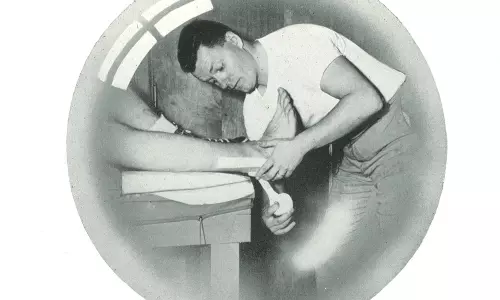
THE LONGEST DAY: Future Bobcat Athletic Trainer Doc Herwig was Among Those Landing on Utah Beach 76 Years Ago Today
6/6/2020 1:00:00 PM | Football, General
Doc Herwig joined Bobcat Athletics and 1949 and was a Gallatin Valley icon for decades after
BOZEMAN, Montana – It was an innocent conversation near Veteran's Day years ago in a Bozeman hotel after Cat Chat, a gathering of Bobcat fans who were there that day to hear then-head coach Mike Kramer visit with play-by-play man Kris Atteberry and those gathered about the team.
Asked by Atteberry if any were veterans in the crowd, nearly everyone present raised a hand, each insisting the man next to him was more worthy. The Greatest Generation saved American democracy during World War II then helped shape and reshape the country – and the world – in the decades that followed. One of those in the room that day, Gordon "Doc" Herwig, stayed after the session ended to share his ever-present smile and good humor, and to tell some stories.
Herwig told stories of the time that his squad was ordered to pull over and wait in a grove of trees for (a prominent British general) "to get there first for a photo op," recalls Atteberry, who grew up in Bozeman and now a broadcaster for the Minnesota Twins. Herwig spent the war in the European theater, fighting at the Battle of the Bulge where soldiers fought brutal weather and field conditions in addition to the Germans, resorting among other life hacks to keeping socks under their helmets to keep them warm.
Joining the U.S. Army in 1941, Herwig served in the 9th Infantry in eight major European campaigns, including as a rifle squad leader in the North Africa Landing, Tunisia and Sicily, fighting up the spine in Italy. He was a platoon leader at Utah Beach 76 years ago, when Allied Forces invaded western Europe at Normandy, across the English Channel. The 9th helped liberate France, fought into Germany, opened a concentration camp, and held various positions throughout the spring until V-E Day. Although everyone who survived battle respectfully deferred that status to their comrades who didn't, it's impossible to overstate the heroism of all Allied Forces in World War II.
For his war efforts, Herwig was awarded the Purple Heart, Bronze Star, and Silver Star. As a Sergeant 1st Class he saw 19 months of active combat.
After the war the product of the Albany, New York, area completed college at Bowling Green in Ohio. He graduated cum laude in 1948, and shortly thereafter married Janet Elizabeth Sauer, his classmate. After a short time as a high school athletic trainer in Ohio he and Liz moved to Bozeman in 1949, and Doc Herwig became Montana State's first full-time, academically-trained athletic trainer. (To that point, the school had an array of athletic trainers who were generally cited for dedication and excellent work but weren't full-time athletic trainers.) Herwig also served as an assistant professor in Health and Physical Education.
In 1951-52 Herwig took a leave of absence to train as a physical therapist at Stanford, then worked at Montana State until 1956. In 1956-57 he joined the athletics staff and faculty at Southern Illinois, but returned to Bozeman after a year to to establish the Gallatin Valley's first physical therapy practice at Bozeman Deaconess Hospital. He served south-central Montana in that capacity until his retirement in 1983.
Chuck Karnop, who served on Montana State's athletic training staff for about four decades, called Herwig "a very good physical therapist and a really positive person in the community." Karnop said that when legendary Montana State basketball player Bill Salonen was inducted into the Bobcat Athletics Hall of Fame he "talked glowingly about Doc as a great athletic trainer who really helped (student-athletes) during his time."
For the rest of his life Herwig actively supported the Bobcats, at practices and Cat Chat and games. The smile was ever-present, and a positive comment never far off. Herwig was always willing to share stories, and was like most of his generation just as quick to deflect credit. He passed away in the fall of 2005, but after positively affecting so many in Bozeman and the surrounding area his memory and spirit certainly lives.
And for all who enjoy the freedoms preserved through brutal combat thousands of miles from home so many years ago, we all owe Doc Herwig and America's Greatest Generation a debt that can never be repaid.
(Information for this story acquired from personal conversations with Herwig and others, and from Gordon Herwig's obituary.)
Asked by Atteberry if any were veterans in the crowd, nearly everyone present raised a hand, each insisting the man next to him was more worthy. The Greatest Generation saved American democracy during World War II then helped shape and reshape the country – and the world – in the decades that followed. One of those in the room that day, Gordon "Doc" Herwig, stayed after the session ended to share his ever-present smile and good humor, and to tell some stories.
Herwig told stories of the time that his squad was ordered to pull over and wait in a grove of trees for (a prominent British general) "to get there first for a photo op," recalls Atteberry, who grew up in Bozeman and now a broadcaster for the Minnesota Twins. Herwig spent the war in the European theater, fighting at the Battle of the Bulge where soldiers fought brutal weather and field conditions in addition to the Germans, resorting among other life hacks to keeping socks under their helmets to keep them warm.
Joining the U.S. Army in 1941, Herwig served in the 9th Infantry in eight major European campaigns, including as a rifle squad leader in the North Africa Landing, Tunisia and Sicily, fighting up the spine in Italy. He was a platoon leader at Utah Beach 76 years ago, when Allied Forces invaded western Europe at Normandy, across the English Channel. The 9th helped liberate France, fought into Germany, opened a concentration camp, and held various positions throughout the spring until V-E Day. Although everyone who survived battle respectfully deferred that status to their comrades who didn't, it's impossible to overstate the heroism of all Allied Forces in World War II.
For his war efforts, Herwig was awarded the Purple Heart, Bronze Star, and Silver Star. As a Sergeant 1st Class he saw 19 months of active combat.
After the war the product of the Albany, New York, area completed college at Bowling Green in Ohio. He graduated cum laude in 1948, and shortly thereafter married Janet Elizabeth Sauer, his classmate. After a short time as a high school athletic trainer in Ohio he and Liz moved to Bozeman in 1949, and Doc Herwig became Montana State's first full-time, academically-trained athletic trainer. (To that point, the school had an array of athletic trainers who were generally cited for dedication and excellent work but weren't full-time athletic trainers.) Herwig also served as an assistant professor in Health and Physical Education.
In 1951-52 Herwig took a leave of absence to train as a physical therapist at Stanford, then worked at Montana State until 1956. In 1956-57 he joined the athletics staff and faculty at Southern Illinois, but returned to Bozeman after a year to to establish the Gallatin Valley's first physical therapy practice at Bozeman Deaconess Hospital. He served south-central Montana in that capacity until his retirement in 1983.
Chuck Karnop, who served on Montana State's athletic training staff for about four decades, called Herwig "a very good physical therapist and a really positive person in the community." Karnop said that when legendary Montana State basketball player Bill Salonen was inducted into the Bobcat Athletics Hall of Fame he "talked glowingly about Doc as a great athletic trainer who really helped (student-athletes) during his time."
For the rest of his life Herwig actively supported the Bobcats, at practices and Cat Chat and games. The smile was ever-present, and a positive comment never far off. Herwig was always willing to share stories, and was like most of his generation just as quick to deflect credit. He passed away in the fall of 2005, but after positively affecting so many in Bozeman and the surrounding area his memory and spirit certainly lives.
And for all who enjoy the freedoms preserved through brutal combat thousands of miles from home so many years ago, we all owe Doc Herwig and America's Greatest Generation a debt that can never be repaid.
(Information for this story acquired from personal conversations with Herwig and others, and from Gordon Herwig's obituary.)
Thursday, July 31
Monday, May 19
Wednesday, May 03
Wednesday, May 03