BOBCAT CONVERSATIONS: Defensive End Kyle Finch
4/6/2020 1:00:00 PM | Football
Dillon's Kyle Finch transitions to defensive end in virtual spring environment
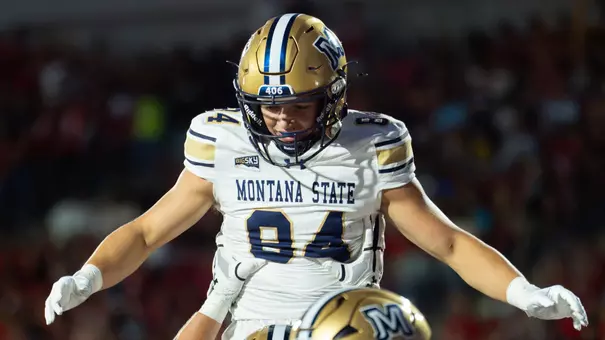
Entering his senior season, Kyle Finch has played a valuable role on the Montana State defense the past two seasons at Buck, the team's hybrid outside linebacker/defensive end position. He played that position with Bryce Sterk in 2018 and Amandre Williams in 2019, but entering the 2020 season Finch moves to defensive end – following the same path as Sterk a year ago – where he is expected to emerge as an important cog on a defense that replaces four of the team's five regular down linemen (starting nose tackle Chase Benson returns). A brilliant student, Finch carries a 4.0 grade point average in mechanical engineering into this spring semester and was CoSIDA First Team Academic All-America as a junior.
How is the change of positions going in a strictly remote-learning environment? "It's definitely different, something you have to adapt to no matter who you are. Everyone in the world's going through it, but it's not bad, it's going well so far. The coaches have devised a pretty good plan to make sure things are going well and we're starting to get some schemes installed. I had a little bit of experience at (end) last year, so it's going smoothly."
What is the biggest difference between end and Buck in this scheme? "In this scheme it's a lot more being a 4I, kind of a B-gap player, much more of an inside defensive lineman than an outside linebacker, which is almost what Buck is. I would say that's the biggest difference. You're down in the trenches a lot more, everything is closer, the 12 inches in front of your face (is the responsibility), and I kind of like that about it, a little bit tighter spaces, not so much open space, pass drops, stuff like that."
Does having watched Bryce Sterk make the same move last year help? "That helps a lot. There are a ton of correlations in our defensive scheme between that Buck position (and end). It was awesome to see Bryce make a really smooth transition, obviously, and have a great season, and I learned a lot from having him there, both at the end and Buck positions. I hope to make the transition smoothly as well."
Is maintaining the amount of pressure the front seven put on opposing quarterbacks last year a priority this season? "Absolutely. I think obviously there's an emphasis on maintaining a strong pass rush and putting pressure on the quarterback. That's one of they keys to our defensive scheme and one of the keys to being a successful defense and a on top of that a successful team, so that's a huge, huge point to make sure that we're taking care of. Throughout the winter and spring there's been a lot of emphasis on it, and personally that's a skill I've been working to develop, as well."
What is your defensive line room like compared to last year? "It's different, especially for guys like Amandre and Chase and I being the seniors in the room now. Things are different, I know, but we plan to pick it up where we left off. Those guys last year set a great example for us, guys like Marcus (Ferriter), who had been there for five years, Bryce (Sterk) and (Jason) Scrempos, Derek (Marks) obviously had been there since I came in. Those guys set a really good example for us to step up to that role as seniors. Things obviously have to change and evolve, that's the nature of the game, but it's still a great room of guys, really tight-knit, kind of a little family unit."
What can you say about Coach Hout as a teacher and technician? "Coach Hout's awesome. I've created a really solid relationship with Coach Hout over the last three years now, having him as my position coach. I really love that he's detail-oriented and definitely likes to focus on the small things, whether that be in your technique or the overall defensive scheme itself. I really love the way he teaches, he knows the game inside and out, and if there's something he doesn't know he's not too proud to admit it, and he works his tail off to make sure he does the best job he can to help us be successful."
How has remote learning going for you in the academic setting? "That's been a little different, too. It's been about as smooth as it can be so far, just a lot of recorded lectures, live video chat office hours, things like that. My professors have done a pretty good job so far making themselves as accessible as possible while still having to maintain that distance. Whether you're in Seattle, Washington, or still here in Bozeman, Montana, they need to make sure everybody learns the same material and (understands) everything the same way. So it's quite a bit different, but things must go on and they seem to be going well so far."
Has the curriculum been altered much? "I would say not many things have been removed from what the curriculum was planned to be. At this (advanced level of engineering) you can't gloss over things too much, so for the most part things have been business as usual. Obviously modifications have to be made to test taking, group projects, things like that are a work in progress in most classes just because obviously you can't meet in groups with other students and you can't get in the same room together to take tests, but a lot of it has been business as usual."
When are you scheduled to graduate? "I'm slated to graduate in the spring of 2021 because the way the engineering capstone works is it's a two-semester course and I'm hoping we're playing deep into December or January and I didn't want to have to finish up my degree at the same time as some really critical football games so I figured it would be best to not be in a huge rush."
Have you thought about your capstone project yet? "I haven't. I'll be starting that class in the upcoming fall, but I know there have been cool projects that past students have done for businesses around Bozeman and the Gallatin Valley and even beyond that. There's some really cool work (MSU) engineering students have done and I'm really looking forward to that."
What led you to major in mechanical engineering? "I've always had an affinity to mechanical things. I grew up on a ranch and got used to working with my hands and being out with my dad and grandpa trying to fix things and work on things. It always interested me and obviously I knew Montana State had a great engineering program, whether that be mechanical, like I'm in, or electrical, or computer science, there's just a really wide slate of great options. When I felt like this was a great football fit and I knew that if I went to a university that offered engineering it was something I wanted to do, so it worked out really nicely that I could pursue it here."
How challenging has it been to maintain a 4.0 GPA this deep into your academic career? "I have this semester to finish so I can't speak too soon (laughs), but obviously our (academic) staff has done a great job getting things lined out to make it as easy for you to be successful as possible, but it's taken some work and some time to be able to get through it and achieve the things I've wanted to achieve, and my professors have been awesome. Their job is not only to teach but to make sure you're successful, so they've been great."
What do you see yourself doing after your football career is finished? "I'd love to go into industry, whether that be automotive or aerospace or whatever. There's a multitude of things you can do with mechanical (engineering), that was a big reason I chose it, because it's a really diverse field that you can do a lot of things with. So my options are pretty open, but I'm kind of anxious to go out and put to practice some of the skills I've been taught here in school."
Do you have plans for an internship? "I've considered a couple over the summer. It's obviously a bit of a moving target now considering the state of things in the world and in Bozeman. I'm not exactly sure what this summer will look like. It's obviously a little more challenging with the football requirements, while I'm here that's my number one priority and the summertime is important not only for development as a team but for personal skill development, too. Being in Bozeman is a big requirement for me, so that is something I have to work around. Obviously there's opportunities everywhere. If you're in Bozeman, that narrows the field a little bit. I've been looking, but I'm not really sure what's going to happen."
What has been challenging about majoring in mechanical engineering while playing football? "Just the time. We only have so many hours in the day and there's a lot of things that take your time. In engineering there's an old saying that goes, If you estimate how long it's going to take you to do something multiply it by three and that's probably how long it will actually take. That's kind of held true in a lot of ways, so more than anything it's the time and being able to feel like I'm putting m all into both things because they're both things I love. It hasn't been too terrible."
What was the recruiting process like for you as part of Coach Choate's first recruiting class? "It was fun. For me personally I've wanted to play in the Big Sky Conference my whole life as a Montana kid, so I checked out the school over here once Coach Choate (was hired at MSU) and he hired his coaching staff. I got over here the winter of my senior year. I came on a visit here and to the school on the other side of the state, and it was such a good fit over here. I just felt like it was my place, automatically. The culture that Coach Choate was trying to build was just right and the people in the program, it felt like there was a true care and connection there. More than anything that was the experience that I wanted. It has been all that, and more."
Did Coach Choate have any connection to you or your family from his time in Dillon? "I think there may have been some connections. A family friend of ours would have been his wife's parents, so there's a distant connection there, and obviously I have a connection with Coach BJ (Robertson, MSU's special teams coordinator who was one of the first men Choate hired) from him being the coach at (UM) Western in Dillon. I'd known him for a long time."
What sparked your passion for football? "I've got an older brother and ever since he and I were little kids we loved the idea, loved to watch, loved the sport of football. It was something we would watch on Saturdays and Sundays, we'd go play on the field during high school football games on Friday nights with all our other little buddies and stuff. It was something we always wanted to do. My dad (Nate Finch, lettered in 1985-86) played football for the University of Montana, so he was a huge influence. So we started playing in a flag football league and worked our way up through (Beaverhead High's) really successful high school football program. And that's what really solidified that I love the game of football."
What was the conversation like with your dad when you were deciding on your college choice? "It's funny, a lot of people have asked that, and he and my mom were so supportive of wherever I thought would be a good fit. Because of the culture and the family atmosphere and the really welcoming and genuine and authentic environment that we felt over here, they said they didn't tell me at the time but they really hoping that I would come here."
Has your dad stayed connected to the UM football program through the years? "Throughout the years he has, for a long time. He is friends with guys he played there with and who coached there. Big connections, obviously, when you play college football somewhere that's always got a special place in your heart, but for the next year or so and for the past three he's a big-time Bobcat fan."
You must have enjoyed your time playing at Beaverhead High, you were part of a very talented team. "Absolutely, that was a blast playing those four years of high school football in Dillon. I can't say enough about the coaching staff and the culture that has been built around Beaver football. It's a really special deal, a lot of hard-working kids that were driven to be successful and obviously you see those guys now at the next level, Troy (Andersen) and RJ (Fitzgerald) and guys in the past like Caleb Gillis and Ben Folsom and Monte (Folsom). It's a really good tradition."
Which coaches did you play for? "When I played it was Rick Nordahl, Coach (Terry) Thomas had just retired. Coach Thomas was (the major influence in building the culture). He built that program to be what it has been in the last 20 years now. He was the head football and head basketball coach and just really got the culture set to be what it is and helped to develop kids that, I don't know if it was a ton of talent, but wanted to work hard and do things the right way. He knew how to motivate people and push them to be successful and be the best version of themselves. I think more than anything he influenced the program, and Coach Nordahl was part of that for a very long time and he did a great job for the years he was (head coach). And now Coach (Zach) McRae is doing a great job. He was a former player (at Beaverhead) and now is a teacher at the high school. It's a really good lineage of coaches and a really awesome community and atmosphere for football."
Did the presence of some former Dillon teammates at MSU give you a comfort level in choosing this place? "It was helpful. My brother (Austin Finch) graduated from (MSU) as well, so he was over here and he had good connections with a lot of guys on the team before I (joined) the team as well. I got to meet a lot of guys that way, guys like West Wilson and Matt Brownlow, some of those guys that were juniors and seniors when I came in as a freshman. That definitely boosted the comfort level, and having Caleb and the Folsom boys here was really fun because they were guys I had known and played a little bit of football with in high school as well."
Having played with older kids from Dillon, what was it like for you when Troy Andersen and RJ Fitzgerald decided to join the Bobcat program? "I was excited. I was excited not only for them to have the opportunity, but that this was the place they picked to do it because I knew the experience they were going to get. At that point I had only been here for a year, but from that short amount of time I knew the kind of experience they were going to have, and being the people they are I knew how successful they would be. I was excited, and them being my friends it's been a blast being here with those guys."
How do you describe the experience of playing with Troy Andersen for as many years as you have? "He's a fun guy to play sports with. He's so determined and confident in the team and his abilities. He's a lot of fun to play sports with not just because of his athletic attributes but because of who he is as a person. On the field he's a competitive, hard-nosed guy and seeing how far we've both come together now is a lot of fun."
What other sports did you play, particularly in high school? "I played football, and in high school I did track. Other than that I didn't play a ton of organized sports. In the wintertime I loved skiing, and that's something I still love to do. In the summertime I hike and fish. I didn't stay too busy with sports like basketball, but I had a really good four years of track."
What can you say about playing with RJ Fitzgerald in high school? "RJ's a great guy, he's not the same person as Troy in his personality. He has some of the same attributes, but he presents them in a different way. He's a hard working guy who's out to do the best he can but also do whatever he can to help anybody out. He's a guy that would give you the shirt off his back, he'd do anything for you. I've always had a lot of fun spending time with those guys."
The stereotype of farm and ranch kids is that they learn how to work at a very early age, how did that experience shape you? "I'd say it's not much different from (that). If something has to get done you kind of have to do it yourself, not as much for my brother and I when we were younger but we saw a lot of that example set for us by our dad and our mom. Both my grandparents live there on the ranch as well, so I got to spend a lot of time working out in the fields, moving cows, digging ditches, building fence. I got to spend a lot of time with my dad and grandpa growing up that way, and I think they set a great example of doing whatever it takes to get done whatever needs to get done. Along with that it (taught) a team effort within the family unit, and a lot of that carries over to football, not just the position group but the team as a whole."
Has your family ranched that land for generations? "My dad is actually (the) first generation, he and my mom purchased that ranch before my brother and I were born, and we just kind of grew up there. He's expanded as we've gotten older. My mom is from the Billings area and my dad is from Jackson, Wyoming. He grew up on a ranch down there on a different chunk of land. My grandparents moved (to Wyoming) from California and before that Arizona."
Have your teammates talked about what the next few months might look like, a new normal? "It's a moving target right now, nobody really has the answers for what the future holds in the next six months. I think the best case scenario is that we'll be back on campus, business as usual, for summer workouts at the beginning of June. From there it will be quick moving up to the season no matter when we start after this little bit of an interesting break. But I know we're all excited, the coaches are absolutely excited to get everybody back together whenever that may be. But until then it's definitely on us to make the best of it and hopefully gain some sort of slight edge."
Do you find yourself in a leadership role in the program? "I think more than anything being a senior is a big responsibility to set the example for the guys on the team for the work that needs to be done and the way it needs to be done. I can't say enough about the other seniors, guys that are in my class, that are stepping up not only to get things organized but (pushing) people to get the most out of the work they put in. Being on our own obviously there has to be personal accountability and I trust each and every one of those guys to do their own part. There's definitely a responsibility there, but I don't think it's anything that this class would shy away from."
You probably have friends with allegiances to different schools, when someone asks you what it's like to play football for the Bobcats and for Coach Choate what do you tell them? "I say that more than anything it feels like you're part of a family. While football, and winning football games, is the ultimate goal, there's so much more that comes along with that. Coach Choate and the staff that he's collected here has done a wonderful job of keeping the other stuff extremely relevant, graduating and developing young men that can go out into the world after football because obviously we have so much more of our lives ahead of us. The way that he develops us as young men and leaders in our community with families in the future, more than anything I think builds us to be set for the long run, but those same values carry over to the football field and used to help win games hopefully and build a culture that's strong."
#GoCatsGo
How is the change of positions going in a strictly remote-learning environment? "It's definitely different, something you have to adapt to no matter who you are. Everyone in the world's going through it, but it's not bad, it's going well so far. The coaches have devised a pretty good plan to make sure things are going well and we're starting to get some schemes installed. I had a little bit of experience at (end) last year, so it's going smoothly."
What is the biggest difference between end and Buck in this scheme? "In this scheme it's a lot more being a 4I, kind of a B-gap player, much more of an inside defensive lineman than an outside linebacker, which is almost what Buck is. I would say that's the biggest difference. You're down in the trenches a lot more, everything is closer, the 12 inches in front of your face (is the responsibility), and I kind of like that about it, a little bit tighter spaces, not so much open space, pass drops, stuff like that."
Does having watched Bryce Sterk make the same move last year help? "That helps a lot. There are a ton of correlations in our defensive scheme between that Buck position (and end). It was awesome to see Bryce make a really smooth transition, obviously, and have a great season, and I learned a lot from having him there, both at the end and Buck positions. I hope to make the transition smoothly as well."
Is maintaining the amount of pressure the front seven put on opposing quarterbacks last year a priority this season? "Absolutely. I think obviously there's an emphasis on maintaining a strong pass rush and putting pressure on the quarterback. That's one of they keys to our defensive scheme and one of the keys to being a successful defense and a on top of that a successful team, so that's a huge, huge point to make sure that we're taking care of. Throughout the winter and spring there's been a lot of emphasis on it, and personally that's a skill I've been working to develop, as well."
What is your defensive line room like compared to last year? "It's different, especially for guys like Amandre and Chase and I being the seniors in the room now. Things are different, I know, but we plan to pick it up where we left off. Those guys last year set a great example for us, guys like Marcus (Ferriter), who had been there for five years, Bryce (Sterk) and (Jason) Scrempos, Derek (Marks) obviously had been there since I came in. Those guys set a really good example for us to step up to that role as seniors. Things obviously have to change and evolve, that's the nature of the game, but it's still a great room of guys, really tight-knit, kind of a little family unit."
What can you say about Coach Hout as a teacher and technician? "Coach Hout's awesome. I've created a really solid relationship with Coach Hout over the last three years now, having him as my position coach. I really love that he's detail-oriented and definitely likes to focus on the small things, whether that be in your technique or the overall defensive scheme itself. I really love the way he teaches, he knows the game inside and out, and if there's something he doesn't know he's not too proud to admit it, and he works his tail off to make sure he does the best job he can to help us be successful."
How has remote learning going for you in the academic setting? "That's been a little different, too. It's been about as smooth as it can be so far, just a lot of recorded lectures, live video chat office hours, things like that. My professors have done a pretty good job so far making themselves as accessible as possible while still having to maintain that distance. Whether you're in Seattle, Washington, or still here in Bozeman, Montana, they need to make sure everybody learns the same material and (understands) everything the same way. So it's quite a bit different, but things must go on and they seem to be going well so far."
Has the curriculum been altered much? "I would say not many things have been removed from what the curriculum was planned to be. At this (advanced level of engineering) you can't gloss over things too much, so for the most part things have been business as usual. Obviously modifications have to be made to test taking, group projects, things like that are a work in progress in most classes just because obviously you can't meet in groups with other students and you can't get in the same room together to take tests, but a lot of it has been business as usual."
When are you scheduled to graduate? "I'm slated to graduate in the spring of 2021 because the way the engineering capstone works is it's a two-semester course and I'm hoping we're playing deep into December or January and I didn't want to have to finish up my degree at the same time as some really critical football games so I figured it would be best to not be in a huge rush."
Have you thought about your capstone project yet? "I haven't. I'll be starting that class in the upcoming fall, but I know there have been cool projects that past students have done for businesses around Bozeman and the Gallatin Valley and even beyond that. There's some really cool work (MSU) engineering students have done and I'm really looking forward to that."
What led you to major in mechanical engineering? "I've always had an affinity to mechanical things. I grew up on a ranch and got used to working with my hands and being out with my dad and grandpa trying to fix things and work on things. It always interested me and obviously I knew Montana State had a great engineering program, whether that be mechanical, like I'm in, or electrical, or computer science, there's just a really wide slate of great options. When I felt like this was a great football fit and I knew that if I went to a university that offered engineering it was something I wanted to do, so it worked out really nicely that I could pursue it here."
How challenging has it been to maintain a 4.0 GPA this deep into your academic career? "I have this semester to finish so I can't speak too soon (laughs), but obviously our (academic) staff has done a great job getting things lined out to make it as easy for you to be successful as possible, but it's taken some work and some time to be able to get through it and achieve the things I've wanted to achieve, and my professors have been awesome. Their job is not only to teach but to make sure you're successful, so they've been great."
What do you see yourself doing after your football career is finished? "I'd love to go into industry, whether that be automotive or aerospace or whatever. There's a multitude of things you can do with mechanical (engineering), that was a big reason I chose it, because it's a really diverse field that you can do a lot of things with. So my options are pretty open, but I'm kind of anxious to go out and put to practice some of the skills I've been taught here in school."
Do you have plans for an internship? "I've considered a couple over the summer. It's obviously a bit of a moving target now considering the state of things in the world and in Bozeman. I'm not exactly sure what this summer will look like. It's obviously a little more challenging with the football requirements, while I'm here that's my number one priority and the summertime is important not only for development as a team but for personal skill development, too. Being in Bozeman is a big requirement for me, so that is something I have to work around. Obviously there's opportunities everywhere. If you're in Bozeman, that narrows the field a little bit. I've been looking, but I'm not really sure what's going to happen."
What has been challenging about majoring in mechanical engineering while playing football? "Just the time. We only have so many hours in the day and there's a lot of things that take your time. In engineering there's an old saying that goes, If you estimate how long it's going to take you to do something multiply it by three and that's probably how long it will actually take. That's kind of held true in a lot of ways, so more than anything it's the time and being able to feel like I'm putting m all into both things because they're both things I love. It hasn't been too terrible."
What was the recruiting process like for you as part of Coach Choate's first recruiting class? "It was fun. For me personally I've wanted to play in the Big Sky Conference my whole life as a Montana kid, so I checked out the school over here once Coach Choate (was hired at MSU) and he hired his coaching staff. I got over here the winter of my senior year. I came on a visit here and to the school on the other side of the state, and it was such a good fit over here. I just felt like it was my place, automatically. The culture that Coach Choate was trying to build was just right and the people in the program, it felt like there was a true care and connection there. More than anything that was the experience that I wanted. It has been all that, and more."
Did Coach Choate have any connection to you or your family from his time in Dillon? "I think there may have been some connections. A family friend of ours would have been his wife's parents, so there's a distant connection there, and obviously I have a connection with Coach BJ (Robertson, MSU's special teams coordinator who was one of the first men Choate hired) from him being the coach at (UM) Western in Dillon. I'd known him for a long time."
What sparked your passion for football? "I've got an older brother and ever since he and I were little kids we loved the idea, loved to watch, loved the sport of football. It was something we would watch on Saturdays and Sundays, we'd go play on the field during high school football games on Friday nights with all our other little buddies and stuff. It was something we always wanted to do. My dad (Nate Finch, lettered in 1985-86) played football for the University of Montana, so he was a huge influence. So we started playing in a flag football league and worked our way up through (Beaverhead High's) really successful high school football program. And that's what really solidified that I love the game of football."
What was the conversation like with your dad when you were deciding on your college choice? "It's funny, a lot of people have asked that, and he and my mom were so supportive of wherever I thought would be a good fit. Because of the culture and the family atmosphere and the really welcoming and genuine and authentic environment that we felt over here, they said they didn't tell me at the time but they really hoping that I would come here."
Has your dad stayed connected to the UM football program through the years? "Throughout the years he has, for a long time. He is friends with guys he played there with and who coached there. Big connections, obviously, when you play college football somewhere that's always got a special place in your heart, but for the next year or so and for the past three he's a big-time Bobcat fan."
You must have enjoyed your time playing at Beaverhead High, you were part of a very talented team. "Absolutely, that was a blast playing those four years of high school football in Dillon. I can't say enough about the coaching staff and the culture that has been built around Beaver football. It's a really special deal, a lot of hard-working kids that were driven to be successful and obviously you see those guys now at the next level, Troy (Andersen) and RJ (Fitzgerald) and guys in the past like Caleb Gillis and Ben Folsom and Monte (Folsom). It's a really good tradition."
Which coaches did you play for? "When I played it was Rick Nordahl, Coach (Terry) Thomas had just retired. Coach Thomas was (the major influence in building the culture). He built that program to be what it has been in the last 20 years now. He was the head football and head basketball coach and just really got the culture set to be what it is and helped to develop kids that, I don't know if it was a ton of talent, but wanted to work hard and do things the right way. He knew how to motivate people and push them to be successful and be the best version of themselves. I think more than anything he influenced the program, and Coach Nordahl was part of that for a very long time and he did a great job for the years he was (head coach). And now Coach (Zach) McRae is doing a great job. He was a former player (at Beaverhead) and now is a teacher at the high school. It's a really good lineage of coaches and a really awesome community and atmosphere for football."
Did the presence of some former Dillon teammates at MSU give you a comfort level in choosing this place? "It was helpful. My brother (Austin Finch) graduated from (MSU) as well, so he was over here and he had good connections with a lot of guys on the team before I (joined) the team as well. I got to meet a lot of guys that way, guys like West Wilson and Matt Brownlow, some of those guys that were juniors and seniors when I came in as a freshman. That definitely boosted the comfort level, and having Caleb and the Folsom boys here was really fun because they were guys I had known and played a little bit of football with in high school as well."
Having played with older kids from Dillon, what was it like for you when Troy Andersen and RJ Fitzgerald decided to join the Bobcat program? "I was excited. I was excited not only for them to have the opportunity, but that this was the place they picked to do it because I knew the experience they were going to get. At that point I had only been here for a year, but from that short amount of time I knew the kind of experience they were going to have, and being the people they are I knew how successful they would be. I was excited, and them being my friends it's been a blast being here with those guys."
How do you describe the experience of playing with Troy Andersen for as many years as you have? "He's a fun guy to play sports with. He's so determined and confident in the team and his abilities. He's a lot of fun to play sports with not just because of his athletic attributes but because of who he is as a person. On the field he's a competitive, hard-nosed guy and seeing how far we've both come together now is a lot of fun."
What other sports did you play, particularly in high school? "I played football, and in high school I did track. Other than that I didn't play a ton of organized sports. In the wintertime I loved skiing, and that's something I still love to do. In the summertime I hike and fish. I didn't stay too busy with sports like basketball, but I had a really good four years of track."
What can you say about playing with RJ Fitzgerald in high school? "RJ's a great guy, he's not the same person as Troy in his personality. He has some of the same attributes, but he presents them in a different way. He's a hard working guy who's out to do the best he can but also do whatever he can to help anybody out. He's a guy that would give you the shirt off his back, he'd do anything for you. I've always had a lot of fun spending time with those guys."
The stereotype of farm and ranch kids is that they learn how to work at a very early age, how did that experience shape you? "I'd say it's not much different from (that). If something has to get done you kind of have to do it yourself, not as much for my brother and I when we were younger but we saw a lot of that example set for us by our dad and our mom. Both my grandparents live there on the ranch as well, so I got to spend a lot of time working out in the fields, moving cows, digging ditches, building fence. I got to spend a lot of time with my dad and grandpa growing up that way, and I think they set a great example of doing whatever it takes to get done whatever needs to get done. Along with that it (taught) a team effort within the family unit, and a lot of that carries over to football, not just the position group but the team as a whole."
Has your family ranched that land for generations? "My dad is actually (the) first generation, he and my mom purchased that ranch before my brother and I were born, and we just kind of grew up there. He's expanded as we've gotten older. My mom is from the Billings area and my dad is from Jackson, Wyoming. He grew up on a ranch down there on a different chunk of land. My grandparents moved (to Wyoming) from California and before that Arizona."
Have your teammates talked about what the next few months might look like, a new normal? "It's a moving target right now, nobody really has the answers for what the future holds in the next six months. I think the best case scenario is that we'll be back on campus, business as usual, for summer workouts at the beginning of June. From there it will be quick moving up to the season no matter when we start after this little bit of an interesting break. But I know we're all excited, the coaches are absolutely excited to get everybody back together whenever that may be. But until then it's definitely on us to make the best of it and hopefully gain some sort of slight edge."
Do you find yourself in a leadership role in the program? "I think more than anything being a senior is a big responsibility to set the example for the guys on the team for the work that needs to be done and the way it needs to be done. I can't say enough about the other seniors, guys that are in my class, that are stepping up not only to get things organized but (pushing) people to get the most out of the work they put in. Being on our own obviously there has to be personal accountability and I trust each and every one of those guys to do their own part. There's definitely a responsibility there, but I don't think it's anything that this class would shy away from."
You probably have friends with allegiances to different schools, when someone asks you what it's like to play football for the Bobcats and for Coach Choate what do you tell them? "I say that more than anything it feels like you're part of a family. While football, and winning football games, is the ultimate goal, there's so much more that comes along with that. Coach Choate and the staff that he's collected here has done a wonderful job of keeping the other stuff extremely relevant, graduating and developing young men that can go out into the world after football because obviously we have so much more of our lives ahead of us. The way that he develops us as young men and leaders in our community with families in the future, more than anything I think builds us to be set for the long run, but those same values carry over to the football field and used to help win games hopefully and build a culture that's strong."
#GoCatsGo

Players Mentioned
OLB
/ Football
DT
/ Football
DL
/ Football
S
/ Football
OL
/ Football
DE
/ Football
DL
/ Football
DB
/ FootballThursday, July 31
Monday, May 19
Wednesday, May 03
Wednesday, May 03