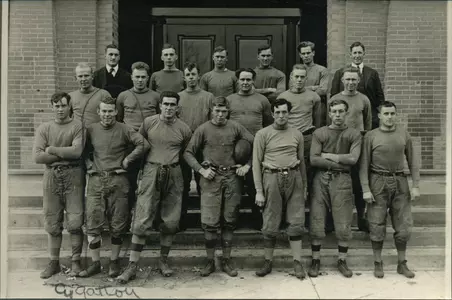
The 1915 Aggies featured Cy Gatton (circled) and Punk Taylor (with football)
Photo by: Garrett Becker
BOBCAT CALENDAR: Big Bobcat wins over the Grizzlies in 2002 and 2019 bookend a successful period in MSU football, Presented by Inland NW Toyota Dealers Association
11/23/2020 3:25:00 PM | Football
Today in 1914, a Bobcat from Bozeman was voted team captain which began a long journey for Punk Taylor
A day-by-day look at Bobcat football history...
November 23
SPOTLIGHT: In the last 18 seasons of the Treasure State's cherished football rivalry, so often one-sided and frequently tilted westward, the Bobcats and Grizzlies have each won* nine games.
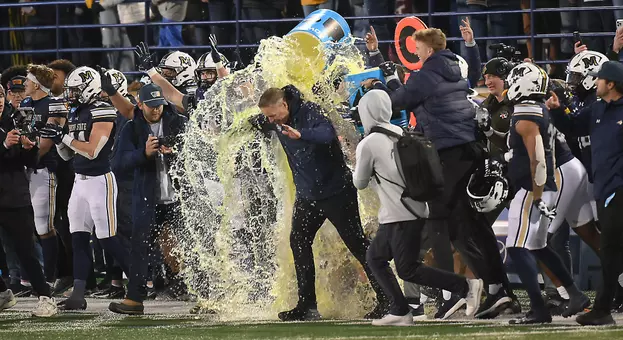
Bookending the 18-year stretch of parity is the date November 23, which staged Montana State's thrilling 10-7 win in Missoula in 2002 and the 48-14 thumping of the Grizzlies in 2019. Picking among those two ball games, or any of the seven won by the Blue and Gold that came in between, is like picking a favorite offspring. The historic nature of those two November 23 wins, though, demand closer examination.
In 2002, the Cats and Griz battled on a frigid day beneath Mt. Sentinel with Montana State looking to end 16 years of misery. The season had been somewhat magical for the Bobcats, with improbable wins and implausible losses scattered among some truly impressive performances. The Bobcats arrived at Washington-Grizzly Stadium that morning with a 6-5 record overall but a 4-2 league mark and a chance to capture a share of the Big Sky title and the league's automatic berth in the FCS Playoffs. Most outsiders felt that a nice little turnaround by MSU would end where so many Bobcat dreams had died through the years, but Mike Kramer had assembled a veteran team, forged by the fire of three challenging seasons of stop-and-start progress. Those guys believed they'd win.
In 2019, the Bobcats took the home turf with an air of swagger, but more a strong belief in the coaches and their teammates that it was clearly displayed, embraced, internalized. And the game was over before it really started. MSU pinned the Griz deep in their own territory on the opening kickoff, watched as the visitors jumped offside, and on the first snap Jahque Alleyne jarred the ball loose from Samori Toure and Derek Marks recovered the fumble. In fact, that made two consecutive Cat-Griz snaps that MSU had knocked the ball loose from a Grizzly ball carrier with Marks jumping on the loose ball.
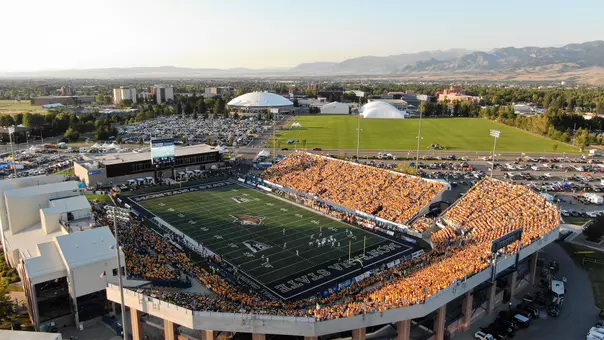
It's worth pointing out the disparate paths the two principles in that play took to the southeast corner of Bobcat Stadium. Alleyne began his career at Virginia Tech, moved to Bozeman sight unseen, paid his own way in school for a year before officially joining the team, all for a chance at a moment just like that. Marks, whose grandfather played for the Cats, grew up in Blue and Gold. He spent so many hours just a few yards away, in the stadium's south bleachers, cheering for his team.
The Bobcats fumbled on two of their first four plays, but were fortunate enough to recover those fumbles. But then, on the fifth play, receiver Kevin Kassis took the ball on an end-around. He appeared to be looking to pass, but saw an opening and dashed for the pylon. He made it into the end zone, and the excellent student celebrated with his peers, MSU students, deliriously rejoicing in the stunning turn of events.
From that moment on, it wasn't really a matter of if. It was a matter of how.
The Cats kicked a field goal on their next possession, then scored another touchdown, then scored another touchdown. Montana State led 24-0 at that point, and 31-14 at halftime, and the game was never in the slightest bit of doubt in the second half. Without key cog, Montana State rolled up 27 first downs to UM's 12, gained 382 yards on the ground, and more than doubled the Grizzlies 488 yards to 241. The 48-14 win marked the most points and second-largest margin of victory ever by MSU in this series.
It was a remarkable performance by the home team. Isaiah Ifanse rambled for 171 yards, and Logan Jones gained 121. Jones capped an amazing career that included a brillitant freshman season, periods of personal growth that included coming to grips with the discipline involved in playing for Jeff Choate, several painful injuries and the subsequent difficult rehabs. He traded the opportunity to play in the 2018 post-season for the right to enjoy a day like November 23, 2019, when the final moments of his final regular season game were greeted with an ear-to-ear grin and the adulation of the student body.
This afternoon in 2019 featured sunshine and smiles. In 2002, today's game was the kind picture a novelist or artist would paint for an important late-season game in Montana - blustery, very cold, snow flurries. At times during pregame warmups the snow obscured MSU's all-white uniforms. Against this backdrop, Montana State looked to clinch its first winning season since 1998, its first conference title since 1984, its first win against the Griz since 1985, and its first win ever in Washington-Grizzly Stadium. And MSU had to do so against the reigning national champions.
The game was a slugfest dominated by two excellent defenses. The University's football success was well-chronicled and universally understood in the fall of 2002, but even after an exhilarating resuscitation the Cats began this day mostly a curiosity, a once-proud program struggling to rise up again.
Montana State opened the scoring late in the first quarter when Nate Cook nailed a 27-yard field goal, but MSU's early offensive success was indicative that the Bobcats would at least function on this day. Freshman quarterback Travis Lulay was five-for-six passing for 43 yards in the first quarter, and MSU rushed for 35 yards in the opening period.
The day's two strongest storylines also emerged early. Senior running back Ryan Johnson rushed for 27 yards in the first quarter, a slow and steady pace that would prove imoprtant. It would also serve as the final real chapter in an amazing and historic career.
More noticeable, though, was the dominance of Montana State's defense. The Cats held UM to 37 total yards in the first quarter, all on the ground. The only Grizzly pass that didn't fall incomplete was intercepted by Roger Cooper to set up Cook's short field goal. By halftime UM had completed one of 19 pass attempts. Head coach Joe Glenn and the Grizzlies stubbornly tried to attack Bobcat cornerbacks, particularly Joey Thomas, all day. It never worked. John Edwards finished his afternoon's work 8-for-33 passing for only 106 yards. Thomas and Kahiam Hunter, MSU's other corner, dominated the day. Safeties Kane Ioane and Kenneth Qualls limited UM to only one completion of longer than 19 yards. The Bobcat defense sacked Edwards twice, and allowed UM only 3.4 yards per play on the afternoon.
MSU led 3-0 at halftime, but changed the game on the first drive of the third quarter. In a half-empty stadium, Johnson gained one yard then Lulay hit senior receiver Junior Adams for an eight-yard gain. Johnson gained one yard, then five more, then Lulay hit Scott Turnquist for a short gain. Turnquist fumbled but MSU recovered, and facing a third-and-three from the MSU 37 Lulay hit Adams again for a five yard gain. Johnson ran for five more, then David Mayfield was stopped for no gain.
Then it happened. 31 Mix Empty Left. Lulay lined up alone in the backfield, with Junior Adams in the slot to the left and Corey Smith flanked right. Lulay knew one would be open, and Adams got off the line clean. Lulay hit him in stride, and Adams raced past Trey Young. He was in the clear, and near the goal line he took a look over his shoulder to confirm what he knew.
Touchdown Bobcats.
Staked to a 10-0 lead, Montana State's staples under Kramer - a physical ground game and pressuring defense, took over. UM's only score of the day came after a Bobcat fumble on a drive that covered 32 yards. UM gained six first downs and 134 yards in the second half, mounting only one drive of more than five plays and none longer than 39 yards.
While the Grizzlies didn't do much offensively in the second half, Johnson did. He rushed for 12 yards on the first drive of the second half, 14 yards on the second, 21 on the third, six on the fifth, and 13 on the sixth. When MSU took over with two minutes to play after the Bobcat defense harassed Edwards into a fourth down incompletion, Johnson and Lulay ran out the clock. Johnson finished the day with 132 yards rushing and helped the Bobcats hold the ball for eight seconds short of 40 minutes. As Lulay fell on the ball for the final time, Voice of the Cats Dean Alexander counted down the seconds, as Bobcat fans around the world - literally - celebrated gleefully, Kramer just smiled. He knew what that moment meant to so many.
It was pretty much mirrored Jeff Choate's reaction 17 years later almost to the minute, when Montana State won a drastically different but equally historic game in 2019.
*-The Grizzlies won the 2011 game on the field but because it used ineligible players vacated the victory, whatever that means.
BONUS: The series record between Montana State and UM is stark. The Grizzlies own a 73-40 edge, with five ties. With some context, though, things seem less lopsided.
The Treasure State's two Division I schools helped form the Big Sky Conference for the 1963 football season. That year marked the first time since the dawn of the 20th century that the schools held similar footing in terms of funding, conference affiliation, and aspirations for their football program. For many of those years, the Grizzlies played in the forerunner of the Pac 12 Conference before shifting to the Skyline Conference, which morphed into the WAC and eventually the Mountain West. During those years the Bobcats belonged to the Rocky Mountain Conference, which was a national player until the league's bigger schools - Utah, Utah State, BYU, Wyoming, Colorado State and Colorado - departed in 1938. From that point on, the RMC was a small-school conference.
From 1963 until today, UM leads the Bobcats 31 wins to 26, and that is before accounting for the 2011 game.
BOBCAT GAMES ON TODAY'S DATE
2019 - #8 MSU 48, #3 Montana 14
2013 - #5 UM 28, MSU 14
2002 - MSU 10, at UM 7
1996 - UM 35, MSU 14
1996 - at UM 35, MSU 14
1946 - MSU 45, at Colo Mines 7
(Thanks go to Craig Kirwin, who provided much of the research for this note.)
FINIS: Today in 1914, members of the Montana State football team voted Radford "Punk" Taylor the team captain for the 1915 football season. Serving as a team captain today is an honor, certainly, and is a venerated position within a football program. In football's early years, though, the team captain was like the coach on the field. He generally called plays, organized the team, and was responsible for keeping things running.
Punk Taylor was born in 1894 and raised in Bozeman when it was very much a pioneer community. His father Auburn Taylor (who went by Darby) farmed and operated heavy horse-drawn wagons, also serving as a deputy sherif and local Alderman. He drew attention in the press when a street car near the Bozeman Hotel spooked his team of horses one day in 1906, and sent his "light buggy," according to the December 6, 1906, Butte Miner, streaking east on Main Street "at a wild pace." Known for above average size and strength, Taylor held the reins and eventually controlled the team near the present Main Street Exit off of I-90. The Taylors - Darby and his wife Nannie, both originally from Missouri, along with children Radford (15 at the time of the 1910 census), Horace (13), Cybbele (12), and Lousile (5) - lived on West Mendenhall. Cy Gatton and Punk Taylor helped lead Gallatin County High to the 1912 state football championship, and in the fall of 1913 matriculated down Willson and up the hill to Montana State College. Taylor and Gatton were part of a talented class of athletes that included Bill Fluhr, the best friend of Bobcat player Charlie Lange who died in the fall of 1911 from injuries suffered in football practice, along with Jay Duquette and Hubert "Slicker" Rice. Roy Strand, Montana State's president from 1937-42 and namesake of the school's Student Union, was also a member of that class.
Taylor and Gatton played for Eugene Bunker at Gallatin High in 1912, and followed their coach to campus for the 1913 season. Bunker, a former star at the University of Wisconsin who began his coaching career there, resigned before the 1914 season to tend to his burgeoning business interests and (eventual) legal practice. He apparently remained in Bozeman for the remainder of his life, serving two different terms as county attorney, and Montana State lured Utah coach Fred Bennion.
After seasons of 0-2 in 1912 and 2-2 in 1913, the Bobcats took off under Bennion, who came to Bozeman in part to study agriculture and eventually embark on a very successful career in ag extension. His first Montana State team finished 5-1, the most wins in a season to that point in school history, and he followed that with a 4-2-1 season.
Two of the program's great stars on those three teams were Taylor and Gatton. Both men earned all-state honors as sophomores in 2014, and were lauded as among the finest players at their positions in the Northwest as juniors. The 1914 vote for captaincy came down to three players when the team met at the home of Alonzo Triutt - Taylor, Myron Carr, and Gatton. Each of those three, according to the Butte Miner, were in the hospital at the time, recovering from injuries. One year later, Gatton won the captaincy, edging Taylor.
And then they were gone. The September 7, 1916 Billings Gazette noted that "'Punk' Taylor, probably the best known left tackle in the state of Montana, and Si Gatton, star fullback on the Aggie football squard (sic) last year, passed through the city yesterday en route to the University of Wisconsin at Madison, Wis., where they will attend school this year. The news that the two star players of the Aggie eleven would leave school this year was issued from the state college last week.
"Both players are well known in Billings. They have played against the local high school teams while on the Aggie lineup and also when they were mainstays of the Bozeman high school team. The two players are almost sure of berths on the Wisconsin team and they intend to try out for football on reporting at the university. They are making the journey east on a stock train."
The reasons the two hometown stars departed are open for conjecture. It seems plausible that Bunker's connections at his alma mater aided the two. Burdened with the departure of Gatton and Taylor and further hindered when seven other players were dispatched as part of the state's National Guard unit to the Mexican Border to help police skirmishes, among them Pat Morphey and Ladimer Mashin.
According to the December 9, 1916 Butte Miner, Gatton and Taylor played on Wisconsin's freshman team that fall. While failing to pass a physical necessary for induction into the U.S. Navy prior to World War I because of football injuries, Taylor eventually joined the U.S. Army. Gatton entered the Army and trained at Camp Lewis in Washington for service in the Army Air Corps, and eventually perished in the last days of the war after his plane was shot down in France.
In 1919, Taylor was back at Wisconsin, studying agriculture. While he never won a starting job for the Badgers, he was credited for some outstanding play that included a primary block on a teammate's long touchdown run against Chicago that year. During his time in Madison he worked at the school's heating plant from 6-12 pm each night.
Taylor relocated to Hardin, Montana, after his college days to work in agriculture-related fields, and in 1922 married Betty Taylor of that town. Around 1931 the Taylors moved to Peoria, Illinois, for a number of years before relocating to Memphis to manage a heavy equipment firm. He apparently remained in the Memphis area for the rest of his life, eventually operating Taylor Machinery Company.
Football, though, seems never to have left Taylor's thoughts. The March 3, 1961 Capital Times of Madison, Wisconsin, ran a story on Taylor's invention of a "muscle buggy" to be used in training a football team. Taylor came up with the idea while watching Memphis State practice The contraption was a 20 lb water tank flanked by two wheels, filled with 12 lbs of water, and a two-pronged handle. The objective was to lift the apparatus until standing upright then push if over its rear wheel. Memphis State used several of these modified wheel barrows, and Taylor also gifted some to the Wisconsin football program.
Taylor passed away on July 25, 1977, and is buried next to his wife in Germantown, Tennessee. While Gatton remained intensely popular even after leaving Bozeman, Taylor, described in the 1917 Montana as "one of those people who speak slowly and distinctly. He made a speech in Assembly once, after having played battering ram with big Bentz of Missoula, but since then his oratorical achievements have been more or less limited. Doesn't believein taking life too seriously, and even attends classes just for fun." While Gatton was cited occasionally in the Exponent during his time at Camp Lewis and while overseas before he perished, Taylor seems to have mostly faded from memory at Montana State. But that belies his legacy as a brilliant football player at his hometown high school and college.
November 23
SPOTLIGHT: In the last 18 seasons of the Treasure State's cherished football rivalry, so often one-sided and frequently tilted westward, the Bobcats and Grizzlies have each won* nine games.
Bookending the 18-year stretch of parity is the date November 23, which staged Montana State's thrilling 10-7 win in Missoula in 2002 and the 48-14 thumping of the Grizzlies in 2019. Picking among those two ball games, or any of the seven won by the Blue and Gold that came in between, is like picking a favorite offspring. The historic nature of those two November 23 wins, though, demand closer examination.
In 2002, the Cats and Griz battled on a frigid day beneath Mt. Sentinel with Montana State looking to end 16 years of misery. The season had been somewhat magical for the Bobcats, with improbable wins and implausible losses scattered among some truly impressive performances. The Bobcats arrived at Washington-Grizzly Stadium that morning with a 6-5 record overall but a 4-2 league mark and a chance to capture a share of the Big Sky title and the league's automatic berth in the FCS Playoffs. Most outsiders felt that a nice little turnaround by MSU would end where so many Bobcat dreams had died through the years, but Mike Kramer had assembled a veteran team, forged by the fire of three challenging seasons of stop-and-start progress. Those guys believed they'd win.
In 2019, the Bobcats took the home turf with an air of swagger, but more a strong belief in the coaches and their teammates that it was clearly displayed, embraced, internalized. And the game was over before it really started. MSU pinned the Griz deep in their own territory on the opening kickoff, watched as the visitors jumped offside, and on the first snap Jahque Alleyne jarred the ball loose from Samori Toure and Derek Marks recovered the fumble. In fact, that made two consecutive Cat-Griz snaps that MSU had knocked the ball loose from a Grizzly ball carrier with Marks jumping on the loose ball.
It's worth pointing out the disparate paths the two principles in that play took to the southeast corner of Bobcat Stadium. Alleyne began his career at Virginia Tech, moved to Bozeman sight unseen, paid his own way in school for a year before officially joining the team, all for a chance at a moment just like that. Marks, whose grandfather played for the Cats, grew up in Blue and Gold. He spent so many hours just a few yards away, in the stadium's south bleachers, cheering for his team.
The Bobcats fumbled on two of their first four plays, but were fortunate enough to recover those fumbles. But then, on the fifth play, receiver Kevin Kassis took the ball on an end-around. He appeared to be looking to pass, but saw an opening and dashed for the pylon. He made it into the end zone, and the excellent student celebrated with his peers, MSU students, deliriously rejoicing in the stunning turn of events.
From that moment on, it wasn't really a matter of if. It was a matter of how.
The Cats kicked a field goal on their next possession, then scored another touchdown, then scored another touchdown. Montana State led 24-0 at that point, and 31-14 at halftime, and the game was never in the slightest bit of doubt in the second half. Without key cog, Montana State rolled up 27 first downs to UM's 12, gained 382 yards on the ground, and more than doubled the Grizzlies 488 yards to 241. The 48-14 win marked the most points and second-largest margin of victory ever by MSU in this series.
It was a remarkable performance by the home team. Isaiah Ifanse rambled for 171 yards, and Logan Jones gained 121. Jones capped an amazing career that included a brillitant freshman season, periods of personal growth that included coming to grips with the discipline involved in playing for Jeff Choate, several painful injuries and the subsequent difficult rehabs. He traded the opportunity to play in the 2018 post-season for the right to enjoy a day like November 23, 2019, when the final moments of his final regular season game were greeted with an ear-to-ear grin and the adulation of the student body.
This afternoon in 2019 featured sunshine and smiles. In 2002, today's game was the kind picture a novelist or artist would paint for an important late-season game in Montana - blustery, very cold, snow flurries. At times during pregame warmups the snow obscured MSU's all-white uniforms. Against this backdrop, Montana State looked to clinch its first winning season since 1998, its first conference title since 1984, its first win against the Griz since 1985, and its first win ever in Washington-Grizzly Stadium. And MSU had to do so against the reigning national champions.
The game was a slugfest dominated by two excellent defenses. The University's football success was well-chronicled and universally understood in the fall of 2002, but even after an exhilarating resuscitation the Cats began this day mostly a curiosity, a once-proud program struggling to rise up again.
Montana State opened the scoring late in the first quarter when Nate Cook nailed a 27-yard field goal, but MSU's early offensive success was indicative that the Bobcats would at least function on this day. Freshman quarterback Travis Lulay was five-for-six passing for 43 yards in the first quarter, and MSU rushed for 35 yards in the opening period.
The day's two strongest storylines also emerged early. Senior running back Ryan Johnson rushed for 27 yards in the first quarter, a slow and steady pace that would prove imoprtant. It would also serve as the final real chapter in an amazing and historic career.
More noticeable, though, was the dominance of Montana State's defense. The Cats held UM to 37 total yards in the first quarter, all on the ground. The only Grizzly pass that didn't fall incomplete was intercepted by Roger Cooper to set up Cook's short field goal. By halftime UM had completed one of 19 pass attempts. Head coach Joe Glenn and the Grizzlies stubbornly tried to attack Bobcat cornerbacks, particularly Joey Thomas, all day. It never worked. John Edwards finished his afternoon's work 8-for-33 passing for only 106 yards. Thomas and Kahiam Hunter, MSU's other corner, dominated the day. Safeties Kane Ioane and Kenneth Qualls limited UM to only one completion of longer than 19 yards. The Bobcat defense sacked Edwards twice, and allowed UM only 3.4 yards per play on the afternoon.
MSU led 3-0 at halftime, but changed the game on the first drive of the third quarter. In a half-empty stadium, Johnson gained one yard then Lulay hit senior receiver Junior Adams for an eight-yard gain. Johnson gained one yard, then five more, then Lulay hit Scott Turnquist for a short gain. Turnquist fumbled but MSU recovered, and facing a third-and-three from the MSU 37 Lulay hit Adams again for a five yard gain. Johnson ran for five more, then David Mayfield was stopped for no gain.
Then it happened. 31 Mix Empty Left. Lulay lined up alone in the backfield, with Junior Adams in the slot to the left and Corey Smith flanked right. Lulay knew one would be open, and Adams got off the line clean. Lulay hit him in stride, and Adams raced past Trey Young. He was in the clear, and near the goal line he took a look over his shoulder to confirm what he knew.
Touchdown Bobcats.
Staked to a 10-0 lead, Montana State's staples under Kramer - a physical ground game and pressuring defense, took over. UM's only score of the day came after a Bobcat fumble on a drive that covered 32 yards. UM gained six first downs and 134 yards in the second half, mounting only one drive of more than five plays and none longer than 39 yards.
While the Grizzlies didn't do much offensively in the second half, Johnson did. He rushed for 12 yards on the first drive of the second half, 14 yards on the second, 21 on the third, six on the fifth, and 13 on the sixth. When MSU took over with two minutes to play after the Bobcat defense harassed Edwards into a fourth down incompletion, Johnson and Lulay ran out the clock. Johnson finished the day with 132 yards rushing and helped the Bobcats hold the ball for eight seconds short of 40 minutes. As Lulay fell on the ball for the final time, Voice of the Cats Dean Alexander counted down the seconds, as Bobcat fans around the world - literally - celebrated gleefully, Kramer just smiled. He knew what that moment meant to so many.
It was pretty much mirrored Jeff Choate's reaction 17 years later almost to the minute, when Montana State won a drastically different but equally historic game in 2019.
*-The Grizzlies won the 2011 game on the field but because it used ineligible players vacated the victory, whatever that means.
BONUS: The series record between Montana State and UM is stark. The Grizzlies own a 73-40 edge, with five ties. With some context, though, things seem less lopsided.
The Treasure State's two Division I schools helped form the Big Sky Conference for the 1963 football season. That year marked the first time since the dawn of the 20th century that the schools held similar footing in terms of funding, conference affiliation, and aspirations for their football program. For many of those years, the Grizzlies played in the forerunner of the Pac 12 Conference before shifting to the Skyline Conference, which morphed into the WAC and eventually the Mountain West. During those years the Bobcats belonged to the Rocky Mountain Conference, which was a national player until the league's bigger schools - Utah, Utah State, BYU, Wyoming, Colorado State and Colorado - departed in 1938. From that point on, the RMC was a small-school conference.
From 1963 until today, UM leads the Bobcats 31 wins to 26, and that is before accounting for the 2011 game.
BOBCAT GAMES ON TODAY'S DATE
2019 - #8 MSU 48, #3 Montana 14
2013 - #5 UM 28, MSU 14
2002 - MSU 10, at UM 7
1996 - UM 35, MSU 14
1996 - at UM 35, MSU 14
1946 - MSU 45, at Colo Mines 7
(Thanks go to Craig Kirwin, who provided much of the research for this note.)
FINIS: Today in 1914, members of the Montana State football team voted Radford "Punk" Taylor the team captain for the 1915 football season. Serving as a team captain today is an honor, certainly, and is a venerated position within a football program. In football's early years, though, the team captain was like the coach on the field. He generally called plays, organized the team, and was responsible for keeping things running.
Punk Taylor was born in 1894 and raised in Bozeman when it was very much a pioneer community. His father Auburn Taylor (who went by Darby) farmed and operated heavy horse-drawn wagons, also serving as a deputy sherif and local Alderman. He drew attention in the press when a street car near the Bozeman Hotel spooked his team of horses one day in 1906, and sent his "light buggy," according to the December 6, 1906, Butte Miner, streaking east on Main Street "at a wild pace." Known for above average size and strength, Taylor held the reins and eventually controlled the team near the present Main Street Exit off of I-90. The Taylors - Darby and his wife Nannie, both originally from Missouri, along with children Radford (15 at the time of the 1910 census), Horace (13), Cybbele (12), and Lousile (5) - lived on West Mendenhall. Cy Gatton and Punk Taylor helped lead Gallatin County High to the 1912 state football championship, and in the fall of 1913 matriculated down Willson and up the hill to Montana State College. Taylor and Gatton were part of a talented class of athletes that included Bill Fluhr, the best friend of Bobcat player Charlie Lange who died in the fall of 1911 from injuries suffered in football practice, along with Jay Duquette and Hubert "Slicker" Rice. Roy Strand, Montana State's president from 1937-42 and namesake of the school's Student Union, was also a member of that class.
Taylor and Gatton played for Eugene Bunker at Gallatin High in 1912, and followed their coach to campus for the 1913 season. Bunker, a former star at the University of Wisconsin who began his coaching career there, resigned before the 1914 season to tend to his burgeoning business interests and (eventual) legal practice. He apparently remained in Bozeman for the remainder of his life, serving two different terms as county attorney, and Montana State lured Utah coach Fred Bennion.
After seasons of 0-2 in 1912 and 2-2 in 1913, the Bobcats took off under Bennion, who came to Bozeman in part to study agriculture and eventually embark on a very successful career in ag extension. His first Montana State team finished 5-1, the most wins in a season to that point in school history, and he followed that with a 4-2-1 season.
Two of the program's great stars on those three teams were Taylor and Gatton. Both men earned all-state honors as sophomores in 2014, and were lauded as among the finest players at their positions in the Northwest as juniors. The 1914 vote for captaincy came down to three players when the team met at the home of Alonzo Triutt - Taylor, Myron Carr, and Gatton. Each of those three, according to the Butte Miner, were in the hospital at the time, recovering from injuries. One year later, Gatton won the captaincy, edging Taylor.
And then they were gone. The September 7, 1916 Billings Gazette noted that "'Punk' Taylor, probably the best known left tackle in the state of Montana, and Si Gatton, star fullback on the Aggie football squard (sic) last year, passed through the city yesterday en route to the University of Wisconsin at Madison, Wis., where they will attend school this year. The news that the two star players of the Aggie eleven would leave school this year was issued from the state college last week.
"Both players are well known in Billings. They have played against the local high school teams while on the Aggie lineup and also when they were mainstays of the Bozeman high school team. The two players are almost sure of berths on the Wisconsin team and they intend to try out for football on reporting at the university. They are making the journey east on a stock train."
The reasons the two hometown stars departed are open for conjecture. It seems plausible that Bunker's connections at his alma mater aided the two. Burdened with the departure of Gatton and Taylor and further hindered when seven other players were dispatched as part of the state's National Guard unit to the Mexican Border to help police skirmishes, among them Pat Morphey and Ladimer Mashin.
According to the December 9, 1916 Butte Miner, Gatton and Taylor played on Wisconsin's freshman team that fall. While failing to pass a physical necessary for induction into the U.S. Navy prior to World War I because of football injuries, Taylor eventually joined the U.S. Army. Gatton entered the Army and trained at Camp Lewis in Washington for service in the Army Air Corps, and eventually perished in the last days of the war after his plane was shot down in France.
In 1919, Taylor was back at Wisconsin, studying agriculture. While he never won a starting job for the Badgers, he was credited for some outstanding play that included a primary block on a teammate's long touchdown run against Chicago that year. During his time in Madison he worked at the school's heating plant from 6-12 pm each night.
Taylor relocated to Hardin, Montana, after his college days to work in agriculture-related fields, and in 1922 married Betty Taylor of that town. Around 1931 the Taylors moved to Peoria, Illinois, for a number of years before relocating to Memphis to manage a heavy equipment firm. He apparently remained in the Memphis area for the rest of his life, eventually operating Taylor Machinery Company.
Football, though, seems never to have left Taylor's thoughts. The March 3, 1961 Capital Times of Madison, Wisconsin, ran a story on Taylor's invention of a "muscle buggy" to be used in training a football team. Taylor came up with the idea while watching Memphis State practice The contraption was a 20 lb water tank flanked by two wheels, filled with 12 lbs of water, and a two-pronged handle. The objective was to lift the apparatus until standing upright then push if over its rear wheel. Memphis State used several of these modified wheel barrows, and Taylor also gifted some to the Wisconsin football program.
Taylor passed away on July 25, 1977, and is buried next to his wife in Germantown, Tennessee. While Gatton remained intensely popular even after leaving Bozeman, Taylor, described in the 1917 Montana as "one of those people who speak slowly and distinctly. He made a speech in Assembly once, after having played battering ram with big Bentz of Missoula, but since then his oratorical achievements have been more or less limited. Doesn't believein taking life too seriously, and even attends classes just for fun." While Gatton was cited occasionally in the Exponent during his time at Camp Lewis and while overseas before he perished, Taylor seems to have mostly faded from memory at Montana State. But that belies his legacy as a brilliant football player at his hometown high school and college.

Players Mentioned

S
/ Football
RB
/ Football
RB
/ Football
WR
/ Football
DL
/ FootballThursday, July 31
Monday, May 19
Wednesday, May 03
Wednesday, May 03