Frosty Peters at Illinois
Photo by: Courtesy Decatur Herald and Review
BOBCAT CALENDAR: From the Bobkittens to the Shadow of Red Grange to Baseball's Bush Leagues, World Record-Holder Frosty Peters Enjoyed an Amazing Career in Sports
10/31/2020 9:00:00 AM | Football
Frosty Peters may be the most famous man ever to play Montana State freshman football without advancing to the varsity
A day-by-day look at Montana State football history...
October 31
SPOTLIGHT: Nearly a century later, the "world's record" set by Montana State freshman Frosty Peters today in 1924 still pops up on occasion.
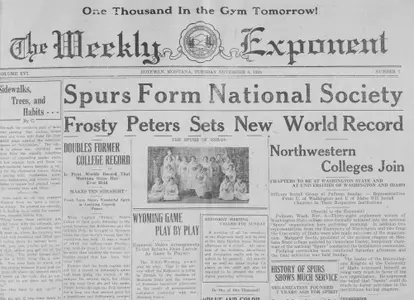
Peters captained Montana State's freshman team, the Bobkittens, in 1924 when he drop-kicked 17 field goals against Billings Polytechnic (now Rocky Mountain College). Freshman coach Schubert Dyche admitted the event was planned ahead of time, with full participation of all team members.
What is unsaid is also obvious: at a time when it was becoming obsolete because of the effectiveness of place-kicking, Peters was a heck of a drop-kicker. He was widely referred to decades after his playing career ended as the last of the great drop-kickers.
Peters' amazing day 96 years ago in his hometown is still worth a look. At one point he made 10 consecutive kicks that day, missing eight in total, and it was widely hailed not just as a world record, but as the first one ever held at Montana State. It more than doubled the mark previously set in 1900, nearly a quarter-century earlier, by a player named Robertson of Purdue, who converted eight in a game against Rose Polytechnic.
Rumors of a coordinated effort to secure Peters' moment of glory had circulated on the Bozeman campus in the days leading to the game, but the tell came early. The team captain and star player burst through the line and sailed toward the end zone, but he "deliberately dropped on the ball on the Poly 25 yard line" according to the Weekly Exponent, giving the assembled fans "their first hint that this game was to be unusual in many respects."
Things were only beginning to get weird. Reports indicate that a strong wind blew through much of Peters' three quarters (he and the starters sat out the fourth). Peters kicked seven times in the first quarter, making only three. He got hot in the second quarter, though, and spanning halftime he made 10 in a row.
The whole team was in on the plan, as the Exponent points out. "Not all the credit of winning this wonderful record goes to Captain Peters by any means. The whole freshman squad showed a remarkable team spirit in running the ball down to within 10 or 15 yards of the goal post, only to drop on the ball and give their captain another chance at his record. Once in a while a freshman back would almost forget his part in the play and would almost go over for a touchdown, and would have to retrace his steps, amid the jeers of the crowd, to the kicking position."
The game ended with a 64-0 Bobkittens win. Both of the day's touchdowns came in the fourth quarter.
Montana State's 1924 freshman team featured some amazing talent. Pop Lloyd, Herschell Hurd, Keith Ario and Dewey Cashmore all starred on that team, and would become the backbone of a successful Bobcat program over the next three years. It was a strong core which as juniors and seniors won seven of their eight Rocky Mountain Conference games.
"The Bobkitten football team had as successful a record in their schedule as the varsity with theirs," the 1925 Montanan reports. "Like the varsity, they were scored on by only one team during the entire season. In a sense, they were even more successful than the varsity because they did not lose a single game."
That group of players prepared to matriculate to the varsity as 1924 turned to 1925, but Peters would not be with them. The Billings native starred for the Bobcat track team in the spring of 1925, competing at the Drake Relays in Des Moines, Iowa. The Big Timber Pioneer mentioned that a Billings resident who had matriculated at the University of Illinois impressed upon Peters a positive notion of that school. Illinois newspaper reports indicate that legendary UI's legendary coach Bob Zuppke recruited Peters after his freshman season at Montana State. Whatever factors were involved, he transferred there for the fall of 1925.
It didn't take Peters long to turn heads in the Midwest. According to the Urbana Daily Courier of December 19, 1925: "I.F. ("Frosty") Peters and J.A. Timm showed impressive backfield talent in the varsity scrimmages and are considered good material for the two vacancies in the backfield, left by the closing of the careers of Grange and Earl Britton. Peters and Timm came from afar to attend Illinois, having been impressed with the fame of the school while attending their home high schools in Montana and Idaho, respectively, and decided to strive for collegiate glory here. Timm was chosen captain of the squad."
The Big Timber Pioneer reported on November 11, 1925, that Peters, known at Illinois as "an isolated personality," worked as a "watchdog at the Urbana fire house. For his services he is entitled to a bed, which is a necessary item with all of us. By next summer he hopes to know enough about fire fighting to act as extra fireman, but they don't have many blazes in Urbana, so 'Frosty' is not going to be overworked." The Pioneer reported that Peters rode his bike around Urbana and aspired to coach football.
By the time Peters' varsity career at Illinois began in the fall of 1926 he was already labeled "Second Red Grange," which had to be daunting for someone who had spent his year on the freshman team scrimmaging the Galloping Ghost. According to Chicago Tribune college football writer Norman E. Brown, "For some months the world has been hearing of the new 'Red' Grange of the Illinois U. football team - the man who is destined to succeed the Phantom as star of the Illini,." referring, of course, to our man Frosty.
The Illini finished 6-2 in 1926, losing only to Michigan and Ohio State, with Peters handling kicking chores and playing quarterback. Peters' impression was immediate and positive - he scored a touchdown and converted three of his four drop-kick PATs in the season opener against tiny Coe College of Iowa.
According to the November 11, 1926 Big Timber Pioneer, Peters at some point between the fall of 1926 and the next football season suffered a knee injury, and missed the 1927 campaign. While the Illini finished 7-0-1 in 1927, Peters spent at least part of the year in Helena, possibly studying at Mt. St. Charles (now Carroll) College. The school's December 21, 1927 Prospector newspaper reported that "The other day "Frosty" Peters was found sitting on the back porch intensely absorbed in study. On being asked what was the big idea he simply told us to get going and and leave him alone as he was doing his outside reading for English," and on January 23, 1928, the same publication said, "'Wooley' Gelhausen and 'Frosty' Peters, together with company, attended a very delightful matinee one afternoon last week."
Peters rejoined the Illini in 1928, and the team finished 7-1 and Big 10 Champions, with the loss coming at Michigan. Peters scored the game's only touchdown in UI's 8-0 win over Ohio State in Champaign.
As a senior, Peters' Illini finished 6-1-1, with a loss at Northwestern and a tie to Iowa. Against Kansas in 1929, according to the Decatur Daily Review (April 18, 1980) he "led the Orange and Blue attack, breaking away for a sensational 50-yard return of Captain Lyman's punt and tossing bullet passes that completely routed the Kansas defense." He completed 10 of 13 passes in Illinois' 27-0 win at Ohio State.
During Peters' three seasons on the UI varsity, Illinois rolled up a 19-4-1 record. Peters was the team's quarterback kicker each season.
Peters' reward for a fine career at Illinois was a berth in the 1930 East-West Shrine Game, and the next fall he was playing in the NFL. Not much information is available to flesh out Peters' NFL career, but he played for the Providence Steam Roller and Portsmouth Spartans in 1930, for the Brooklyn Dodgers in 1931, and the Chicago Cardinals in 1932. In 25 career NFL games, Peters is credited with two field goals and nine extra points made.
From 1933-35 he starred in professional football's minor league, earning 2nd Team All-AFL honors at quarterback for the Memphis Tigers in 1934. He was a player-coach in Memphis in 1933-34, and served in the same capacity with the St. Louis Gunners in 1935.
Although track and field may have been Peters' best sport, he returned to another pastime he learned growing up in Billings. Peters' name frequently showed up in box scores of town team baseball games throughout Montana in the 1930s, and after retiring from football he began working his way through minor league baseball's ranks as an umpire. He attended an academy conducted by sports promoter Ray Doan and National League umpire George Barr in Hot Springs, Arkansas, in 1937 as one of 30 students who toiled from February 15 through March at a cost of $50 tuition. The umpire training coincided with a players 'college' which featured instruction from stars such as Rogers Hornsby and Dizzy Dean.
Peters was one of the Doan School's 15 1937 graduates to advance into the professional ranks. He worked the Florida State League in 1937 and 1938 and was promoted to the Class AA American Association for the 1939 season. The Daytona Beach Morning Journal of November 29, 1939, said Peters was "a little more disliked than is the average umpire," and added of Peters' advancement that "our loss is the American association's loss."
After three seasons working baseball's bushes, Peters "answered one of Uncle Sam's invitations," according to the June 6, 1943, Reading Eagle, and served in the Army Air Force's Technical Training Command. Stationed at the University of Michigan, Peters called the career transition "the same old business" as umpiring, particularly directing the physical training program. In February, 1944, Peters was married to University of Michigan faculty member Margaret McLaughlin of Fairmont, Minnesota.
After World War II ended Peters resumed his umpiring career. It didn't last long, however. In the summer of 1946 he was assaulted by an American Association manager. The manager's five-game suspension and $100 fine, it seemed to Peters, was "an open invitation for everybody in the league to start punching you around." (That account comes from Negro League Baseball: The Rise and Ruin of a Black Institution, citing The Sporting News of July 24, 1946.)
According to the Decatur Herald & Review, Peters moved to Decatur, Illinois, "helping to design bridges for Warren & Van Praag" Inc. Engineering. After retiring he wintered in Texas and worked at the Scovill Golf Course managing the driving range.
Peters was a fine golfer, winning two Montana Senior Championships. A Decatur area golf pro, Rich Hammel, indicated that "he could shoot his age" and was a "phenomenal athlete."
According to the Decatur Daily Review (April 18, 1980), Forrest Ingman Peters died in his basement apartment, "privately," a demise befitting his lifestyle. Peters turned down all efforts by the University of Illinois to honor him for his playing career during his later years, and former Decatur area prep football coach Bob Mathewson who was part of the outreach process told the Daily Review that Peters "had fallen out with the U of I" because the school "had ticked him off some way and he didn't want any part of it. He was a cantankerous devil." No relatives were located in the weeks after his death, and Peters is buried in Decatur, Illinois.
GAMES ON TODAY'S DATE
2015 - at North Dakota 44, MSU 38
2009 - MSU 41, Idaho State 10
1998 - MSU 32, Northern Arizona 25
1992 - MSU 17, Boise State 13
1987 - UM 16, MSU 9
1981 - UM 27, MSU 17
1970 - Idaho 37, MSU 24
1964 - at North Dakota 9, MSU 7
1959 - MSU 35, North Dakota 14
1954 - MSU 22, Idaho State 13
1953 - Idaho St 13, MSU 0
1924 - Frosty Peters drop-kicked 17 field goals for the Bobkitten freshmen team against Billings Poly (now Rocky Mountain College) to set a world record.
1908 - MSU 0, Montana Tech 0
1903 - MSU 0, Montana Tech 0
FINIS: Two of Montana State's 33 all-time ties happened on this date in the school's first 10 seasons of football. Both were scoreless ties with Montana Tech in Bozeman. In fact, they were consecutive meetings in the series because the schools didn't meet in 1904 or 1905 and Montana State didn't play football in 1906 or 1907.
October 31
SPOTLIGHT: Nearly a century later, the "world's record" set by Montana State freshman Frosty Peters today in 1924 still pops up on occasion.
Peters captained Montana State's freshman team, the Bobkittens, in 1924 when he drop-kicked 17 field goals against Billings Polytechnic (now Rocky Mountain College). Freshman coach Schubert Dyche admitted the event was planned ahead of time, with full participation of all team members.
What is unsaid is also obvious: at a time when it was becoming obsolete because of the effectiveness of place-kicking, Peters was a heck of a drop-kicker. He was widely referred to decades after his playing career ended as the last of the great drop-kickers.
Peters' amazing day 96 years ago in his hometown is still worth a look. At one point he made 10 consecutive kicks that day, missing eight in total, and it was widely hailed not just as a world record, but as the first one ever held at Montana State. It more than doubled the mark previously set in 1900, nearly a quarter-century earlier, by a player named Robertson of Purdue, who converted eight in a game against Rose Polytechnic.
Rumors of a coordinated effort to secure Peters' moment of glory had circulated on the Bozeman campus in the days leading to the game, but the tell came early. The team captain and star player burst through the line and sailed toward the end zone, but he "deliberately dropped on the ball on the Poly 25 yard line" according to the Weekly Exponent, giving the assembled fans "their first hint that this game was to be unusual in many respects."
Things were only beginning to get weird. Reports indicate that a strong wind blew through much of Peters' three quarters (he and the starters sat out the fourth). Peters kicked seven times in the first quarter, making only three. He got hot in the second quarter, though, and spanning halftime he made 10 in a row.
The whole team was in on the plan, as the Exponent points out. "Not all the credit of winning this wonderful record goes to Captain Peters by any means. The whole freshman squad showed a remarkable team spirit in running the ball down to within 10 or 15 yards of the goal post, only to drop on the ball and give their captain another chance at his record. Once in a while a freshman back would almost forget his part in the play and would almost go over for a touchdown, and would have to retrace his steps, amid the jeers of the crowd, to the kicking position."
The game ended with a 64-0 Bobkittens win. Both of the day's touchdowns came in the fourth quarter.
Montana State's 1924 freshman team featured some amazing talent. Pop Lloyd, Herschell Hurd, Keith Ario and Dewey Cashmore all starred on that team, and would become the backbone of a successful Bobcat program over the next three years. It was a strong core which as juniors and seniors won seven of their eight Rocky Mountain Conference games.
"The Bobkitten football team had as successful a record in their schedule as the varsity with theirs," the 1925 Montanan reports. "Like the varsity, they were scored on by only one team during the entire season. In a sense, they were even more successful than the varsity because they did not lose a single game."
That group of players prepared to matriculate to the varsity as 1924 turned to 1925, but Peters would not be with them. The Billings native starred for the Bobcat track team in the spring of 1925, competing at the Drake Relays in Des Moines, Iowa. The Big Timber Pioneer mentioned that a Billings resident who had matriculated at the University of Illinois impressed upon Peters a positive notion of that school. Illinois newspaper reports indicate that legendary UI's legendary coach Bob Zuppke recruited Peters after his freshman season at Montana State. Whatever factors were involved, he transferred there for the fall of 1925.
It didn't take Peters long to turn heads in the Midwest. According to the Urbana Daily Courier of December 19, 1925: "I.F. ("Frosty") Peters and J.A. Timm showed impressive backfield talent in the varsity scrimmages and are considered good material for the two vacancies in the backfield, left by the closing of the careers of Grange and Earl Britton. Peters and Timm came from afar to attend Illinois, having been impressed with the fame of the school while attending their home high schools in Montana and Idaho, respectively, and decided to strive for collegiate glory here. Timm was chosen captain of the squad."
The Big Timber Pioneer reported on November 11, 1925, that Peters, known at Illinois as "an isolated personality," worked as a "watchdog at the Urbana fire house. For his services he is entitled to a bed, which is a necessary item with all of us. By next summer he hopes to know enough about fire fighting to act as extra fireman, but they don't have many blazes in Urbana, so 'Frosty' is not going to be overworked." The Pioneer reported that Peters rode his bike around Urbana and aspired to coach football.
By the time Peters' varsity career at Illinois began in the fall of 1926 he was already labeled "Second Red Grange," which had to be daunting for someone who had spent his year on the freshman team scrimmaging the Galloping Ghost. According to Chicago Tribune college football writer Norman E. Brown, "For some months the world has been hearing of the new 'Red' Grange of the Illinois U. football team - the man who is destined to succeed the Phantom as star of the Illini,." referring, of course, to our man Frosty.
The Illini finished 6-2 in 1926, losing only to Michigan and Ohio State, with Peters handling kicking chores and playing quarterback. Peters' impression was immediate and positive - he scored a touchdown and converted three of his four drop-kick PATs in the season opener against tiny Coe College of Iowa.
According to the November 11, 1926 Big Timber Pioneer, Peters at some point between the fall of 1926 and the next football season suffered a knee injury, and missed the 1927 campaign. While the Illini finished 7-0-1 in 1927, Peters spent at least part of the year in Helena, possibly studying at Mt. St. Charles (now Carroll) College. The school's December 21, 1927 Prospector newspaper reported that "The other day "Frosty" Peters was found sitting on the back porch intensely absorbed in study. On being asked what was the big idea he simply told us to get going and and leave him alone as he was doing his outside reading for English," and on January 23, 1928, the same publication said, "'Wooley' Gelhausen and 'Frosty' Peters, together with company, attended a very delightful matinee one afternoon last week."
Peters rejoined the Illini in 1928, and the team finished 7-1 and Big 10 Champions, with the loss coming at Michigan. Peters scored the game's only touchdown in UI's 8-0 win over Ohio State in Champaign.
As a senior, Peters' Illini finished 6-1-1, with a loss at Northwestern and a tie to Iowa. Against Kansas in 1929, according to the Decatur Daily Review (April 18, 1980) he "led the Orange and Blue attack, breaking away for a sensational 50-yard return of Captain Lyman's punt and tossing bullet passes that completely routed the Kansas defense." He completed 10 of 13 passes in Illinois' 27-0 win at Ohio State.
During Peters' three seasons on the UI varsity, Illinois rolled up a 19-4-1 record. Peters was the team's quarterback kicker each season.
Peters' reward for a fine career at Illinois was a berth in the 1930 East-West Shrine Game, and the next fall he was playing in the NFL. Not much information is available to flesh out Peters' NFL career, but he played for the Providence Steam Roller and Portsmouth Spartans in 1930, for the Brooklyn Dodgers in 1931, and the Chicago Cardinals in 1932. In 25 career NFL games, Peters is credited with two field goals and nine extra points made.
From 1933-35 he starred in professional football's minor league, earning 2nd Team All-AFL honors at quarterback for the Memphis Tigers in 1934. He was a player-coach in Memphis in 1933-34, and served in the same capacity with the St. Louis Gunners in 1935.
Although track and field may have been Peters' best sport, he returned to another pastime he learned growing up in Billings. Peters' name frequently showed up in box scores of town team baseball games throughout Montana in the 1930s, and after retiring from football he began working his way through minor league baseball's ranks as an umpire. He attended an academy conducted by sports promoter Ray Doan and National League umpire George Barr in Hot Springs, Arkansas, in 1937 as one of 30 students who toiled from February 15 through March at a cost of $50 tuition. The umpire training coincided with a players 'college' which featured instruction from stars such as Rogers Hornsby and Dizzy Dean.
Peters was one of the Doan School's 15 1937 graduates to advance into the professional ranks. He worked the Florida State League in 1937 and 1938 and was promoted to the Class AA American Association for the 1939 season. The Daytona Beach Morning Journal of November 29, 1939, said Peters was "a little more disliked than is the average umpire," and added of Peters' advancement that "our loss is the American association's loss."
After three seasons working baseball's bushes, Peters "answered one of Uncle Sam's invitations," according to the June 6, 1943, Reading Eagle, and served in the Army Air Force's Technical Training Command. Stationed at the University of Michigan, Peters called the career transition "the same old business" as umpiring, particularly directing the physical training program. In February, 1944, Peters was married to University of Michigan faculty member Margaret McLaughlin of Fairmont, Minnesota.
After World War II ended Peters resumed his umpiring career. It didn't last long, however. In the summer of 1946 he was assaulted by an American Association manager. The manager's five-game suspension and $100 fine, it seemed to Peters, was "an open invitation for everybody in the league to start punching you around." (That account comes from Negro League Baseball: The Rise and Ruin of a Black Institution, citing The Sporting News of July 24, 1946.)
According to the Decatur Herald & Review, Peters moved to Decatur, Illinois, "helping to design bridges for Warren & Van Praag" Inc. Engineering. After retiring he wintered in Texas and worked at the Scovill Golf Course managing the driving range.
Peters was a fine golfer, winning two Montana Senior Championships. A Decatur area golf pro, Rich Hammel, indicated that "he could shoot his age" and was a "phenomenal athlete."
According to the Decatur Daily Review (April 18, 1980), Forrest Ingman Peters died in his basement apartment, "privately," a demise befitting his lifestyle. Peters turned down all efforts by the University of Illinois to honor him for his playing career during his later years, and former Decatur area prep football coach Bob Mathewson who was part of the outreach process told the Daily Review that Peters "had fallen out with the U of I" because the school "had ticked him off some way and he didn't want any part of it. He was a cantankerous devil." No relatives were located in the weeks after his death, and Peters is buried in Decatur, Illinois.
GAMES ON TODAY'S DATE
2015 - at North Dakota 44, MSU 38
2009 - MSU 41, Idaho State 10
1998 - MSU 32, Northern Arizona 25
1992 - MSU 17, Boise State 13
1987 - UM 16, MSU 9
1981 - UM 27, MSU 17
1970 - Idaho 37, MSU 24
1964 - at North Dakota 9, MSU 7
1959 - MSU 35, North Dakota 14
1954 - MSU 22, Idaho State 13
1953 - Idaho St 13, MSU 0
1924 - Frosty Peters drop-kicked 17 field goals for the Bobkitten freshmen team against Billings Poly (now Rocky Mountain College) to set a world record.
1908 - MSU 0, Montana Tech 0
1903 - MSU 0, Montana Tech 0
FINIS: Two of Montana State's 33 all-time ties happened on this date in the school's first 10 seasons of football. Both were scoreless ties with Montana Tech in Bozeman. In fact, they were consecutive meetings in the series because the schools didn't meet in 1904 or 1905 and Montana State didn't play football in 1906 or 1907.

Thursday, July 31
Monday, May 19
Wednesday, May 03
Wednesday, May 03