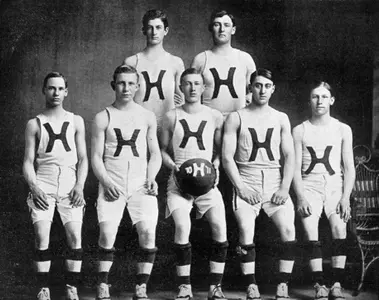
Charles Lange (front, second from left) with 1911 Helena High Basketball Team
Photo by: Courtesy Helena Independent-Record
BOBCAT CALENDAR: Tragedy Struck Montana State Football Today in 1911
10/28/2020 9:00:00 AM | Football
Freshman halfback Charles Lange died of injuries suffered in an intrasquad scrimmage
A day-by-day look at Bobcat football history...
October 28
SPOTLIGHT: It's lost to history when the Montana Agricultural College's football team learned that teammate Charlie Lange had passed away.
The Aggies were in Salt Lake City to play Utah today in 1911, two days after losing to Utah State in Logan. Given that the Utah game ended in a 97-0 defeat - "The Aggies... never once had any kind of a chance to score - to say nothing of wining" is how the Utah Weekly Chronicle described the game - it's possible to think the team knew of Lange's fate before kickoff. Since that is mentioned nowhere in the advance information, though, it seems unlikely. During an intrasquad scrimmage on October 9, the Bozeman Chronicle reported that the MAC freshman, "one of Helena's best athletes, was fallen upon in such a manner that the knee of another player was driven into the back of his neck."
"Fat" Lange came to Bozeman with a reputation as a scrapper on the gridiron and a gritty basketball player, and since he earned an appointment to the U.S. Naval Academy as an alternate it can be assumed he was the he excelled academically and was an admirable citizen. Former Helena newspaperman and esteemed historian Curt Synness wrote in the Helena Independent-Record in 2010 about Lange's early weeks in Bozeman: "Determined to make the football squad, the tough 19-year old freshman did not miss a practice."
Football in the 1910s was substantially different than the game we know today. The forward pass had yet to open the up play, players massed around the ball with no player more than five yards from the line of scrimmage and ends aligned within two arm's reach of tackles. Viewing video from this era is disorienting because deception is the primary offensive component. Serious injuries happened regularly, and death was not uncommon.
According to the October 13 Weekly Exponent, the injury occurred while Lange "was advancing the ball for the first team. He was tackled by a player from behind and at that instant collided with one advancing from the front. No blame rests on any particular player, it being one of the unavoidable accidents of life."
Dr. J. E. Ragsdale was present, and supervised Lange's transportation to Bozeman Deaconess Hospital downtown. Many members of the student body visited "and in other ways showed support."
After surgery on Sunday, October 15, the Weekly Exponent reported that Lange "is resting easy..." Lange's fractured fifth right vertebrae was repaired to alleviate pressure on the spinal cord, and the procedure "promises to be successful and if so will be one of the most delicate and difficult ever performed successfully in the West. It is now thought that feeling is returning to the chest and down the back. The paralysis has been complete from the armpits down." Lange's mother remained with him in Bozeman but the rest of his family returned to Helena, and the effects of the paralysis were thought to be measured in months.
On October 27, the day before his death, the Weekly Exponent that Lange was moved to his parents' home in Helena, and that his "condition remains about the same as it had been for several days, the operation having thus far failed to relieve the paralysis. The case is not altogether hopeless, though it is admittedly serious."
According to Synness' reporting, however, Lange's condition was deteriorating. The fever that the Exponent mentioned developed into pneumonia. He asked to see his hometown friends, and "one by one, he bade them farewell, and he was the most cheerful of the sad dozens who visited," according to the Chronicle. Lange emphasized repeatedly that "it was an accident" to relieve those involved of blame, and he told family and visitors in the hours before his death, "It is better that I should die, than to stay alive like this."
Lange passed away in his home around 3 pm on October 28, 1911, leaving behind his parents, Mr. and Mrs. Frank J. Lange, brother Fred, and sister Virginia. Among the pall bearers at his funeral were William Fluhr, a friend who enrolled at Montana State and played football in the fall of 1912.
A pall understandably descended on the Bozeman campus, and the football team canceled the remainder of its season. While the sport returned to Montana State in 1912, Helena High shelved its program for the next eight years, according to Synness, not returning until the fall of 1919. One of those who helped revive the program was Lange's boyhood friend Fluhr, who by then was coaching basketball at Carroll College.
GAMES ON TODAY'S DATE
2017 - MSU 28, Idaho State 14
2006 - MSU 24, at Weber St 18
2000 - at NAU 32, MSU 9
1995 - EWU 28, MSU 10
1989 - MSU 31, Weber State 27
1978 - NAU 43, MSU 22
1972 - Idaho St 20, MSU 16
1967 - MSU 20, North Dakota 16
1961 - Idaho St 14, MSU 12
1950 - Colo Coll 34, MSU 18 HC
1939 - MSU 10, Idaho St 6
1933 - MSU 19, Montana Tech 0
1922 - MSU 10, at Montana Tech 0
1916 - All-Stars 6, MSU 0
1913 - MSU 13, Utah State 0 first win against out-of-state opponent
1911 - at Utah 97, MSU 0
1910 - MSU 0, Montana Tech 0
1908 - MSU 24, Gallatin High 4
FINIS: Two notes from that Utah-Montana State game more than a century ago may bring a smile to Bobcat fans' faces all this time later. First, Utah coach Fred Bennion would be leading the three seasons later. Second, the presence of one Ute seemed to draw the attention of several Montana Agricultural College players. According to the Weekly Chronicle: "From the local view point, the game's one big feature was the brilliant broken field running of the back field. In this, as is usually the case, Captain Romney was always conspicuous. His weight, strength, and style of advance constantly 'annoyed' the Bozeman eleven. In this 'feature' end of it, however, Romney didn't stand alone for with him, and at no great distance, came Ashton, Sutherland, Fitzpatrick and Holmstead..."
Captain Romney, of course, would play for the Bobcats three seasons later. He would coach the Bobcats beginning 11 years later. And to this day he has a building named for him on the Montana State campus.
October 28
SPOTLIGHT: It's lost to history when the Montana Agricultural College's football team learned that teammate Charlie Lange had passed away.
The Aggies were in Salt Lake City to play Utah today in 1911, two days after losing to Utah State in Logan. Given that the Utah game ended in a 97-0 defeat - "The Aggies... never once had any kind of a chance to score - to say nothing of wining" is how the Utah Weekly Chronicle described the game - it's possible to think the team knew of Lange's fate before kickoff. Since that is mentioned nowhere in the advance information, though, it seems unlikely. During an intrasquad scrimmage on October 9, the Bozeman Chronicle reported that the MAC freshman, "one of Helena's best athletes, was fallen upon in such a manner that the knee of another player was driven into the back of his neck."
"Fat" Lange came to Bozeman with a reputation as a scrapper on the gridiron and a gritty basketball player, and since he earned an appointment to the U.S. Naval Academy as an alternate it can be assumed he was the he excelled academically and was an admirable citizen. Former Helena newspaperman and esteemed historian Curt Synness wrote in the Helena Independent-Record in 2010 about Lange's early weeks in Bozeman: "Determined to make the football squad, the tough 19-year old freshman did not miss a practice."
Football in the 1910s was substantially different than the game we know today. The forward pass had yet to open the up play, players massed around the ball with no player more than five yards from the line of scrimmage and ends aligned within two arm's reach of tackles. Viewing video from this era is disorienting because deception is the primary offensive component. Serious injuries happened regularly, and death was not uncommon.
According to the October 13 Weekly Exponent, the injury occurred while Lange "was advancing the ball for the first team. He was tackled by a player from behind and at that instant collided with one advancing from the front. No blame rests on any particular player, it being one of the unavoidable accidents of life."
Dr. J. E. Ragsdale was present, and supervised Lange's transportation to Bozeman Deaconess Hospital downtown. Many members of the student body visited "and in other ways showed support."
After surgery on Sunday, October 15, the Weekly Exponent reported that Lange "is resting easy..." Lange's fractured fifth right vertebrae was repaired to alleviate pressure on the spinal cord, and the procedure "promises to be successful and if so will be one of the most delicate and difficult ever performed successfully in the West. It is now thought that feeling is returning to the chest and down the back. The paralysis has been complete from the armpits down." Lange's mother remained with him in Bozeman but the rest of his family returned to Helena, and the effects of the paralysis were thought to be measured in months.
On October 27, the day before his death, the Weekly Exponent that Lange was moved to his parents' home in Helena, and that his "condition remains about the same as it had been for several days, the operation having thus far failed to relieve the paralysis. The case is not altogether hopeless, though it is admittedly serious."
According to Synness' reporting, however, Lange's condition was deteriorating. The fever that the Exponent mentioned developed into pneumonia. He asked to see his hometown friends, and "one by one, he bade them farewell, and he was the most cheerful of the sad dozens who visited," according to the Chronicle. Lange emphasized repeatedly that "it was an accident" to relieve those involved of blame, and he told family and visitors in the hours before his death, "It is better that I should die, than to stay alive like this."
Lange passed away in his home around 3 pm on October 28, 1911, leaving behind his parents, Mr. and Mrs. Frank J. Lange, brother Fred, and sister Virginia. Among the pall bearers at his funeral were William Fluhr, a friend who enrolled at Montana State and played football in the fall of 1912.
A pall understandably descended on the Bozeman campus, and the football team canceled the remainder of its season. While the sport returned to Montana State in 1912, Helena High shelved its program for the next eight years, according to Synness, not returning until the fall of 1919. One of those who helped revive the program was Lange's boyhood friend Fluhr, who by then was coaching basketball at Carroll College.
GAMES ON TODAY'S DATE
2017 - MSU 28, Idaho State 14
2006 - MSU 24, at Weber St 18
2000 - at NAU 32, MSU 9
1995 - EWU 28, MSU 10
1989 - MSU 31, Weber State 27
1978 - NAU 43, MSU 22
1972 - Idaho St 20, MSU 16
1967 - MSU 20, North Dakota 16
1961 - Idaho St 14, MSU 12
1950 - Colo Coll 34, MSU 18 HC
1939 - MSU 10, Idaho St 6
1933 - MSU 19, Montana Tech 0
1922 - MSU 10, at Montana Tech 0
1916 - All-Stars 6, MSU 0
1913 - MSU 13, Utah State 0 first win against out-of-state opponent
1911 - at Utah 97, MSU 0
1910 - MSU 0, Montana Tech 0
1908 - MSU 24, Gallatin High 4
FINIS: Two notes from that Utah-Montana State game more than a century ago may bring a smile to Bobcat fans' faces all this time later. First, Utah coach Fred Bennion would be leading the three seasons later. Second, the presence of one Ute seemed to draw the attention of several Montana Agricultural College players. According to the Weekly Chronicle: "From the local view point, the game's one big feature was the brilliant broken field running of the back field. In this, as is usually the case, Captain Romney was always conspicuous. His weight, strength, and style of advance constantly 'annoyed' the Bozeman eleven. In this 'feature' end of it, however, Romney didn't stand alone for with him, and at no great distance, came Ashton, Sutherland, Fitzpatrick and Holmstead..."
Captain Romney, of course, would play for the Bobcats three seasons later. He would coach the Bobcats beginning 11 years later. And to this day he has a building named for him on the Montana State campus.
Thursday, July 31
Monday, May 19
Wednesday, May 03
Wednesday, May 03