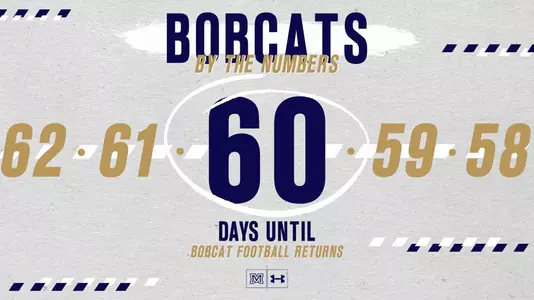
BOBCATS BY THE NUMBERS: 60 Days Before Kickoff, and the First Touchdown Pass in Cat-Griz History
7/2/2019 3:00:00 PM | Football
A "Pennsylvania Double Pass" accounted for the first aerial strike in a Cat-Griz game
July 2: In addition to a quick look at players wearing the jersey number corresponding to the number of days remaining until Montana State's season opener at Texas Tech on August 31, Bobcats by the Numbers brings you another tidbit or two aligning with that number.
#60
Rylan Wilcox, DL: A walk-on from Big Sky High in Missoula, Rylan Wilcox enters his redshirt freshman season as a developmental offensive lineman. At 6-3, 220, Wilcox is projected as a tackle.
60 – Yards covered on the first passing touchdown of the Cat-Griz rivalry
First things first: the game of football looked a lot different 110 years ago than it does today, so you'll have to use quite a bit of imagination to conjure an image of Montana State's only score in a 15-5 loss to the University in 1909. Trailing 6-0 (touchdowns of the time were worth five points), Montana State possessed in the second quarter. Quarterback Bill Tremper took the snap and lateraled to Jack Taylor. Taylor then fired a forward pass to end Louis Pool, who raced 60 yards for the touchdown on what was called a "Pennsylvania double-pass play." That was the only play Montana State could muster. Minnesota transfer William Ittner scored a pair of touchdowns for the University. (Information for this note pulled from old Exponent articles, Montana's Greatest Rivalry by Tom Donovan, and The Divide War by Pat Kearney.)
Chronology: Charles Jackson (1956-59), John Munk (1961), Gary Carle (1963-65), Rod Purdom (1966-67), Eric Wheeler (1968), Terry Totten (1970-71), Gary Wright (1972-74), Mike Tarbox (1975), Grant Fleming (1976), Chris Lofgren (1977), Ron Torchia (1978-79), Don Davis (1980), Brian Strong (1982-83), Todd Vasey (1984-86), Tom Walters (1987), Jeff Newton (1988-89), Scott Eaton (1990), Martin Nava (1992-93), Clay Allard (1994-95), Levi Casey (1996-97), Eric Ecker (1999), Brent Swaggert (2000-03), Dylan Kinkelaar (2004-08), Odin Coe (2011-12), Dylan Mahoney (2013-15), Taylor Tuiasosopo (2016-17), Rylan Wilcox (2018-)
Other #60 Notes: If you were a Bobcat fan in the mid-2000s, how could you not love Dylan Kinkelaar? A star for tiny Winifred, he helped lead the Red Raiders to an 8-man playoff berth for the first time since 1981 (the school did manage some 6-man playoff success in the interim – hat-tip to Fritz Neighbor for his great story on Winfred in the October 13, 2002 Billings Gazette). Kinkelaar arrived as an unknown walk-on and redshirted in 2004, seeing hardly any action in 2005. But in 2006 he played in all 13 games for an FCS Playoff team, and a season later he played in all 11 games. He was a spot starter each of those seasons, and earned MSU's starting defensive end spot entering his senior season. He got off to a great start, but in the team's third game at Minnesota suffered a broken ankle. It was thought that his career was over, but Kinkelaar seemingly willed his body to heal, and returned after missing just five games. He logged a sack in his first game back against Northern Colorado, one of the team's most inspirational plays of the season, and had three-and-a-half tackles-for-loss and two-and-a-half sacks over the last four games. Not ony did Kinkelaar become a tremendous player as a Bobcat, working his way from literally the ground floor of the program, but he was a scholar. He distinguished himself at MSU for his research in th area of artificially inseminating cattle. More importantly, Kinkelaar was a strong building block in the foundation of in-state players in general, and walk-ons from small, rural high schools in particular, that allowed Mike Kramer and then Rob Ash to build and maintain a championship program, enjoying prosperity while surviving extreme turbulence… The journey and story of Charlie Jackson – as he was known during his time at Montana State in the late 1950s – is one of the program's most unique and interesting. A Navy man who played fullback in the service, he was brought to Bozeman by assistant coach Herb Agocs as the first African-American to play at Montana State. Jackson earned his Army commission through the school's ROTC program, then re-launched his career as an officer for more than two decades. He also started his family, which included a son that would play football at East Carolina, in Bozeman. While the narrative is fascinating, the football portion of the equation is enough to land Charles Henry Jackson in the BBTN Spotlight. He transitioned to guard upon arriving at Montana State, and for four seasons lined up next to center (and linebacker) Sonny Holland. Jackson earned honorable mention all-league honors in the school's final season in the Rocky Mountain Conference, and was selected as an honorable mention small school All-America the next two seasons. During his four seasons at Montana State he helped form the heart of a program that included Holland, Dave Alt, Rocco Perciavalle, and a number of players considered among the top Bobcats ever. That group compiled a 35-6-1 record over that time, and Jackson was part and parcel of that success. He may not be mentioned early when Bobcat fans rattle off the top players in program history, but with his athleticism, track record of success, and accolades certainly land him on that list.
#60
Rylan Wilcox, DL: A walk-on from Big Sky High in Missoula, Rylan Wilcox enters his redshirt freshman season as a developmental offensive lineman. At 6-3, 220, Wilcox is projected as a tackle.
60 – Yards covered on the first passing touchdown of the Cat-Griz rivalry
First things first: the game of football looked a lot different 110 years ago than it does today, so you'll have to use quite a bit of imagination to conjure an image of Montana State's only score in a 15-5 loss to the University in 1909. Trailing 6-0 (touchdowns of the time were worth five points), Montana State possessed in the second quarter. Quarterback Bill Tremper took the snap and lateraled to Jack Taylor. Taylor then fired a forward pass to end Louis Pool, who raced 60 yards for the touchdown on what was called a "Pennsylvania double-pass play." That was the only play Montana State could muster. Minnesota transfer William Ittner scored a pair of touchdowns for the University. (Information for this note pulled from old Exponent articles, Montana's Greatest Rivalry by Tom Donovan, and The Divide War by Pat Kearney.)
Chronology: Charles Jackson (1956-59), John Munk (1961), Gary Carle (1963-65), Rod Purdom (1966-67), Eric Wheeler (1968), Terry Totten (1970-71), Gary Wright (1972-74), Mike Tarbox (1975), Grant Fleming (1976), Chris Lofgren (1977), Ron Torchia (1978-79), Don Davis (1980), Brian Strong (1982-83), Todd Vasey (1984-86), Tom Walters (1987), Jeff Newton (1988-89), Scott Eaton (1990), Martin Nava (1992-93), Clay Allard (1994-95), Levi Casey (1996-97), Eric Ecker (1999), Brent Swaggert (2000-03), Dylan Kinkelaar (2004-08), Odin Coe (2011-12), Dylan Mahoney (2013-15), Taylor Tuiasosopo (2016-17), Rylan Wilcox (2018-)
Other #60 Notes: If you were a Bobcat fan in the mid-2000s, how could you not love Dylan Kinkelaar? A star for tiny Winifred, he helped lead the Red Raiders to an 8-man playoff berth for the first time since 1981 (the school did manage some 6-man playoff success in the interim – hat-tip to Fritz Neighbor for his great story on Winfred in the October 13, 2002 Billings Gazette). Kinkelaar arrived as an unknown walk-on and redshirted in 2004, seeing hardly any action in 2005. But in 2006 he played in all 13 games for an FCS Playoff team, and a season later he played in all 11 games. He was a spot starter each of those seasons, and earned MSU's starting defensive end spot entering his senior season. He got off to a great start, but in the team's third game at Minnesota suffered a broken ankle. It was thought that his career was over, but Kinkelaar seemingly willed his body to heal, and returned after missing just five games. He logged a sack in his first game back against Northern Colorado, one of the team's most inspirational plays of the season, and had three-and-a-half tackles-for-loss and two-and-a-half sacks over the last four games. Not ony did Kinkelaar become a tremendous player as a Bobcat, working his way from literally the ground floor of the program, but he was a scholar. He distinguished himself at MSU for his research in th area of artificially inseminating cattle. More importantly, Kinkelaar was a strong building block in the foundation of in-state players in general, and walk-ons from small, rural high schools in particular, that allowed Mike Kramer and then Rob Ash to build and maintain a championship program, enjoying prosperity while surviving extreme turbulence… The journey and story of Charlie Jackson – as he was known during his time at Montana State in the late 1950s – is one of the program's most unique and interesting. A Navy man who played fullback in the service, he was brought to Bozeman by assistant coach Herb Agocs as the first African-American to play at Montana State. Jackson earned his Army commission through the school's ROTC program, then re-launched his career as an officer for more than two decades. He also started his family, which included a son that would play football at East Carolina, in Bozeman. While the narrative is fascinating, the football portion of the equation is enough to land Charles Henry Jackson in the BBTN Spotlight. He transitioned to guard upon arriving at Montana State, and for four seasons lined up next to center (and linebacker) Sonny Holland. Jackson earned honorable mention all-league honors in the school's final season in the Rocky Mountain Conference, and was selected as an honorable mention small school All-America the next two seasons. During his four seasons at Montana State he helped form the heart of a program that included Holland, Dave Alt, Rocco Perciavalle, and a number of players considered among the top Bobcats ever. That group compiled a 35-6-1 record over that time, and Jackson was part and parcel of that success. He may not be mentioned early when Bobcat fans rattle off the top players in program history, but with his athleticism, track record of success, and accolades certainly land him on that list.
Players Mentioned


Leon Costello Press Conference: Kennedy-Stark Athletic Center
Thursday, July 31
A Conversation with President Dr. Waded Cruzado | Montana State Athletics
Monday, May 19
Big Cats, Little Trucks - Willie Patterson
Wednesday, May 03
Matt Houk Introductory Press Conference
Wednesday, May 03