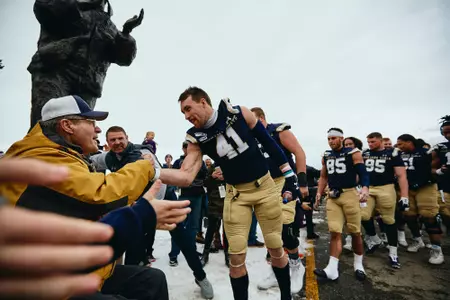
Sonny Holland greets Brayden Konkol before the MSU-UAlbany Playoff Game
Photo by: Adrian Sanchez-Gonzalez
BOBCAT HISTORY LESSON; A look at the Beginning of the MSU-NDSU Rivalry, and at a Man Who's Seen So Much Bobcat History
12/20/2019 3:00:00 PM | Football
The series between Montana State and North Dakota State began in 1914 at the Gallatin County Fairgrounds
Montana State retraces some historic footsteps on Saturday, heading to Fargo, North Dakota, to rekindle a post-season series that dates back over four decades. Here is a look at the beginning of MSU's series with the Bison, and at a man who has been a part of so much Bobcat history:
All-Time Series: Montana State leads the series 21-14, including a 14-4 edge in Bozeman and a 3-2 mark at neutral sites. The Bison, however, have doubled up the Cats 8-4 in Fargo, including 1-0 in the Fargodome.
In the Post-Season: North Dakota State leads 2-1 in the post-season, having beaten the Bobcats in the second round in 2010 (42-17 in Bozeman) and 2018 (52-10 in Fargo). Montana State won 10-3 in a 1976 semifinal contest.
Streaks and Stuff
The Bison have won two straight in the series, and own a two-game streak against MSU in Fargo, as well. North Dakota State's longest streak in the series is eight games – more than half the Bison wins against the Cats – between 1964 and 1971. That encompasses part of a long stretch of success for the Bobcat football program, but in that time NDSU beat three Big Sky Championship teams and two that played in bowl games. When discussing streaks and North Dakota State, however, the conversation begins and ends with the incredible 35 straight win this Bison team has compiled. It is the longest Division I streak in college football's two-platoon era. Only the 1953-57 Oklahoma Sooners (47 straight wins), the 1908-14 Washington Huskies (40 wins in a row) and a pair of 19th century Yale teams that each won 37 straight in a game that what fans will witness on Saturday in hardly any way exceed NDSU's current stretch of wins.
Memory
During a week in which many people around the Bobcat football program are thinking of Montana State's legendary 1984 football team, the school's most recent to advance to the national semifinals, and the 1976 squad, which accomplished the task this year's team attempts on Saturday by beating North Dakota State in Fargo, it's a fitting time to think about how a shared past ties Bobcat fans together.
The photo that accompanies this story, taken by Adrian Sanchez-Gonzalez of MSU Communications, is certainly one of the greatest Bobcat Football shots ever. Sonny Holland, considered by many The Greatest Bobcat of them All, greeted Bobcat players as they entered the stadium in which he provided so many thrills as the program's head coach. Holland led the Cats to
While he was an elementary school student in Butte during Montana State's first-ever trip to the post-season, a 13-13 tie with New Mexico in the Harbor Bowl on January 1, 1947, Holland has borne witness to every Bobcat post-season since. He was a freshman star on the 1956 National Championship team that tied St. Joseph's (Indiana) in the Aluminum bowl, and was an assistant coach for the 1964 Camellia Bowl team. Holland was head coach at Great Falls High in 1966, when the Cats returned to the Camellia Bowl, but was the MSU's head coach during the 1976 National Championship run. He was the school's alumni director when it marched to the 1984 national crown, and by the team's return to the post-season in 2002 had become a venerated part of Montana State's program, regularly traveling with the team.
In the photo, Holland's work in building Bobcat football is evident in his smile, in the reverence by which safety Brayden Konkol – from Belgrade, who grew up watching MSU games in the stadium he has dominated as an All-Big Sky and All-America defender for the past four years – greets him, and in the pride that shines through his smile. Like so many of his teammates, including fellow Belgrade product Derek marks, Konkol grew up in Montana. Sides in the Cat-Griz rivalry are usually picked early in the Treasure State. But so many great Bobcats come from outside Montana's borders, and phone calls and social media posts throughout the week testify to the Blue and Gold bond that ties so many Bobcats – wherever they grew up – to the program they worked so hard for. To a man, they all benefit from getting to know Sonny Holland, and learning of the program's great tradition.
Holland was the head coach in 1976 when the Cats traveled to Fargo and won a thrilling 10-3 semifinal game against North Dakota State. That propelled the team to a national championship contest against Akron, a 24-13 Bobcat win on the plains of Texas.
For the thrills Montana State's 2019 Bobcats have provided over the last four months, it's a worthwhile exercise to remember for a moment those that paved the way. No one's efforts are more worth honoring than Sonny Holland.
Here's a Good Story
The fall of 1914 was a time of great optimism on College Hill. Fred Bennion had taken over a reorganized Department of Athletics which included football coaching duties, the College and the community of Bozeman both experienced stability, and positive energy emanated from the largest freshman class the school had welcomed in its two-plus decades. And on the football front, the November 20, 1914 Weekly Exponent headline blared:
"North Dakota Champs Bow in Defeat to College Eleven"
That's how the Montana State student newspaper of let the campus know that the Blue and Gold had beaten the best of neighboring North Dakota's college squads two days earlier in the first-ever athletic competition between the schools that square off Saturday in the Fargodome. It was a minor sensation 105 years ago, as the North Dakota Aggies had traveled further than any previous team to face the Bobcats in Bozeman. Montana State dominated that game, played in good conditions at the Gallatin County Fairgrounds, from start to finish. The soon-to-be-named Bobcats held North Dakota State to 130 yards, gaining 377.
According to the game account, "Both teams used a combination of the old-style line play and ultra-modern forward passing, open field running, that brought cheers of admiration from the spectators as the backs plowed through the line for a gain or a pretty forward pass sailed down the field in the form of a spiral to the out-stretched arms of a waiting end."
How did that ultra-modern game translate statistically? Montana State threw six passes, completing two, for 30 yards. 'Dakota' threw the ball nine times, also completing two, for 35 yards. Bobcat backs Jack Travers, who scored two touchdowns, and Robideaux drew praise for their performances.
After a sluggish first quarter, Montana State took over at the NDSU 45 late in the second quarter of a still-scoreless contest. The Cats marched down the field, with Robideaux scoring as the half expired to give Montana State a 6-0 lead (Jolley missed the point-after try). Travers 'rounded the end' to score Montana State's second touchdown early in the third quarter, and early in the fourth period Travers again scored on a sweep to give the Blue and Gold its 18-0 victory.
That game ended Montana State's 1914 season with a 5-1 record (the loss was to the University, although the game account pointed out that the Blue and Gold had beaten North Dakota State by five points more than their in-state rivals) and a high sense of optimism. Ott Romney anchored the Bobcats as quarterback, and Cy Gatton and Punk Taylor were among the young stars that inspired so much positivity. But less-splashy structural changes also proved to be highly impactful.
Over the summer, the school had hired Fred Bennion from the University of Utah. The Montanan laid out reasons Bennion's presence benefited the College: "(H)e is naturally a capable athlete and a skillful builder of clean, strong athletic teams, and of the same kind of spirit. He is a seasoned veteran, both in performing in athletic uniform and in successfully handling athletic teams and situations, he is an all-around coach who can deliver the goods in all branches of sport and unify them into a strong, consistent system: and better still, he has a sincere interest in MSC."
Bennion was a star fullback at Utah, who caught the first forward pass in school history, and was starred as a thrower and sprinter for the Utes track squad. He spent time at Penn before returning to his home state to serve as Director of Athletics at BYU for two years before working in the same capacity at his alma mater for four years.
While the Exponent conceded that part of Bozeman's allure was "an avidity for money," implying that he received a raise from his salary at Utah, he was also drawn by "a fondness for agriculture." In fact, Bennion would leave athletics after four years to remain in Montana State College's employ as an extension agent. He would move to Oregon to work in ag extension in the early 1920s before returning to Montana State in extension management later in that decade.
In addition to hiring Bennion to coach Montana State's major sports and manage the athletic programs, the school's athletics governance was reconfigured. Instead of a bulky oversight group of wide-ranging of stakeholders – faculty members, students, community stalwarts – to guide its varsity sports fortunes, the 1914-15 academic year began with a streamlined organization. Faculty members Dean Swingle and W.D. Tallman, joined student-athletes Alonzo Truitt (representing the school's senior class) and Vic Cotner (on behalf of the juniors) in forming the Athletic Council. The "new plan of government for athletics," the Montanan recounted, "meets every two weeks or at special meetings and at that time the coach and manager" of the in-season team "may attend the meetings. This Council has complete control of the regulating of all games and financial expenditures, also the awarding of" varsity letters."
The more professional approach to athletics paid immediate dividends. The Bobcats followed the 5-1 1914 season with a 4-2-1 showing in 1915. After a 4-6 showing in basketball during Bennion's first season on board, the Bobcats finished 19-1 in 1916-17, finishing third at the national AAU tournament in Chicago. At about that time, the rumblings of war began to draw Montana State's male students – as part of its Land Grant mission, ROTC training was mandatory for male students at the time – to the nation's service, and athletic fortunes waned.
But none of that was important on November 18, 1914. The Bozeman Daily Chronicle account of that day's game, reprinted in the Exponent, called Montana State's 18-0 win "the best exhibition of football ever seen in Bozeman." Whether that is an honest account or hyperbole, it certainly ushered in a period of stability and prosperity for the College and its athletic programs.
All-Time Series: Montana State leads the series 21-14, including a 14-4 edge in Bozeman and a 3-2 mark at neutral sites. The Bison, however, have doubled up the Cats 8-4 in Fargo, including 1-0 in the Fargodome.
In the Post-Season: North Dakota State leads 2-1 in the post-season, having beaten the Bobcats in the second round in 2010 (42-17 in Bozeman) and 2018 (52-10 in Fargo). Montana State won 10-3 in a 1976 semifinal contest.
Streaks and Stuff
The Bison have won two straight in the series, and own a two-game streak against MSU in Fargo, as well. North Dakota State's longest streak in the series is eight games – more than half the Bison wins against the Cats – between 1964 and 1971. That encompasses part of a long stretch of success for the Bobcat football program, but in that time NDSU beat three Big Sky Championship teams and two that played in bowl games. When discussing streaks and North Dakota State, however, the conversation begins and ends with the incredible 35 straight win this Bison team has compiled. It is the longest Division I streak in college football's two-platoon era. Only the 1953-57 Oklahoma Sooners (47 straight wins), the 1908-14 Washington Huskies (40 wins in a row) and a pair of 19th century Yale teams that each won 37 straight in a game that what fans will witness on Saturday in hardly any way exceed NDSU's current stretch of wins.
Memory
During a week in which many people around the Bobcat football program are thinking of Montana State's legendary 1984 football team, the school's most recent to advance to the national semifinals, and the 1976 squad, which accomplished the task this year's team attempts on Saturday by beating North Dakota State in Fargo, it's a fitting time to think about how a shared past ties Bobcat fans together.
The photo that accompanies this story, taken by Adrian Sanchez-Gonzalez of MSU Communications, is certainly one of the greatest Bobcat Football shots ever. Sonny Holland, considered by many The Greatest Bobcat of them All, greeted Bobcat players as they entered the stadium in which he provided so many thrills as the program's head coach. Holland led the Cats to
While he was an elementary school student in Butte during Montana State's first-ever trip to the post-season, a 13-13 tie with New Mexico in the Harbor Bowl on January 1, 1947, Holland has borne witness to every Bobcat post-season since. He was a freshman star on the 1956 National Championship team that tied St. Joseph's (Indiana) in the Aluminum bowl, and was an assistant coach for the 1964 Camellia Bowl team. Holland was head coach at Great Falls High in 1966, when the Cats returned to the Camellia Bowl, but was the MSU's head coach during the 1976 National Championship run. He was the school's alumni director when it marched to the 1984 national crown, and by the team's return to the post-season in 2002 had become a venerated part of Montana State's program, regularly traveling with the team.
In the photo, Holland's work in building Bobcat football is evident in his smile, in the reverence by which safety Brayden Konkol – from Belgrade, who grew up watching MSU games in the stadium he has dominated as an All-Big Sky and All-America defender for the past four years – greets him, and in the pride that shines through his smile. Like so many of his teammates, including fellow Belgrade product Derek marks, Konkol grew up in Montana. Sides in the Cat-Griz rivalry are usually picked early in the Treasure State. But so many great Bobcats come from outside Montana's borders, and phone calls and social media posts throughout the week testify to the Blue and Gold bond that ties so many Bobcats – wherever they grew up – to the program they worked so hard for. To a man, they all benefit from getting to know Sonny Holland, and learning of the program's great tradition.
Holland was the head coach in 1976 when the Cats traveled to Fargo and won a thrilling 10-3 semifinal game against North Dakota State. That propelled the team to a national championship contest against Akron, a 24-13 Bobcat win on the plains of Texas.
For the thrills Montana State's 2019 Bobcats have provided over the last four months, it's a worthwhile exercise to remember for a moment those that paved the way. No one's efforts are more worth honoring than Sonny Holland.
Here's a Good Story
The fall of 1914 was a time of great optimism on College Hill. Fred Bennion had taken over a reorganized Department of Athletics which included football coaching duties, the College and the community of Bozeman both experienced stability, and positive energy emanated from the largest freshman class the school had welcomed in its two-plus decades. And on the football front, the November 20, 1914 Weekly Exponent headline blared:
"North Dakota Champs Bow in Defeat to College Eleven"
That's how the Montana State student newspaper of let the campus know that the Blue and Gold had beaten the best of neighboring North Dakota's college squads two days earlier in the first-ever athletic competition between the schools that square off Saturday in the Fargodome. It was a minor sensation 105 years ago, as the North Dakota Aggies had traveled further than any previous team to face the Bobcats in Bozeman. Montana State dominated that game, played in good conditions at the Gallatin County Fairgrounds, from start to finish. The soon-to-be-named Bobcats held North Dakota State to 130 yards, gaining 377.
According to the game account, "Both teams used a combination of the old-style line play and ultra-modern forward passing, open field running, that brought cheers of admiration from the spectators as the backs plowed through the line for a gain or a pretty forward pass sailed down the field in the form of a spiral to the out-stretched arms of a waiting end."
How did that ultra-modern game translate statistically? Montana State threw six passes, completing two, for 30 yards. 'Dakota' threw the ball nine times, also completing two, for 35 yards. Bobcat backs Jack Travers, who scored two touchdowns, and Robideaux drew praise for their performances.
After a sluggish first quarter, Montana State took over at the NDSU 45 late in the second quarter of a still-scoreless contest. The Cats marched down the field, with Robideaux scoring as the half expired to give Montana State a 6-0 lead (Jolley missed the point-after try). Travers 'rounded the end' to score Montana State's second touchdown early in the third quarter, and early in the fourth period Travers again scored on a sweep to give the Blue and Gold its 18-0 victory.
That game ended Montana State's 1914 season with a 5-1 record (the loss was to the University, although the game account pointed out that the Blue and Gold had beaten North Dakota State by five points more than their in-state rivals) and a high sense of optimism. Ott Romney anchored the Bobcats as quarterback, and Cy Gatton and Punk Taylor were among the young stars that inspired so much positivity. But less-splashy structural changes also proved to be highly impactful.
Over the summer, the school had hired Fred Bennion from the University of Utah. The Montanan laid out reasons Bennion's presence benefited the College: "(H)e is naturally a capable athlete and a skillful builder of clean, strong athletic teams, and of the same kind of spirit. He is a seasoned veteran, both in performing in athletic uniform and in successfully handling athletic teams and situations, he is an all-around coach who can deliver the goods in all branches of sport and unify them into a strong, consistent system: and better still, he has a sincere interest in MSC."
Bennion was a star fullback at Utah, who caught the first forward pass in school history, and was starred as a thrower and sprinter for the Utes track squad. He spent time at Penn before returning to his home state to serve as Director of Athletics at BYU for two years before working in the same capacity at his alma mater for four years.
While the Exponent conceded that part of Bozeman's allure was "an avidity for money," implying that he received a raise from his salary at Utah, he was also drawn by "a fondness for agriculture." In fact, Bennion would leave athletics after four years to remain in Montana State College's employ as an extension agent. He would move to Oregon to work in ag extension in the early 1920s before returning to Montana State in extension management later in that decade.
In addition to hiring Bennion to coach Montana State's major sports and manage the athletic programs, the school's athletics governance was reconfigured. Instead of a bulky oversight group of wide-ranging of stakeholders – faculty members, students, community stalwarts – to guide its varsity sports fortunes, the 1914-15 academic year began with a streamlined organization. Faculty members Dean Swingle and W.D. Tallman, joined student-athletes Alonzo Truitt (representing the school's senior class) and Vic Cotner (on behalf of the juniors) in forming the Athletic Council. The "new plan of government for athletics," the Montanan recounted, "meets every two weeks or at special meetings and at that time the coach and manager" of the in-season team "may attend the meetings. This Council has complete control of the regulating of all games and financial expenditures, also the awarding of" varsity letters."
The more professional approach to athletics paid immediate dividends. The Bobcats followed the 5-1 1914 season with a 4-2-1 showing in 1915. After a 4-6 showing in basketball during Bennion's first season on board, the Bobcats finished 19-1 in 1916-17, finishing third at the national AAU tournament in Chicago. At about that time, the rumblings of war began to draw Montana State's male students – as part of its Land Grant mission, ROTC training was mandatory for male students at the time – to the nation's service, and athletic fortunes waned.
But none of that was important on November 18, 1914. The Bozeman Daily Chronicle account of that day's game, reprinted in the Exponent, called Montana State's 18-0 win "the best exhibition of football ever seen in Bozeman." Whether that is an honest account or hyperbole, it certainly ushered in a period of stability and prosperity for the College and its athletic programs.
Players Mentioned

S
/ FootballThursday, July 31
Monday, May 19
Wednesday, May 03
Wednesday, May 03