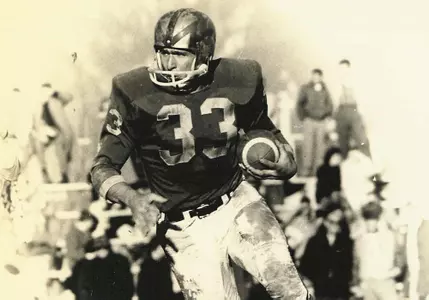
Rocco Perciavalle
BOBCAT HISTORY LESSON: Montana State's Second Game Against Cal Poly Offered a Look Into the Future
10/4/2019 9:00:00 AM | Football
Halfback Tommy Molen led the Cats to a 1959 win vs. Cal Poly
Montana State's top-and-start series with Cal Poly dates back to the middle of the 20th century… here is a look:
All-Time Series: Cal Poly leads the Bobcats 10-6.
In Bozeman: The Bobcats have split eight games with Cal Poly, but two of those have come in the Mustangs' last two visits. MSU won 49-42 in 2018 and 45-28 in 2015.
At Opponent: The Mustangs set the tone in this series with a physical 16-6 win over Montana State at San Luis Obispo in 1958. Game accounts note that the Bobcats were plagued by injuries leading into that game, and the same was true for the visiting team a year later when Cal Poly suffered a 35-18 loss at Gatton Field.
Streaks and Stuff
Montana State's current two-game streak ties the Bobcats' longest in the series. MSU won in 1959 and '60, and in 1995 and '96. Cal Poly's won seven straight against the Cats from 1997 to 2014.
Here's a Good Story
Montana State's 1959 home-opening win against Cal Poly "was one the boys really wanted," Bobcat coach Herb Agocs said following the game. The 35-18 win avenged a loss to the Mustangs one season earlier in San Luis Obispo, which came in the eighth week of a nine-game season and proved to be the team's only loss. In addition to salving an old wound, the 1959 win, coupled with the season-opening victory at South Dakota State, established some history while providing fans a glimpse of the future.
In his second season as Bobcats head coach, Agocs implemented a a "three platoon system" which The Montana Exponent called "seemingly the turning point" of the Cal Poly game. "The three units worked well; and when the Cal Poly starting unit was worn down, the issue was really settled."
The Bobcats competed as an independent for the second of six seasons in 1958, and featured a strong senior core that had won the 1956 NAIA National Championship with a cumulative four-season record of 27-3-1 by the time the mud from that sloppy day had dried. The 1959 senior class included Bobcat legends Sonny Holland, Rocco Perciavalle and Charlie Jackson, a group that helped lead the school's football program to sustained national prominence for the first time.
But the platoon system, at the time, was considered a novelty. Michigan's use of eight players dedicated to the offensive side of the ball in 1945 was the first notable use of a platoon system, and in 1958 LSU's Paul Dietzel utilized a three-platoon system nicknamed "The Chinese Bandits." That system emerged simultaneously at Montana State, explained by The Exponent's Kemp Wilson: "Coach Herb Agocs is using the three platoon system for the first time this year, with an offensive squad, a defensive unit, and an all-purpose squad. Like LSU, the Bobcats have given nicknames to the three squads. The defensive unit is known as the Renegades, the offensive squad are (sic) the Gold Team, and the all-purpose unit is called the Go Cats."
Montana State's brilliant, long-time Sports Information Director Ken Nicholson wrote in his season preview that "Agocs indicated in spring practice that he would utilize three units this fall – No. 1 or two-way unit, a defensive team and an offensive outfit." That thinking morphed during the preseason into its eventual defense, offense, and 'all-purpose' unit. The Renegades had allowed only one touchdown through the first six games, although the Cats had stumbled to a 3-3 under the weight of a challenging schedule. Montana State's losses, all on the road, came at the hands of Arizona State, Utah State, and Idaho State.
The depth that led Agocs to install a 'three platoon' system ended up as Montana State's greatest ally in 1959. The Cats rallied for three straight season-ending wins, routing North Dakota (35-14), Montana (40-6). and San Diego (47-0). By the time 1960 rolled around, Montana State had returned to the familiar single-platoon system. MSU media guides first listed starting units on both offense and defense in 1966.
Memory
"Junior halfback Tom Molen gained the crowd's attention in two ways during the Cal Poly game. Not only did he score two touchdowns, but he was the muddiest player on the field." – Kemp Wilson, The Montana Exponent, October 2, 1958
A fleet-footed sophomore halfback, Molen provided the "spark that seemed to get the Cats moving after a sluggish first period" with a second-quarter touchdown run of 25 yards. Dave Alt's two-point conversion gave Montana State an 8-6 lead. Fullback Rocco Perciavalle countered a quick Mustangs touchdown with an interception return to the five-yard line, then scored himself to give Montana State a lead it wouldn't relinquish. Molen caught a third quarter touchdown pass to put the game away.
Molen posted a terrific season in 1959, narrowly missing the school single-season rushing record set by Rocco Perciavalle one season earlier. His son Bryan played for the Bobcats in the 2001 and '02.
All-Time Series: Cal Poly leads the Bobcats 10-6.
In Bozeman: The Bobcats have split eight games with Cal Poly, but two of those have come in the Mustangs' last two visits. MSU won 49-42 in 2018 and 45-28 in 2015.
At Opponent: The Mustangs set the tone in this series with a physical 16-6 win over Montana State at San Luis Obispo in 1958. Game accounts note that the Bobcats were plagued by injuries leading into that game, and the same was true for the visiting team a year later when Cal Poly suffered a 35-18 loss at Gatton Field.
Streaks and Stuff
Montana State's current two-game streak ties the Bobcats' longest in the series. MSU won in 1959 and '60, and in 1995 and '96. Cal Poly's won seven straight against the Cats from 1997 to 2014.
Here's a Good Story
Montana State's 1959 home-opening win against Cal Poly "was one the boys really wanted," Bobcat coach Herb Agocs said following the game. The 35-18 win avenged a loss to the Mustangs one season earlier in San Luis Obispo, which came in the eighth week of a nine-game season and proved to be the team's only loss. In addition to salving an old wound, the 1959 win, coupled with the season-opening victory at South Dakota State, established some history while providing fans a glimpse of the future.
In his second season as Bobcats head coach, Agocs implemented a a "three platoon system" which The Montana Exponent called "seemingly the turning point" of the Cal Poly game. "The three units worked well; and when the Cal Poly starting unit was worn down, the issue was really settled."
The Bobcats competed as an independent for the second of six seasons in 1958, and featured a strong senior core that had won the 1956 NAIA National Championship with a cumulative four-season record of 27-3-1 by the time the mud from that sloppy day had dried. The 1959 senior class included Bobcat legends Sonny Holland, Rocco Perciavalle and Charlie Jackson, a group that helped lead the school's football program to sustained national prominence for the first time.
But the platoon system, at the time, was considered a novelty. Michigan's use of eight players dedicated to the offensive side of the ball in 1945 was the first notable use of a platoon system, and in 1958 LSU's Paul Dietzel utilized a three-platoon system nicknamed "The Chinese Bandits." That system emerged simultaneously at Montana State, explained by The Exponent's Kemp Wilson: "Coach Herb Agocs is using the three platoon system for the first time this year, with an offensive squad, a defensive unit, and an all-purpose squad. Like LSU, the Bobcats have given nicknames to the three squads. The defensive unit is known as the Renegades, the offensive squad are (sic) the Gold Team, and the all-purpose unit is called the Go Cats."
Montana State's brilliant, long-time Sports Information Director Ken Nicholson wrote in his season preview that "Agocs indicated in spring practice that he would utilize three units this fall – No. 1 or two-way unit, a defensive team and an offensive outfit." That thinking morphed during the preseason into its eventual defense, offense, and 'all-purpose' unit. The Renegades had allowed only one touchdown through the first six games, although the Cats had stumbled to a 3-3 under the weight of a challenging schedule. Montana State's losses, all on the road, came at the hands of Arizona State, Utah State, and Idaho State.
The depth that led Agocs to install a 'three platoon' system ended up as Montana State's greatest ally in 1959. The Cats rallied for three straight season-ending wins, routing North Dakota (35-14), Montana (40-6). and San Diego (47-0). By the time 1960 rolled around, Montana State had returned to the familiar single-platoon system. MSU media guides first listed starting units on both offense and defense in 1966.
Memory
"Junior halfback Tom Molen gained the crowd's attention in two ways during the Cal Poly game. Not only did he score two touchdowns, but he was the muddiest player on the field." – Kemp Wilson, The Montana Exponent, October 2, 1958
A fleet-footed sophomore halfback, Molen provided the "spark that seemed to get the Cats moving after a sluggish first period" with a second-quarter touchdown run of 25 yards. Dave Alt's two-point conversion gave Montana State an 8-6 lead. Fullback Rocco Perciavalle countered a quick Mustangs touchdown with an interception return to the five-yard line, then scored himself to give Montana State a lead it wouldn't relinquish. Molen caught a third quarter touchdown pass to put the game away.
Molen posted a terrific season in 1959, narrowly missing the school single-season rushing record set by Rocco Perciavalle one season earlier. His son Bryan played for the Bobcats in the 2001 and '02.
Thursday, July 31
Monday, May 19
Wednesday, May 03
Wednesday, May 03