BOBCATS BY THE NUMBERS: Mitch Brott is the Latest in a Long Line of Excellent Bobcats to Wear #63
6/28/2018 2:24:00 PM | Football
Herb Roberts played a key role on one of Montana State's all-time great teams
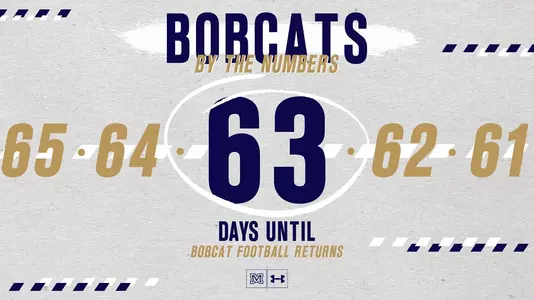
June 28: Bobcats by the Numbers takes a look at current and past Bobcats that correspond to the number of days remaining before Montana State opens the 2018 football season against Western Illinois in Bobcat Stadium's annual Gold Rush game on August 30.
#63
Mitch Brott, OT: The recent lineage of offensive tackles at Montana State is impressive. From Mitch Brott, who enters his junior season in 2018 already established as one of the top offensive tackles in the Big Sky, the line is not direct but traces a long way back to include luminaries such as John Weidenaar, Mike Person, Peder Jensen, Brent Swaggert and Josh Hausmann. There are many others, of course, but the point is not to include every terrific O-lineman in MSU's recent history. It is to point out that Mitch Brott appears ready to assume that role. Brott plays with the intensity – some call it playing nasty or playing angry, but it amounts to the willingness to finish every play as hard as you started it – and intelligence, a little attitude, and great pride. He enters his junior season as a one-time Freshman All-America who in spite of starting each of his 22 games at Montana State has gained little other traction in terms of post-season kudos. Early in the summer he has tracked as only a third team preseason All-Big Sky choice, although preseason honors are not what folks remember. Brott's current trajectory could lead him to the territory occupied by the best offensive linemen in Bobcat history.
Spotlight – Herb Roberts: When life returned a new normal in the years after World War II, the dynamic of life on college campuses changed drastically, where the integration of military veterans back into mainstream life became a focal point. Beginning with what was officially called the Servicemen's Readjustment Act of 1944, the GI Bill addressed a wide range of issues pertaining to the re-integration of men and women who had helped the world persevere against the evils of Nazi Germany and the Axis powers. Part of that program, signed by Franklin Roosevelt, was an education provision that remained in effect for more than a decade (first providing free education to veterans, then insuring loans into the 1960s). Montana State's football program revived in 1946 on a jolt of returning military men, as the Cats reached their first ever bowl game, and a year later snapped a long losing streak against the Grizzlies. The success waned temporarily, but throughout the 1950s Montana State offered veterans the opportunity to play football while gaining their degree. One of those players was Herb Roberts. The Beaver Dam, Wisconsin, product was part of Coach Tony Storti's pipeline to the upper Midwest, and after 40 months as a U.S. Marine – which included time playing on service football teams – Roberts grabbed starting left tackle honors based on work done in pre-fall practices. Noted for his 'squat frame' and maturity in MSC publicity material, Roberts earned Third Team All-Rocky Mountain Conference honors as a true freshman, but "likes guard best and asked if he couldn't go back to that position" for the 1954 season. The change took, and the Cats finished 8-1 that season for the most wins in program history, the only blemish coming in controversial fashion in Missoula. Roberts' four-year starting career culminated with the Bobcats' 1956 National Championship, but there was a time when his career appeared in jeopardy. Roberts suffered injuries in an auto crash during the winter before his junior season that left him in a body cast all winter. But his presence stabilized the Bobcats in 1955 and during the championship run he was part of a senior class that helped integrate a sensationally talented group of freshmen that included future MSU Hall of Famers Sonny Holland, Charlie Jackson and Dave Alt.
Chronology: Herb Roberts (1956), Bob Grine (1957), Phil Schneider (1959), Phil Schneider (1960-61), Larry Jones (1963-64), Stan Szczepanczyk (1965), Mike Volmer (1966-69), Phil Rubert (1970), Larry Stevenson (1971), Paul Klaboe (1972-73), Tim Nixon (1974-76), Tim McVicker (1977-79), Tim McVicker (1980), Eric Smith (1982), Dave Kuchar (1983-84), Pete Fusang (1985), Pat Harmon (1986), Corey Widmer (1987-90), Jeff Corbett (1991), Duff Wall (1992), Clay Allard (1993), Ty O'Connor (1994-98), Phil Espinoza (2000), Ben Smith (2001), Rory Canfield (2003), Sean Neil (2004-07), Neil Boyce (2008), Kyle Godecke (2011-15), Mitch Brott (2016-)
Other #63 Notes: After Corey Widmer and Ty O'Conner brought fame to #63 as 1990s era defensive linemen, that jersey number has resided on the other line of the scrimmage for most of the last decade at Montana State. Since reserve defensive lineman Sean Neil, a US Air Force veteran and excellent student, vacated that number in 2008 it has been occupied by a key offensive line cog every season but one. Kyle Godecke and Mitch Brott have held that number down with distinction since 2011.
#63
Mitch Brott, OT: The recent lineage of offensive tackles at Montana State is impressive. From Mitch Brott, who enters his junior season in 2018 already established as one of the top offensive tackles in the Big Sky, the line is not direct but traces a long way back to include luminaries such as John Weidenaar, Mike Person, Peder Jensen, Brent Swaggert and Josh Hausmann. There are many others, of course, but the point is not to include every terrific O-lineman in MSU's recent history. It is to point out that Mitch Brott appears ready to assume that role. Brott plays with the intensity – some call it playing nasty or playing angry, but it amounts to the willingness to finish every play as hard as you started it – and intelligence, a little attitude, and great pride. He enters his junior season as a one-time Freshman All-America who in spite of starting each of his 22 games at Montana State has gained little other traction in terms of post-season kudos. Early in the summer he has tracked as only a third team preseason All-Big Sky choice, although preseason honors are not what folks remember. Brott's current trajectory could lead him to the territory occupied by the best offensive linemen in Bobcat history.
Spotlight – Herb Roberts: When life returned a new normal in the years after World War II, the dynamic of life on college campuses changed drastically, where the integration of military veterans back into mainstream life became a focal point. Beginning with what was officially called the Servicemen's Readjustment Act of 1944, the GI Bill addressed a wide range of issues pertaining to the re-integration of men and women who had helped the world persevere against the evils of Nazi Germany and the Axis powers. Part of that program, signed by Franklin Roosevelt, was an education provision that remained in effect for more than a decade (first providing free education to veterans, then insuring loans into the 1960s). Montana State's football program revived in 1946 on a jolt of returning military men, as the Cats reached their first ever bowl game, and a year later snapped a long losing streak against the Grizzlies. The success waned temporarily, but throughout the 1950s Montana State offered veterans the opportunity to play football while gaining their degree. One of those players was Herb Roberts. The Beaver Dam, Wisconsin, product was part of Coach Tony Storti's pipeline to the upper Midwest, and after 40 months as a U.S. Marine – which included time playing on service football teams – Roberts grabbed starting left tackle honors based on work done in pre-fall practices. Noted for his 'squat frame' and maturity in MSC publicity material, Roberts earned Third Team All-Rocky Mountain Conference honors as a true freshman, but "likes guard best and asked if he couldn't go back to that position" for the 1954 season. The change took, and the Cats finished 8-1 that season for the most wins in program history, the only blemish coming in controversial fashion in Missoula. Roberts' four-year starting career culminated with the Bobcats' 1956 National Championship, but there was a time when his career appeared in jeopardy. Roberts suffered injuries in an auto crash during the winter before his junior season that left him in a body cast all winter. But his presence stabilized the Bobcats in 1955 and during the championship run he was part of a senior class that helped integrate a sensationally talented group of freshmen that included future MSU Hall of Famers Sonny Holland, Charlie Jackson and Dave Alt.
Chronology: Herb Roberts (1956), Bob Grine (1957), Phil Schneider (1959), Phil Schneider (1960-61), Larry Jones (1963-64), Stan Szczepanczyk (1965), Mike Volmer (1966-69), Phil Rubert (1970), Larry Stevenson (1971), Paul Klaboe (1972-73), Tim Nixon (1974-76), Tim McVicker (1977-79), Tim McVicker (1980), Eric Smith (1982), Dave Kuchar (1983-84), Pete Fusang (1985), Pat Harmon (1986), Corey Widmer (1987-90), Jeff Corbett (1991), Duff Wall (1992), Clay Allard (1993), Ty O'Connor (1994-98), Phil Espinoza (2000), Ben Smith (2001), Rory Canfield (2003), Sean Neil (2004-07), Neil Boyce (2008), Kyle Godecke (2011-15), Mitch Brott (2016-)
Other #63 Notes: After Corey Widmer and Ty O'Conner brought fame to #63 as 1990s era defensive linemen, that jersey number has resided on the other line of the scrimmage for most of the last decade at Montana State. Since reserve defensive lineman Sean Neil, a US Air Force veteran and excellent student, vacated that number in 2008 it has been occupied by a key offensive line cog every season but one. Kyle Godecke and Mitch Brott have held that number down with distinction since 2011.
Players Mentioned
OT
/ FootballThursday, July 31
Monday, May 19
Wednesday, May 03
Wednesday, May 03