Bobcat Hall of Famer Joe Tiller
Funeral for Bobcat Hall of Famer Joe Tiller Set for October 11 in Buffalo, Wyoming
10/5/2017 4:18:00 PM | Football
Legendary coach began his career at MSU, remained true to Bobcat roots
Funeral arrangements have been finalized for Bobcat Hall of Famer and legendary football coach Joe Tiller, who passed away on Saturday, September 30, in Buffalo, Wyoming.
A viewing is scheduled at St. John the Baptist Catholic Church in Buffalo on Tuesday, Oct. 10 from 1 to 7 pm, which is followed by a rosary and time for guests to share memories. A funeral mass will be held on Wednesday, Oct. 11 at St. John the Baptist Catholic Church.
Tiller won 126 games in 18 seasons as a college head coach, five at Wyoming (1991-96) and 12 at Purdue (1997-2008). He led Wyoming to the 1993 Copper Bowl and a division championship in 1996 before guiding 10 of his Boilermakers squads to bowl games. The pinnacle came after the 2000 season, when he led Purdue to the Rose Bowl.
The Toledo, Ohio, native remains a beloved figure both nationally and on each campus where he coached, and as an offensive strategist he is credited with bringing the spread offense to the Big 10. Tellingly, every football team he was part of eventually re-hired him. But before all that, before the fame, he was a Bobcat All-America whose coaching career began at Montana State.
"He was a great motivator and a great recruiter, he was really one of the best," said Dennis Erickson, a three-time all-conference Bobcat quarterback during Tiller's time as an MSU assistant whose career and Tiller's remained intertwined through the years. "He didn't have all the answers, didn't say he had all the answers. I was at Wyoming for a year and then (Paul) Roach took it over for four years, and when Joe got the job I'll never forget him telling me, 'I took that job and found one of your old playbooks, and I ran that offense,'" Erickson laughed. "That meant a lot."
Erickson said Tiller had a singular ability to connect with people, particularly his players. "Players loved him. He was hard on them, but he has a soft side to him, too, as we all know."
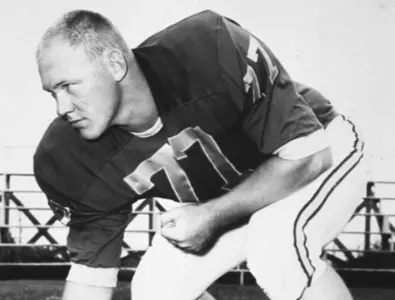
Renowned as one of the top line coaches in college football as an assistant for a quarter century, Tiller played at Montana State from 1960-63. A tackle for the Bobcats, Tiller caught the attention of Herb Agocs' coaching staff as a sophomore 'defensive specialist' before two-platoon football became common. He played for line coach Jim Sweeney during his first three seasons, and when Sweeney was promoted to head coach in 1963 Bobcat legend Sonny Holland took over as line coach. Tiller started his final two seasons, earning All-America honors in 1963 and playing in the East-West Shrine Game.
Tiller was drafted by the AFL's Boston Patriots, but played the 1964 season with Calgary. After that campaign he returned to Montana State as a student assistant that fall and was elevated to a full-time position in 1965, beginning a career-long trend of schools re-hiring Tiller after he'd left. Called perhaps the 'best lineman ever developed at Montana State' by university publications, Tiller's offensive lines produced at least one All-Big Sky choice during his first five seasons. Those lines paved the way for All-America running backs Don Hass and Paul Schafer and quarterback Dennis Erickson.
In 1971 Tiller rejoined his former mentor Sweeney as Washington State's defensive line coach, and one season later became that team's offensive line coach and offensive coordinator. The 1972 Cougars finished 7-4, the program's only winning record between 1965 and '77. In 1974 Tiller returned to the Calgary Stampeders, where he worked as an assistant coach from 1974-82, and as interim head coach for a time during the 1976 season.
The 1983 season brought Tiller back to the college ranks as assistant head coach and defensive line coach at Purdue, where he reconnected with former Bobcat (1970) and Washington State (1971) assistant coach Leon Burtnett. After four seasons he became Paul Roach's offensive coordinator at Wyoming, and in his two seasons on Laramie's high plains that combination produced 16 consecutive WAC wins, back-to-back league championships, and a pair of Holiday Bowl berths.
Tapping into his Big Sky Conference roots in 1989, Tiller returned to Washington State to become Assistant Head Coach and Offensive Coordinator for former Weber State coach Mike Price. Tiller was recommended to Price by his long-time friend Erickson, the Cougars' departing head coach who played at Montana State during Tiller's time on staff in Bozeman. While the Cougars won finished 6-5 in 1989 and 3-8 a season later, that program was building a foundation of success that would lead the Cougars to two Rose Bowls during Price's tenure.
But Tiller wouldn't be there for the glory. Upon Roach's retirement at Wyoming after the 1990 season, Tiller was tapped to replace him with the Cowboys for his first full-time head coaching job. The beginning was rocky – the Pokes finished 4-6-1 in 1991 and 5-7 one year later – but the match was natural. The Cowboys captured a share of the 1993 WAC Championship and appeared in the Copper Bowl that season. In 1996, Wyoming finished 10-2, had the nation's longest winning streak, won the WAC Pacific Division and earned a bid to the inaugural WAC Championship Game. The Cowboys concluded the '96 season ranked 22nd in both national polls. His '96 Cowboys also led the nation in passing offense and featured Biletnikoff Award winner Marcus Harris, who set the NCAA record for career receiving yards. Even now, Tiller has been a part of three of Wyoming's five 10-win seasons. He was named the WAC Coach of the Year in 1996 and was named the American Football Coaches Association (AFCA) Region Coach of the Year in 1993 and '96.
"We had an opportunity to build a very special football program here at Wyoming," said former Wyoming head football coach and athletics director Paul Roach, who hired Tiller for his first head coaching position and whose brother Dick Roach coached at Montana State. "Working with Joe here in the late 80s, I grew to have a great appreciation for his talents as a coach. That combined with his experience at numerous other universities put him in a great position to be a head coach and that is why I asked him to come back to Wyoming and take over our program. He exemplified great character as a person and a coach. Through the years, we developed a great friendship. Joe had a major influence on the young men who played for him and the men who worked with him. He will be missed by many, and we want his family to know just how much he meant to so many people."
After Wyoming's WAC Pacific Division title in 1996, Purdue again beckoned. Tiller took the helm of a program that had one winning season since 1980 and led the Boilermakers to a 9-3 campaign and an Alamo Bowl win in his first season. Tiller's Purdue teams would become top 25 fixtures during his time there, and posted eight consecutive seasons of at least as many wins as losses. At the time of his retirement, he had led Purdue to 10 of its 15 all-time bowl appearances.
More than the success on the field, Tiller introduced the spread offense to the Big 10 and attracted fans of basketball-crazed Indiana to a style dubbed "basketball on grass." Tiller coached 64 players who went on to the National Football League, six All-Americans, and two Academic All-Americans. As he had in Laramie, Tiller endeared himself to Boilermaker fans with his humility and humor. "People ask me about my legacy at Purdue, and I guess I see myself as a guy who came in and fit the place, and the place fit him - a man of the people," Tiller said in 2008. "I've always prided myself on being able to get along with anybody, whether they are a major donor or someone who comes to one game a year. I've tried to respect everybody, so I would like my legacy to be that I was a good guy who could also coach football."
Erickson is one of those players whose life and career Tiller impacted. "He was a true Bobcat and even then he was a tough coach," Erickson said of playing during the formative years of Tiller's coaching career. "He was on everybody, and it really was amazing because he wasn't all that far removed from playing. He knew what he was doing. He was one of the better offensive line coaches I've been around."
"Coach Tiller was an important person in my life and to so many other guys who played for him," said former Purdue quarterback Drew Brees, now with the New Orleans Saints. "He did so much more than teach us how to win. He taught us life lessons and how to be great leaders and men. My thoughts and prayers are with Arnette, Julie, Renee and Mike."
Upon leading the East team to a 45-27 win in the 2015 East-West Shrine Game, Tiller became just the fifth individuall to both play and coach in that post-season contest. He was inducted into Montana State's Athletics Hall of Fame in 1998, the Indiana Football Hall of Fame in 2012, and Purdue's in 2014. In 2008 he was awarded the Order of the Griffin, one of Purdue's highest honors bestowed on individuals for commitment to the university extends beyond the call of duty, and whose strength and vision greatly benefited the institution, and also named Head Coach Emeritus.
The Toledo, Ohio, native starred at Rogers High, and graduated from Montana State in 1965. Tiller is survived by his wife Arnette, also an MSU grad who is originally from Belgrade; daughters Renee and Julie; son Michael; daughter-in-law Hilda; and grandchildren Paulina, Lily, Gus and Tori; and brothers Marvin, who also played football at MSU, and Charles.
In lieu of flowers, the family requests that donations be made in Joe's name to the Cowboy Carousel Center in Buffalo and the Fabry Support and Information Group to help Fabry patients with the cost of treatments. Tax-deductible donations may be made online or through Harness Funeral Home in Buffalo.
A viewing is scheduled at St. John the Baptist Catholic Church in Buffalo on Tuesday, Oct. 10 from 1 to 7 pm, which is followed by a rosary and time for guests to share memories. A funeral mass will be held on Wednesday, Oct. 11 at St. John the Baptist Catholic Church.
Tiller won 126 games in 18 seasons as a college head coach, five at Wyoming (1991-96) and 12 at Purdue (1997-2008). He led Wyoming to the 1993 Copper Bowl and a division championship in 1996 before guiding 10 of his Boilermakers squads to bowl games. The pinnacle came after the 2000 season, when he led Purdue to the Rose Bowl.
The Toledo, Ohio, native remains a beloved figure both nationally and on each campus where he coached, and as an offensive strategist he is credited with bringing the spread offense to the Big 10. Tellingly, every football team he was part of eventually re-hired him. But before all that, before the fame, he was a Bobcat All-America whose coaching career began at Montana State.
"He was a great motivator and a great recruiter, he was really one of the best," said Dennis Erickson, a three-time all-conference Bobcat quarterback during Tiller's time as an MSU assistant whose career and Tiller's remained intertwined through the years. "He didn't have all the answers, didn't say he had all the answers. I was at Wyoming for a year and then (Paul) Roach took it over for four years, and when Joe got the job I'll never forget him telling me, 'I took that job and found one of your old playbooks, and I ran that offense,'" Erickson laughed. "That meant a lot."
Erickson said Tiller had a singular ability to connect with people, particularly his players. "Players loved him. He was hard on them, but he has a soft side to him, too, as we all know."
Renowned as one of the top line coaches in college football as an assistant for a quarter century, Tiller played at Montana State from 1960-63. A tackle for the Bobcats, Tiller caught the attention of Herb Agocs' coaching staff as a sophomore 'defensive specialist' before two-platoon football became common. He played for line coach Jim Sweeney during his first three seasons, and when Sweeney was promoted to head coach in 1963 Bobcat legend Sonny Holland took over as line coach. Tiller started his final two seasons, earning All-America honors in 1963 and playing in the East-West Shrine Game.
Tiller was drafted by the AFL's Boston Patriots, but played the 1964 season with Calgary. After that campaign he returned to Montana State as a student assistant that fall and was elevated to a full-time position in 1965, beginning a career-long trend of schools re-hiring Tiller after he'd left. Called perhaps the 'best lineman ever developed at Montana State' by university publications, Tiller's offensive lines produced at least one All-Big Sky choice during his first five seasons. Those lines paved the way for All-America running backs Don Hass and Paul Schafer and quarterback Dennis Erickson.
In 1971 Tiller rejoined his former mentor Sweeney as Washington State's defensive line coach, and one season later became that team's offensive line coach and offensive coordinator. The 1972 Cougars finished 7-4, the program's only winning record between 1965 and '77. In 1974 Tiller returned to the Calgary Stampeders, where he worked as an assistant coach from 1974-82, and as interim head coach for a time during the 1976 season.
The 1983 season brought Tiller back to the college ranks as assistant head coach and defensive line coach at Purdue, where he reconnected with former Bobcat (1970) and Washington State (1971) assistant coach Leon Burtnett. After four seasons he became Paul Roach's offensive coordinator at Wyoming, and in his two seasons on Laramie's high plains that combination produced 16 consecutive WAC wins, back-to-back league championships, and a pair of Holiday Bowl berths.
Tapping into his Big Sky Conference roots in 1989, Tiller returned to Washington State to become Assistant Head Coach and Offensive Coordinator for former Weber State coach Mike Price. Tiller was recommended to Price by his long-time friend Erickson, the Cougars' departing head coach who played at Montana State during Tiller's time on staff in Bozeman. While the Cougars won finished 6-5 in 1989 and 3-8 a season later, that program was building a foundation of success that would lead the Cougars to two Rose Bowls during Price's tenure.
But Tiller wouldn't be there for the glory. Upon Roach's retirement at Wyoming after the 1990 season, Tiller was tapped to replace him with the Cowboys for his first full-time head coaching job. The beginning was rocky – the Pokes finished 4-6-1 in 1991 and 5-7 one year later – but the match was natural. The Cowboys captured a share of the 1993 WAC Championship and appeared in the Copper Bowl that season. In 1996, Wyoming finished 10-2, had the nation's longest winning streak, won the WAC Pacific Division and earned a bid to the inaugural WAC Championship Game. The Cowboys concluded the '96 season ranked 22nd in both national polls. His '96 Cowboys also led the nation in passing offense and featured Biletnikoff Award winner Marcus Harris, who set the NCAA record for career receiving yards. Even now, Tiller has been a part of three of Wyoming's five 10-win seasons. He was named the WAC Coach of the Year in 1996 and was named the American Football Coaches Association (AFCA) Region Coach of the Year in 1993 and '96.
"We had an opportunity to build a very special football program here at Wyoming," said former Wyoming head football coach and athletics director Paul Roach, who hired Tiller for his first head coaching position and whose brother Dick Roach coached at Montana State. "Working with Joe here in the late 80s, I grew to have a great appreciation for his talents as a coach. That combined with his experience at numerous other universities put him in a great position to be a head coach and that is why I asked him to come back to Wyoming and take over our program. He exemplified great character as a person and a coach. Through the years, we developed a great friendship. Joe had a major influence on the young men who played for him and the men who worked with him. He will be missed by many, and we want his family to know just how much he meant to so many people."
After Wyoming's WAC Pacific Division title in 1996, Purdue again beckoned. Tiller took the helm of a program that had one winning season since 1980 and led the Boilermakers to a 9-3 campaign and an Alamo Bowl win in his first season. Tiller's Purdue teams would become top 25 fixtures during his time there, and posted eight consecutive seasons of at least as many wins as losses. At the time of his retirement, he had led Purdue to 10 of its 15 all-time bowl appearances.
More than the success on the field, Tiller introduced the spread offense to the Big 10 and attracted fans of basketball-crazed Indiana to a style dubbed "basketball on grass." Tiller coached 64 players who went on to the National Football League, six All-Americans, and two Academic All-Americans. As he had in Laramie, Tiller endeared himself to Boilermaker fans with his humility and humor. "People ask me about my legacy at Purdue, and I guess I see myself as a guy who came in and fit the place, and the place fit him - a man of the people," Tiller said in 2008. "I've always prided myself on being able to get along with anybody, whether they are a major donor or someone who comes to one game a year. I've tried to respect everybody, so I would like my legacy to be that I was a good guy who could also coach football."
Erickson is one of those players whose life and career Tiller impacted. "He was a true Bobcat and even then he was a tough coach," Erickson said of playing during the formative years of Tiller's coaching career. "He was on everybody, and it really was amazing because he wasn't all that far removed from playing. He knew what he was doing. He was one of the better offensive line coaches I've been around."
"Coach Tiller was an important person in my life and to so many other guys who played for him," said former Purdue quarterback Drew Brees, now with the New Orleans Saints. "He did so much more than teach us how to win. He taught us life lessons and how to be great leaders and men. My thoughts and prayers are with Arnette, Julie, Renee and Mike."
Upon leading the East team to a 45-27 win in the 2015 East-West Shrine Game, Tiller became just the fifth individuall to both play and coach in that post-season contest. He was inducted into Montana State's Athletics Hall of Fame in 1998, the Indiana Football Hall of Fame in 2012, and Purdue's in 2014. In 2008 he was awarded the Order of the Griffin, one of Purdue's highest honors bestowed on individuals for commitment to the university extends beyond the call of duty, and whose strength and vision greatly benefited the institution, and also named Head Coach Emeritus.
The Toledo, Ohio, native starred at Rogers High, and graduated from Montana State in 1965. Tiller is survived by his wife Arnette, also an MSU grad who is originally from Belgrade; daughters Renee and Julie; son Michael; daughter-in-law Hilda; and grandchildren Paulina, Lily, Gus and Tori; and brothers Marvin, who also played football at MSU, and Charles.
In lieu of flowers, the family requests that donations be made in Joe's name to the Cowboy Carousel Center in Buffalo and the Fabry Support and Information Group to help Fabry patients with the cost of treatments. Tax-deductible donations may be made online or through Harness Funeral Home in Buffalo.
Thursday, July 31
Monday, May 19
Wednesday, May 03
Wednesday, May 03