Ash Named 2011 AFCA President
1/11/2011 2:43:50 PM | Football
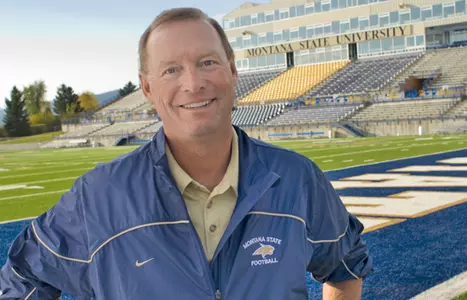
Montana State University Head Coach Rob Ash will lead the American Football Coaches Association in 2011 as president of the organization.
Montana State University Head Coach Rob Ash will lead the American Football Coaches Association in 2011 as president of the organization.
Ash, who moves up from first vice-president of the Association, succeeds outgoing president Larry Kehres of the University of Mount Union. Ash was elected president by members attending the Association's 2011 convention this week in Dallas, Texas.
“This is a tremendous honor to be named president of the American Football Coaches Association” Ash said. “I started out serving on the Meeting Room Committee and have been involved with the Association for a long time. I have watched all those great coaches sit on the dais and have put those men on a pedestal, and to be able to climb this ladder really means a lot to me. I hope that I can be of some valuable service to the AFCA. I came up through the ranks as a Division III player, and Division III head coach to the FCS level, so I have experiences at all different levels of football and have empathy for every coach in this Association.”
In addition to Ash, 2011 AFCA officers include first vice-president Tim Murphy of Harvard University; second vice-president Tommy Tuberville of Texas Tech University and third vice-president Mike Welch of Ithaca College.
Also serving on the Board in 2011: Jim Tressel, Ohio State University; Mack Brown, University of Texas; Todd Berry, University of Louisiana-Monroe; Lee Owens, Ashland University; Jim Grobe, Wake Forest University; Bill Cronin, Georgetown College (Ky.); Frank Solich, Ohio University; Randy Edsall, University of Maryland; Turner Gill, University of Kansas; Mike Riley, Oregon State University; Gary Patterson, TCU; Pat Hill, Fresno State University; David Bailiff, Rice University; Mark Richt, University of Georgia; Pete Fredenburg, University of Mary Hardin-Baylor and Bobby Kennedy, University of Colorado, ex officio member and chairman of the Assistant Coaches Committee. Fredenburg is a newly-elected member of the Board this year. AFCA Executive Director Grant Teaff serves as secretary-treasurer of the organization.
One of the most successful coaches in college football, Ash has built winning programs at all three stops he has made during his 37-year career as head coach. His overall mark sits at 205-116-5 at Juniata, Drake and Montana State. Ash still holds the career wins record at Drake and Juniata. He completed his fourth season as the head coach at Montana State, leading the Bobcats to a 9-3 record, a share of the Big Sky Conference title and a berth in the FCS playoffs in 2010. For his efforts, Ash was named Big Sky Conference Coach of the Year. He has a 30-7 overall record at Montana State, making him one of the winningest coaches in Bobcat history after just four seasons.
Ash moved to Montana State in 2007 after an 18-year head coaching stop at Drake University (1989-2006). His Drake teams posted only two sub-.500 records in 18 years, 1991 and 2002, and those seasons combined were just three games below break-even (9-12). Ash's last three Drake squads finished with a cumulative 25-8 record. The Bulldogs won four Pioneer Football League titles during Ash's tenure.
After graduating from Cornell (Iowa) College in 1973, Ash began his coaching career at his alma mater in 1975 after attaining his Master's Degree at Michigan. He spent four years as an assistant before being named head coach at Juniata in 1980. Ash accumulated a record of 51-36-3 from 1980-88 at Juniata, leading the Eagles to a Middle Atlantic Conference co-championship in 1981. His teams finished with winning records in two of his first five campaigns, but his final three squads rolled up a 30-11-1 mark, which comprises one of the most successful spans in Eagles history.
Ash and his wife Margaret have two grown children - Scott and Kelly.
The AFCA was founded in 1922 and currently has more than 11,000 members around the world, ranging from the high school level to the professional ranks. According to its constitution, the AFCA was formed, in part, to “maintain the highest possible standards in football and the coaching profession” and to “provide a forum for the discussion and study of all matters pertaining to football and coaching.”