Bobcat History Lesson: Mr. Bobcat, Reno Sales
11/17/2007 12:00:00 AM | Football
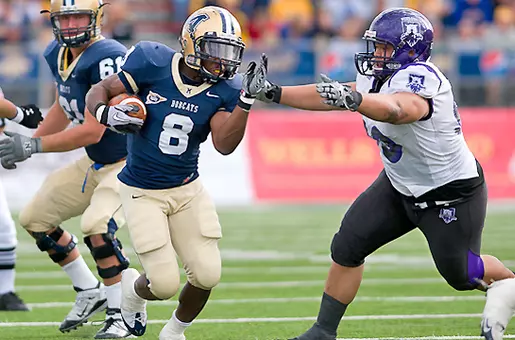
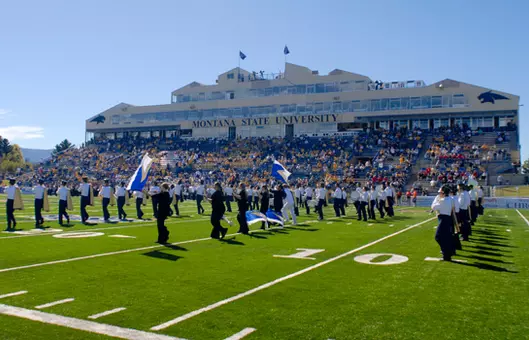
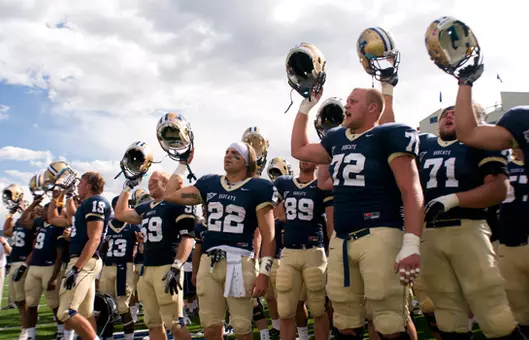
Just before noon today, over 14,000 fans will gather in one of college football's most beautiful settings to watch - or, more accurately, to participate in - the greatest annual football game that barely anyone outside Montana knows about. The 107th Cat-Griz game features one of college football's dominant programs in Montana, and another in the Bobcats that held that mantle at one time, and which look to regain that position over time.
Those fans gather in Bobcat Stadium at 11th Street and Kagy Boulevard in Bozeman, but it wasn't always that way. For nearly a quarter century, fans flocked to the same site, but in doing so paid homage to a great Montanan, Reno H. Sales.
In the late 1960s, as momentum built for the Bobcats to leave ancient Gatton Field, where the MSU PE Complex and the parking lot across from the SUB now stand, Mr. Bobcat, as Sales was known, stepped forward. He donated cash and stock options that allowed MSU to build a new football stadium to accommodate one of the best small-college programs in America. While political wrangling scaled the project's scope back from a spectacular football facility to a perfectly functional Division II stadium, it was the generosity of Sales that made it possible.
As time passes, though, fewer and fewer remember the legacy of this great man, known across the state as Mr. Bobcat. Sales was born in Iowa, but his family moved to the area now known as Gallatin Gateway. At the time, it became known as Salesville. Reno Sales matriculated through Gallatin High School and advanced to Montana State College of Agriculture and Mechanics at nearby Bozeman, where he played on the College's first-ever football team. He was the only member of Montana State's first graduating class, and eventually moved on to Columbia University in New York City, where he earned an advanced degree.
Sales eventually landed in Butte, where he became a towering figure in the mining industry. He invented several procedures related to copper mining, and became internationally renowned and respected in the industry. But Sales never strayed far from the sporting scene. He played in and helped operate Butte's mining league, a nationally-known baseball loop, and was a founding member of the Butte Country Club.
Sales also never strayed far from his beloved Bobcats, following the team for many years, through the many down times and also in his later years when Tony Storti began building a dynasty that would outlast even Mr. Bobcat. Sales played in the early Cat-Griz games, and in fact broke his hand in the fist-ever meeting between the schools. His impact, though, lasted far beyond the grid. Mr. Bobcat's legacy is felt every time the Bobcats and Grizzlies get together.
Those fans gather in Bobcat Stadium at 11th Street and Kagy Boulevard in Bozeman, but it wasn't always that way. For nearly a quarter century, fans flocked to the same site, but in doing so paid homage to a great Montanan, Reno H. Sales.
In the late 1960s, as momentum built for the Bobcats to leave ancient Gatton Field, where the MSU PE Complex and the parking lot across from the SUB now stand, Mr. Bobcat, as Sales was known, stepped forward. He donated cash and stock options that allowed MSU to build a new football stadium to accommodate one of the best small-college programs in America. While political wrangling scaled the project's scope back from a spectacular football facility to a perfectly functional Division II stadium, it was the generosity of Sales that made it possible.
As time passes, though, fewer and fewer remember the legacy of this great man, known across the state as Mr. Bobcat. Sales was born in Iowa, but his family moved to the area now known as Gallatin Gateway. At the time, it became known as Salesville. Reno Sales matriculated through Gallatin High School and advanced to Montana State College of Agriculture and Mechanics at nearby Bozeman, where he played on the College's first-ever football team. He was the only member of Montana State's first graduating class, and eventually moved on to Columbia University in New York City, where he earned an advanced degree.
Sales eventually landed in Butte, where he became a towering figure in the mining industry. He invented several procedures related to copper mining, and became internationally renowned and respected in the industry. But Sales never strayed far from the sporting scene. He played in and helped operate Butte's mining league, a nationally-known baseball loop, and was a founding member of the Butte Country Club.
Sales also never strayed far from his beloved Bobcats, following the team for many years, through the many down times and also in his later years when Tony Storti began building a dynasty that would outlast even Mr. Bobcat. Sales played in the early Cat-Griz games, and in fact broke his hand in the fist-ever meeting between the schools. His impact, though, lasted far beyond the grid. Mr. Bobcat's legacy is felt every time the Bobcats and Grizzlies get together.
Wednesday, June 10
Friday, March 27
Monday, March 23
Friday, March 13