Bobcats Head Back to 'Shop'
2/25/2005 12:00:00 AM | Football
Any calendar year, in the world of a college football coach, can be divided into a sequential series of seasons.
You can start the entire cycle with spring football, the period of any year most purely dedicated to coaching. The cycle continues with spring recruiting, the summer meet-and-greet circuit (for coaches), and conditioning (for players).
Two-a-days begin in August, and with that frenzied period begins four months or so that are dedicated to the present season, nearly at hand. During the season, and immediately after, coaches dedicate themselves to recruiting, replenishing the program's talent pool. The travel is hectic in December, and even moreso in January, but once signing day hits coaches are, in the parlance of Bobcat coach Mike Kramer, "out of the submarine."
"We've docked," he is fond of saying the week winter recruiting ceases. Kramer tells his assistants that he doesn't want to see anyone in the office for more than four hours a day for the next couple of weeks, thus the staff re-charges its batteries.
And then, when college coaching staffs re-convene in mid-February, the fun begins. "This is the nuts and bolts," says Bobcat offensive coordinator Don Bailey. "If you love the football part of coaching, the Xs and Os, this is the great part."
As usual, Bobcat head coach Mike Kramer has a slightly different take. "Now we're in the laboratory," Kramer says. "We look at everything we do, we grade every play from the season, then we grade how we graded every play while the season was on. We scout ourselves for play-calling and tendencies and substitutions. We evaluate everything."
Bailey said that his intensive spring film sessions don't typically inspire major overhauls, but can lead to serious tinkering. "Once you watch a game tape five times you're not going to see a lot of things you didn't see before," he said. "You can be a little surprised statistically, thinking a play worked better or more often than it really did."
One thing that catches Bailey off guard each spring, while going through this process, is how thorough the in-season preparation is, and how often it doesn't matter that much.
"Having done this three years now, when you look at the game (play-calling) sheet, and watch the film, you realize that you really played the game in your head during the week. By Thursday, we've gone over every conceivable situation, and watching the film you can look back and see how if your third-and-one call made sense, if your third-and-10 calls made sense. It kind of dawns on you that the game-time decision-making isn't has hard as you might think, but the preparation during the week is maybe more comprehensive than a lot of people understand."
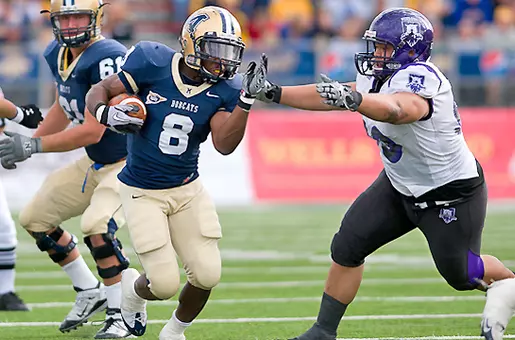
Still, Bailey says, it comes down to player executing when the whistle blows. "It all comes down to a guy making a play," he said. "Maybe we had a great play called that goes for 20 yards, but if Travis Lulay isn't able to get away from the defensive player and make a throw on the run the play call doesn't matter."
The working done at this time of year typically sets the table for spring ball, which starts at MSU in late March. "The ideas we come up with now, spring is the time to try them out and see what works and what doesn't. The things that don't work, you can get rid of them."
You can start the entire cycle with spring football, the period of any year most purely dedicated to coaching. The cycle continues with spring recruiting, the summer meet-and-greet circuit (for coaches), and conditioning (for players).
Two-a-days begin in August, and with that frenzied period begins four months or so that are dedicated to the present season, nearly at hand. During the season, and immediately after, coaches dedicate themselves to recruiting, replenishing the program's talent pool. The travel is hectic in December, and even moreso in January, but once signing day hits coaches are, in the parlance of Bobcat coach Mike Kramer, "out of the submarine."
"We've docked," he is fond of saying the week winter recruiting ceases. Kramer tells his assistants that he doesn't want to see anyone in the office for more than four hours a day for the next couple of weeks, thus the staff re-charges its batteries.
And then, when college coaching staffs re-convene in mid-February, the fun begins. "This is the nuts and bolts," says Bobcat offensive coordinator Don Bailey. "If you love the football part of coaching, the Xs and Os, this is the great part."
As usual, Bobcat head coach Mike Kramer has a slightly different take. "Now we're in the laboratory," Kramer says. "We look at everything we do, we grade every play from the season, then we grade how we graded every play while the season was on. We scout ourselves for play-calling and tendencies and substitutions. We evaluate everything."
Bailey said that his intensive spring film sessions don't typically inspire major overhauls, but can lead to serious tinkering. "Once you watch a game tape five times you're not going to see a lot of things you didn't see before," he said. "You can be a little surprised statistically, thinking a play worked better or more often than it really did."
One thing that catches Bailey off guard each spring, while going through this process, is how thorough the in-season preparation is, and how often it doesn't matter that much.
"Having done this three years now, when you look at the game (play-calling) sheet, and watch the film, you realize that you really played the game in your head during the week. By Thursday, we've gone over every conceivable situation, and watching the film you can look back and see how if your third-and-one call made sense, if your third-and-10 calls made sense. It kind of dawns on you that the game-time decision-making isn't has hard as you might think, but the preparation during the week is maybe more comprehensive than a lot of people understand."
Still, Bailey says, it comes down to player executing when the whistle blows. "It all comes down to a guy making a play," he said. "Maybe we had a great play called that goes for 20 yards, but if Travis Lulay isn't able to get away from the defensive player and make a throw on the run the play call doesn't matter."
The working done at this time of year typically sets the table for spring ball, which starts at MSU in late March. "The ideas we come up with now, spring is the time to try them out and see what works and what doesn't. The things that don't work, you can get rid of them."

Wednesday, June 10
Friday, March 27
Monday, March 23
Friday, March 13