Corey Smith: Anatomy of a Return
10/31/2003 12:00:00 AM | Football
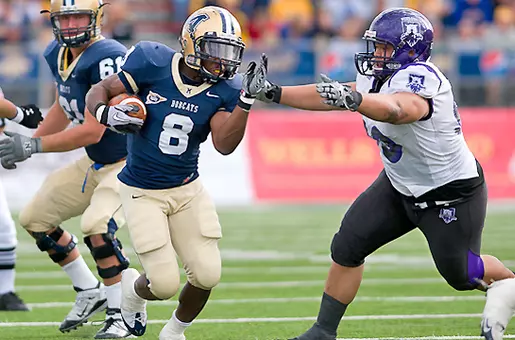
Imagine standing back on the goal line, a football stadium full of people training its eyes on you, waiting for you to break a game open, or be broken open yourself. Imagine what you'd be thinking.
If you're in Corey Smith's shoes, you're not thinking at all.
"I'm out there not really thinking a whole lot when I catch the ball," said Montana State's senior receiver and return specialist. "I'm just catching it first, then running and going on what I see."
Smith has done a lot of running on kick and punt returns this year, to a historic degree, in fact. He currently leads the nation in kick return average at 36 yards per return, and is third in school history in average yards per both punt and kickoff returns. He is also third in the Big Sky in punt return average, and he became the first player in Bobcat history to return a punt and a kickoff for touchdowns in the same game during the home opener.
Bobcat coach Mike Kramer said there is one overriding trait that each successful return possesses: "The ability to run with the ball without cutting your steps. If you can carry the ball in open spaces, fearlessly running as hard as you can go without cutting your steps, that's the predominant skill that you have to have. You have to have pretty good vision, but you still have to know where the return is designed to go and you have to get there without cutting your steps."
Although Smith has returned punts and kicks for the Bobcats this year, he said there is no real preference between the two. "I used to like punt returns better than kick returns," he said, "but this year I'm starting to understand kick returns a little better."
Kramer said the two are related, but require slightly different skills. "In kickoff returns you absolutely have to go where you are supposed to go. If you don't, you get smucked. Corey is really better at kickoffs than punts. Punts you can be a little improvisational, but on kickoffs you must go where you are required to go."
With his mind a clean slate, Smith said he doesn't look very far ahead when his time for a return arrives. "I'm looking at what's right in front of me most of the time," he said. "Once I get past the first person I will look farther upfield to see what I have to do. But for the most part, I'm just looking right in front of me."
Smith said his first move is the most important. "After you beat the first person, I know I have a chance for a big one. If I can make the first person miss, there's always a chance I can go all the way for a touchdown."
The first obligation for any return specialist is to catch the ball. "On punt returns (catching the ball) used to be difficult for me," he said. "I got tutored by Junior Adams. He taught me how to pick it up in the air, and I'm able to catch it a lot easier now. Kick returns have always been easier for me because the ball doesn't move around much. On a punt, if it's windy, the ball's moving around kind of like a knuckle ball, especially in our stadium.
The first obstacle on punt returns is provided by the "gunner," the players split wide whose jobs are to sprint down the field and either make the tackle or slow him up long enough for his mates to make the tackle. "In our punt return system, we have people covering their gunners. I just hope for them to hold them up at the line of scrimmage."
In spite of the imminent danger, Smith said he's not usually tempted to peek at the coverage. "The only time I look is right at the snap to see what kind of release they got at the line. After that I have to look straight at the ball."
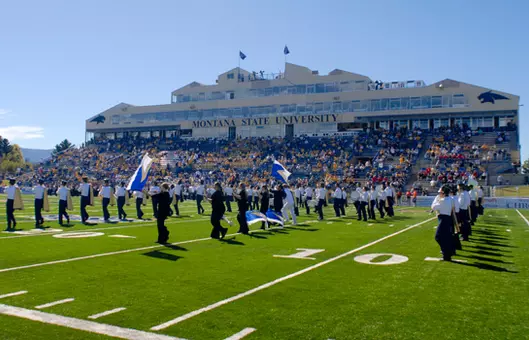
There is one variable that arises during a game for which experience is the only real preparation. "The wind is a pretty big deal," Smith said. "I've pretty much learned how our stadium works, which way the wind's always blowing. I know I have to be deeper if the wind's blowing a certain way. The first time I had to catch kicks in that stadium with a bad wind it was tough."
Smith says that some scouting work is necessary on the road. "The big thing for me going to another stadium is to go out in practice the day before and catch punts," Smith said. "For me it's the background I need to gauge. At Weber State one of the end zones is wide open with mountains back there, and the ball kind of gets lost. You can't really pick it up."
The role of special teams in the structure of a football game is such that it often produces game-changing, momentum-swinging plays. "The most devastating plays in football come from the kick teams, because of all the hidden yardage involved," Kramer said. "Nothing charges or deflates a crowd like a blocked kick or a big return. In that way, Corey can change an entire game whenever he fields a kick."
Smith said he can feel the momentum, and uses the energy. "It gets me more ready to go than anything," Smith said of a big return. "When I have a good return on my first return before we go on offense it really gets me ready and pumped up to play receiver, because I've had the ball in my hand and have taken a hit maybe."
The further Smith continues through the season as the nation's leading kick returner, the more ingrained he becomes as one of the top return men in MSU history. According to Kramer, though, there is one litmus test yet to pass.
"Time will tell as he finishes his career how big an impact he can end up having on the season, because the best guy that I've ever had has to be Junior. He showed the biggest in the big game. It isn't what you do early, it's what you do late in the season that sticks in my mind."
If you're in Corey Smith's shoes, you're not thinking at all.
"I'm out there not really thinking a whole lot when I catch the ball," said Montana State's senior receiver and return specialist. "I'm just catching it first, then running and going on what I see."
Smith has done a lot of running on kick and punt returns this year, to a historic degree, in fact. He currently leads the nation in kick return average at 36 yards per return, and is third in school history in average yards per both punt and kickoff returns. He is also third in the Big Sky in punt return average, and he became the first player in Bobcat history to return a punt and a kickoff for touchdowns in the same game during the home opener.
Bobcat coach Mike Kramer said there is one overriding trait that each successful return possesses: "The ability to run with the ball without cutting your steps. If you can carry the ball in open spaces, fearlessly running as hard as you can go without cutting your steps, that's the predominant skill that you have to have. You have to have pretty good vision, but you still have to know where the return is designed to go and you have to get there without cutting your steps."
Although Smith has returned punts and kicks for the Bobcats this year, he said there is no real preference between the two. "I used to like punt returns better than kick returns," he said, "but this year I'm starting to understand kick returns a little better."
Kramer said the two are related, but require slightly different skills. "In kickoff returns you absolutely have to go where you are supposed to go. If you don't, you get smucked. Corey is really better at kickoffs than punts. Punts you can be a little improvisational, but on kickoffs you must go where you are required to go."
With his mind a clean slate, Smith said he doesn't look very far ahead when his time for a return arrives. "I'm looking at what's right in front of me most of the time," he said. "Once I get past the first person I will look farther upfield to see what I have to do. But for the most part, I'm just looking right in front of me."
Smith said his first move is the most important. "After you beat the first person, I know I have a chance for a big one. If I can make the first person miss, there's always a chance I can go all the way for a touchdown."
The first obligation for any return specialist is to catch the ball. "On punt returns (catching the ball) used to be difficult for me," he said. "I got tutored by Junior Adams. He taught me how to pick it up in the air, and I'm able to catch it a lot easier now. Kick returns have always been easier for me because the ball doesn't move around much. On a punt, if it's windy, the ball's moving around kind of like a knuckle ball, especially in our stadium.
The first obstacle on punt returns is provided by the "gunner," the players split wide whose jobs are to sprint down the field and either make the tackle or slow him up long enough for his mates to make the tackle. "In our punt return system, we have people covering their gunners. I just hope for them to hold them up at the line of scrimmage."
In spite of the imminent danger, Smith said he's not usually tempted to peek at the coverage. "The only time I look is right at the snap to see what kind of release they got at the line. After that I have to look straight at the ball."
There is one variable that arises during a game for which experience is the only real preparation. "The wind is a pretty big deal," Smith said. "I've pretty much learned how our stadium works, which way the wind's always blowing. I know I have to be deeper if the wind's blowing a certain way. The first time I had to catch kicks in that stadium with a bad wind it was tough."
Smith says that some scouting work is necessary on the road. "The big thing for me going to another stadium is to go out in practice the day before and catch punts," Smith said. "For me it's the background I need to gauge. At Weber State one of the end zones is wide open with mountains back there, and the ball kind of gets lost. You can't really pick it up."
The role of special teams in the structure of a football game is such that it often produces game-changing, momentum-swinging plays. "The most devastating plays in football come from the kick teams, because of all the hidden yardage involved," Kramer said. "Nothing charges or deflates a crowd like a blocked kick or a big return. In that way, Corey can change an entire game whenever he fields a kick."
Smith said he can feel the momentum, and uses the energy. "It gets me more ready to go than anything," Smith said of a big return. "When I have a good return on my first return before we go on offense it really gets me ready and pumped up to play receiver, because I've had the ball in my hand and have taken a hit maybe."
The further Smith continues through the season as the nation's leading kick returner, the more ingrained he becomes as one of the top return men in MSU history. According to Kramer, though, there is one litmus test yet to pass.
"Time will tell as he finishes his career how big an impact he can end up having on the season, because the best guy that I've ever had has to be Junior. He showed the biggest in the big game. It isn't what you do early, it's what you do late in the season that sticks in my mind."

Thursday, August 27
Monday, August 24
Monday, August 24
Wednesday, June 10